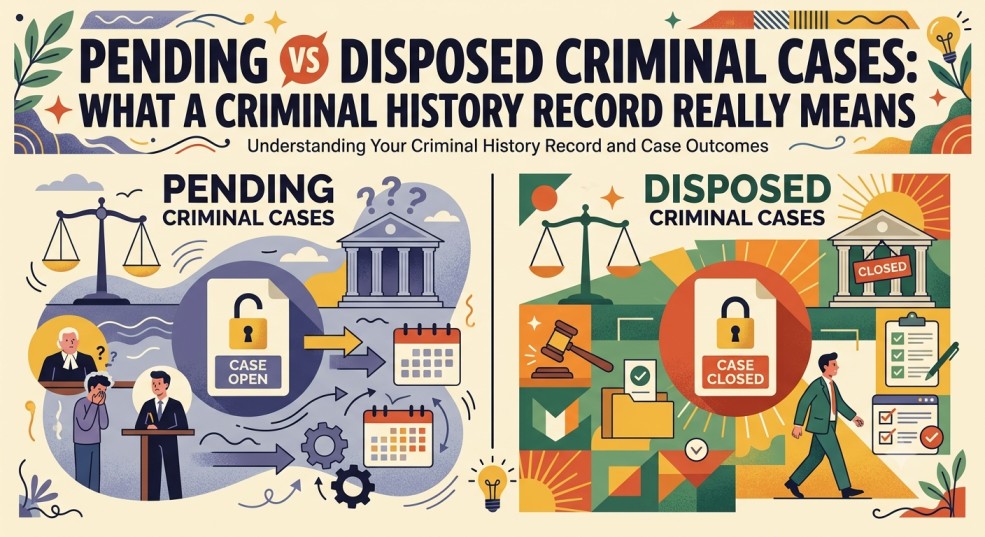
A criminal history record says:
3 cases found.
Is that a serious risk?
There is no responsible way to answer from that number alone.
One case could be pending. Another could have been disposed years ago. The records could relate to different types of proceedings. One of them might not even belong to the person being screened.
This is where criminal record screening often becomes misleading.
Businesses naturally want a simple answer from complex legal information: clean or flagged, low risk or high risk, proceed or stop.
Court records rarely work that way.
Understanding whether a criminal case is pending or disposed is important. But status is only one layer of the record. Mature risk teams need to understand what happened around that status before deciding what the information means.
Pending vs Disposed Criminal Cases: The Practical Difference
At the simplest level, the distinction is straightforward.
|
Case Status |
What It Tells the Reviewer |
What It Does Not Tell the Reviewer |
|
Pending |
The proceeding has not reached final disposal |
That the person is guilty |
|
Disposed |
The proceeding has reached a recorded disposal |
That the case was insignificant |
|
Multiple pending cases |
There may be greater legal exposure to examine |
That all cases carry equal significance |
|
Multiple disposed cases |
There is historical litigation to understand |
What each outcome actually means |
|
No identified match |
No relevant record was surfaced in the search |
That the person or entity carries zero risk |
This last column is where the real work begins.
Status describes where a proceeding stands. It does not interpret the proceeding for you.
Why “Pending” Should Never Be Read as “Guilty”
Imagine an employee background check surfaces one pending criminal proceeding.
The word pending can immediately feel significant.
But a pending matter is exactly that: unresolved.
It does not establish guilt, nor should the existence of the record automatically become an employment, lending or onboarding decision.
The reviewer first needs to establish whether the record belongs to the right person. Then comes the nature of the proceeding, its current status, available underlying information and its relevance to the business decision.
This distinction matters because criminal history screening is supposed to improve a decision, not replace judgement with a database result.
Disposed Does Not Mean “Ignore”
The opposite mistake happens with disposed cases.
A reviewer sees “disposed” and assumes the matter no longer matters.
That conclusion can also be too quick.
Disposal tells you that the proceeding has reached a recorded conclusion. It does not, by itself, explain everything a risk, compliance or legal team may want to know about that proceeding.
For business screening, the better question is not:
“Is this case over?”
It is:
“What does this case, its status and its underlying record contribute to our understanding of this subject?”
Sometimes the answer may be very little.
Sometimes it may justify further review.
That distinction requires context.
The Case Count Trap
Consider two profiles being reviewed by a risk team.
Profile A
6 cases identified
5 disposed
1 pending
Profile B
2 cases identified
0 disposed
2 pending
Which profile carries more relevant exposure?
Still impossible to say.
Now add another layer.
Suppose Profile A consists largely of civil matters, while Profile B contains criminal or regulatory proceedings considered relevant to the decision.
The interpretation changes again.
This is why a raw criminal history record can create false confidence.
6 is not automatically worse than 2. Pending is not automatically worse than disposed. Criminal is not automatically a decision.
Each field adds information. None should be read in isolation.
A Criminal History Record Has More Than One Dimension
LegitQuest's LIBIL® does not treat litigation as a single case count.
Matched records are categorised into civil, criminal, regulatory and tax matters, including whether they are pending or disposed.
That creates a more useful way to read legal history:
Identity → Case Type → Status → Exposure → Source → Review
Each stage answers a different question.
Was the correct person identified?
What type of proceeding was found?
Where does that proceeding currently stand?
Does the broader pattern deserve attention?
Can the finding be traced back to its source?
Does someone need to investigate further?
That sequence matters far more than a simple “case found” flag.
First Make Sure You Have the Right Person
There is little value in debating whether a pending criminal proceeding is significant if it belongs to somebody else.
Indian names can vary across records. Addresses may be inconsistent. Two unrelated people can share the same name. The same proceeding can also appear differently across systems.
LIBIL® applies identity resolution across name variations, addresses and record formats and searches supported Supreme Court, High Court, district court, tribunal, order and FIR records.
This addresses a fundamental screening problem:
Interpretation should begin only after reasonable confidence in identity.
Otherwise, a sophisticated analysis can still produce the wrong conclusion.
Why This Becomes Harder at Business Scale
Now move from one profile to 10,000 profiles.
Suppose manual searching and interpretation takes only 15 minutes for each.
That is approximately 2,500 hours of review.
At 20 minutes, it rises to more than 3,333 hours.
These are illustrative calculations, but they show why organisations cannot rely entirely on manual case-by-case searching as screening volumes grow.
The problem is not merely finding records faster.
It is consistently separating:
genuine matches from false matches,
criminal matters from other litigation,
pending proceedings from disposed matters,
and routine findings from cases that deserve deeper investigation.
When Pending or Disposed Cases Need Deeper Review
Not every identified proceeding needs lawyer-level investigation.
That would defeat the purpose of scalable screening.
LegitQuest structures LIBIL® around different levels of review.
Instant Litigation Check Reports can support high-volume first-pass screening.
Where findings require more context, Detailed Litigation Check Reports add the LIBIL® Score with reasoning and narrative case summaries, typically within 2 to 4 hours.
For very high exposure decisions such as executive hiring, higher-ticket business loans and M&A, Lawyer Verified Litigation Check Reports provide deeper lawyer-prepared review, typically within 3 to 5 business days.
The logic is important:
The existence of a case triggers a question. The significance of the question determines the depth of review.
What a Criminal History Record Should Help a Business Decide
The purpose of screening is not to convert legal history into a simplistic verdict.
For lending, a finding may become an additional legal risk signal alongside conventional credit assessment.
For employment screening, it may lead HR, compliance or legal teams to understand the proceeding before deciding whether it is relevant to the role.
For vendor onboarding, it may justify deeper third-party due diligence.
For M&A, the same record may become part of a much wider investigation into a target, promoters and related parties.
The record has not changed.
The decision context has.
That is why criminal history cannot be interpreted properly without knowing what decision the organisation is trying to make.
Read the Record, Not Just the Status
“Pending” and “disposed” are useful labels.
They are not conclusions.
A meaningful criminal history review asks more:
Is this the correct person? What type of case is it? What is its status? What does the underlying record show? Is there wider litigation exposure? Is the finding relevant to this decision? Does it warrant escalation?
LIBIL® is designed to bring those dimensions together through identity resolution, case categorisation, the LIBIL® Score for applicable reports and source-linked reporting.
That is a more mature way to interpret criminal history.
Because the most important question is rarely:
“How many cases does this person have?”
It is:
“What do the relevant records actually tell us, and what should we investigate next?”
Frequently Asked Questions
What is the difference between a pending and disposed criminal case?
A pending case has not reached final disposal, while a disposed case has reached a recorded conclusion. Neither status alone explains the full significance of the proceeding.
Does a pending criminal case mean the person is guilty?
No. A pending proceeding does not establish guilt. Identity, the nature of the proceeding, case information and its relevance to the business decision should be reviewed.
Should businesses ignore disposed criminal cases?
Not automatically. Disposal is a case status. Businesses should consider the underlying record and its relevance before deciding whether further review is necessary.
Is the number of criminal cases a reliable risk indicator?
Case count alone provides limited context. Case type, status, identity match, broader litigation exposure and source records can materially change how the history is understood.
How does LegitQuest identify pending and disposed cases?
LIBIL® matches records using identity resolution and categorises identified matters as civil, criminal, regulatory or tax, including whether they are pending or disposed.
What should happen when a criminal history check identifies a relevant case?
The finding can be verified against its source and, where appropriate, escalated for a Detailed or Lawyer Verified review before the relevant business team makes its decision.


