


































































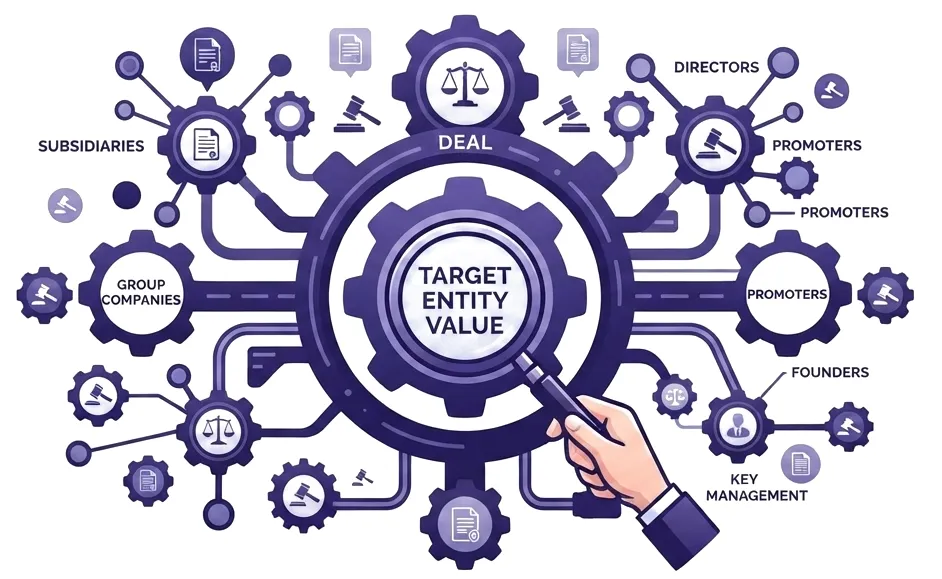
Why Litigation Check Matters in M&A
Litigation doesn't have to be dramatic to matter. An unresolved commercial dispute can sit against enterprise value. A regulatory proceeding can complicate a licence transfer. A promoter's personal litigation history can shape how a deal team frames representations and warranties.
Exposure isn't confined to the target entity alone; it can run across subsidiaries, group companies, promoters, founders, directors, and key management, each of whom may carry relevant legal history that doesn't surface in standard commercial or financial workstreams.
None of this means every litigation record is a red flag. Relevance depends on materiality, case status, jurisdiction, and context which is why litigation findings are an input for deal teams and counsel to interpret, not a standalone verdict on transaction risk.
The Challenge With Traditional M&A Due Diligence
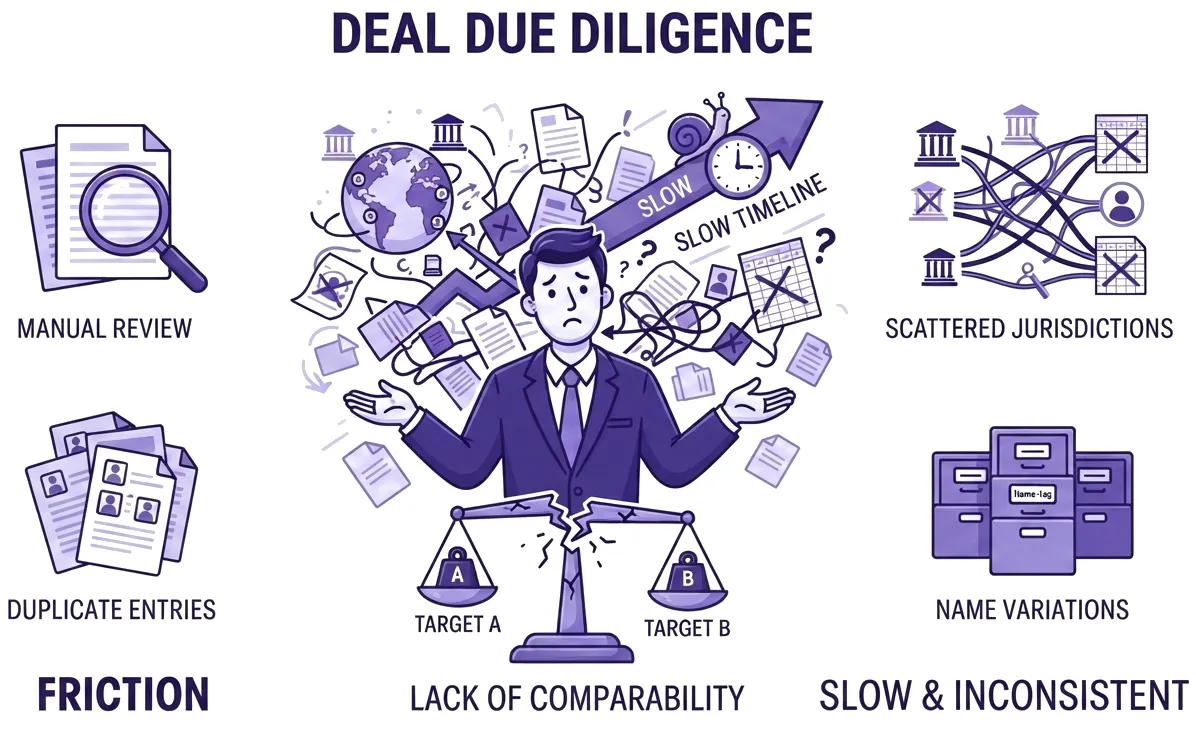
Litigation review inside a typical deal timeline still leans heavily on manual work: reading data room documents, searching individual court portals, cross-checking regulatory databases, calling local counsel, and reconciling spreadsheets across advisors.
That process runs into familiar friction, name variations across filings, incomplete identifiers, records scattered across jurisdictions and lower courts, high litigation volumes for larger promoter groups, duplicate entries, and no consistent way to categorise what's found. Determining which of dozens of matters are actually material can consume disproportionate diligence time.
The result is often a slower timeline and a litigation picture that's harder to compare consistently across targets or across deals.
How to Check Background During M&A Due Diligence
Teams check background on a target across several layers, not a single database lookup.
Target Company
Existing litigation, commercial disputes, regulatory proceedings, insolvency-related matters, and other material claims connected to the entity itself.
Promoters and Founders
Civil litigation, criminal proceedings, regulatory actions, and other legal exposure tied to the individuals steering the business.
Directors and Key Management
Litigation history, criminal proceedings, and regulatory exposure connected to the leadership team taking the company forward post-close.
Group Entities and Subsidiaries
Litigation across related entities, cross-company exposure, and connected disputes that may not appear in the target's own filings.
Identity resolution helps here, matching subjects across name variations, father's names, addresses, and aliases so a genuinely connected record isn't missed and an unrelated namesake isn't mistakenly flagged. To check background properly means structured investigation across these layers, not a single search against one source.
How LIBIL® Fits Into M&A Deal Diligence
Identify the target company, promoters, founders, directors, key management, subsidiaries, and group entities in scope.
Search available court, tribunal, FIR-linked, and public legal record sources for each subject.
Use available identifiers to distinguish relevant subjects from unrelated individuals or entities sharing similar names.
Organise matters by type and status civil, criminal, regulatory, pending, disposed, filed by, filed against.
Apply available matching signals to help analysts judge how confidently a record connects to the subject.
Flag matters that warrant deeper legal review or further investigation ahead of the next diligence stage.
Feed structured outputs into legal diligence, investigative diligence, risk assessment, and deal team discussions around valuation, warranties, and indemnities.
From Litigation Search to Decision-Ready Intelligence
Comprehensive Litigation Search
Searches through India's largest legal database comprising of 500M+ records from supreme court, high court, district court, tribunals.
AI Identity Resolution
Improves matching accuracy across name variations and available identifiers.
Case Categorisation
Organises matters by case type and status for faster triage.
Filed-By vs. Filed-Against Context
Shows the subject's role in each matter.
Pending vs. Disposed Status
Clarifies whether a matter remains active.
Match Confidence
Helps reduce false positives and surface genuinely relevant matches.
Source-Linked Metadata
Case numbers, courts, acts, and status information where available, so findings can be traced back to source.
How a Background Check Report Fits Into Deal Diligence
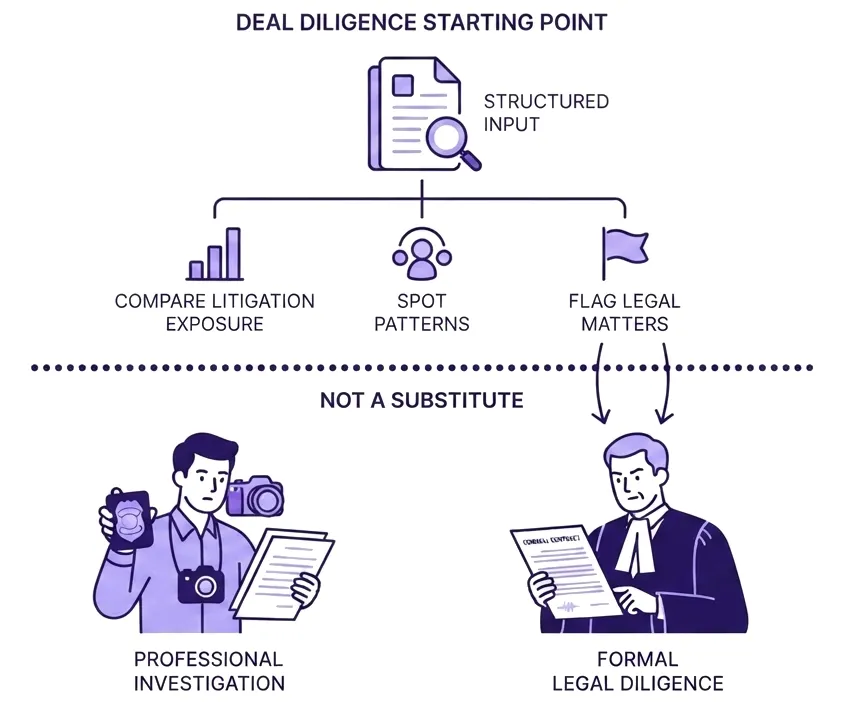
A structured background check report doesn't replace the diligence process; it gives it a consistent starting point. Consolidated findings let deal teams compare litigation exposure across multiple subjects, spot patterns across a promoter group, and flag matters that need closer legal review before they reach the negotiating table.
Treat a background check report the way you'd treat any structured input: useful for organising and prioritising, not a substitute for formal legal diligence or professional investigation. The report tells you where to look for closer, counsel and investigators still do the looking.
Criminal Background Check Within M&A
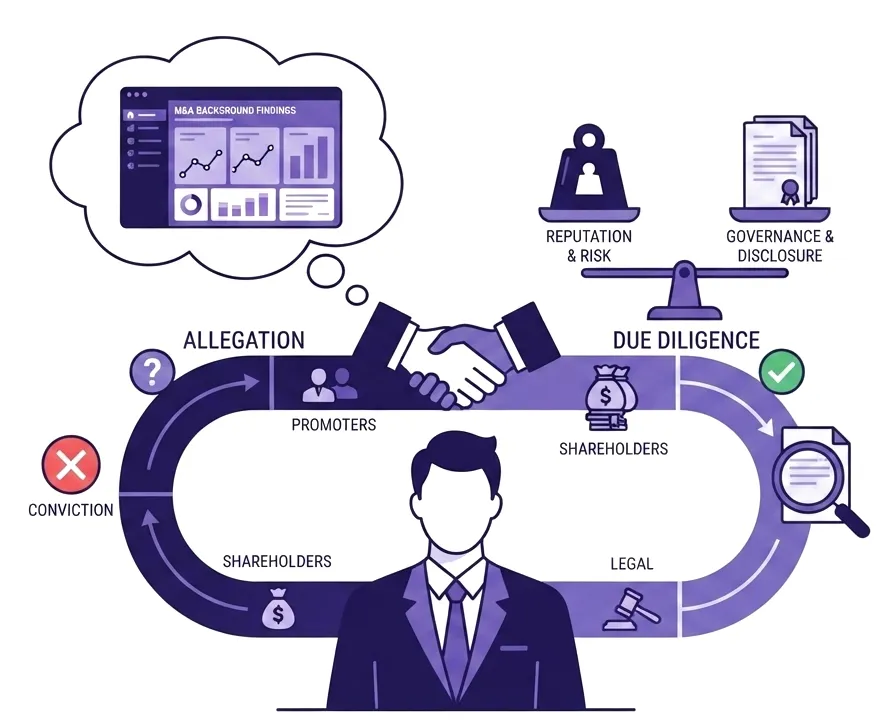
A < Criminal History Check on promoters, directors, founders, key management, or controlling shareholders can carry real weight in a transaction touching reputation, regulatory risk, governance expectations, deal structure, and disclosure obligations.
But the distinctions matter. An allegation is not a conviction. A criminal case still needs contextual review status, jurisdiction, relevance to the role, and identity confirmation before anyone treats it as a data point. A < Online Criminal History Check finding should inform further diligence, not automatically determine a transaction outcome. LIBIL can help surface these signals for review; it complements, rather than replaces, the formal investigative and legal diligence that follows.
M&A Deal Diligence Across Transaction Stages
Initial Screening
Surface potential red flags early, before committing significant diligence resources.
Preliminary Due Diligence
Build an initial litigation profile of the target and key stakeholders.
Detailed Due Diligence
Support deeper review of matters identified during screening.
Deal Negotiation
Inform discussions around valuation, representations, warranties, indemnities, and escrow.
Pre-Closing Review
Support final checks and updates before completion.
Post-Transaction Monitoring
Where supported, help teams track developments relevant to the acquired business after close.
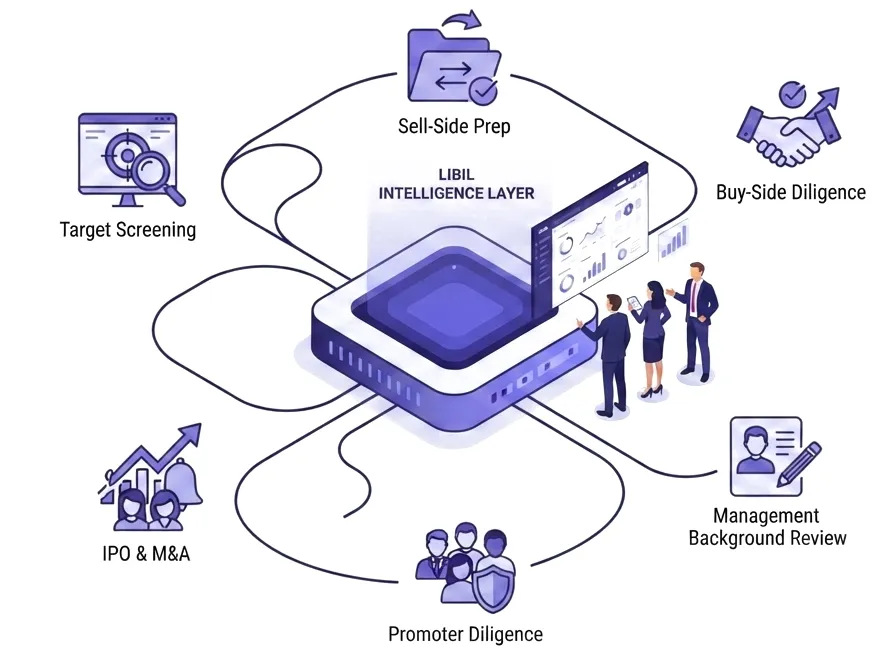
How LIBIL® Supports Deal Advisory and Transaction Teams
Investment banks and deal advisory firms can use litigation checks across target screening, sell-side preparation, buy-side diligence, IPO and M&A transactions, management background reviews, and promoter diligence.
For deal advisory teams juggling multiple live mandates, LIBIL functions as an intelligence layer that plugs into existing workflows rather than a parallel process to help standardise how litigation exposure gets surfaced and reviewed across the deal advisory practice.
Press & Recognitions
-
 Forbes india
Legitquest: On a quest to building a legal technology framework in India
-
 financialexpress
LegitQuest: Now, millions of law case records at your fingertips
-
 yourstory
Google picks 16 Indian startups for its 5th accelerator programme
-
 entrackr
Funding in Indian startups this week (05 Apr-10 Apr)
-
.webp) Economic Times
Economic TimesLegitquest raises $660,000 in ongoing round from existing investors InfoEdge, WaterBridge Ventures
-
 Inc42
Inc42Info Edge To Invest INR 4 Cr In Legal Tech Startup LegitQuest
-
 Business Standard
Startup Investments (Holding) to invest Rs 4 cr in Legitquest
-
 Capital Market
Startup Investments (Holding) to invest Rs 4 cr in Legitquest
-
 Vise Stories
Legitquest Raises $660K in Ongoing Round from Existing Investors
Trusted by the top names in the industry
Bring Litigation Intelligence Into Your Next Transaction
Better M&A decisions need visibility into the legal and litigation landscape surrounding a target and its key stakeholders. LIBIL helps deal teams bring structured litigation intelligence into the broader diligence process as a layer that supports legal counsel and investigative professionals, not a replacement for them.


