

































































Why Risk Management Matters in Investment Banking
Transaction Risk Spans Multiple Dimensions
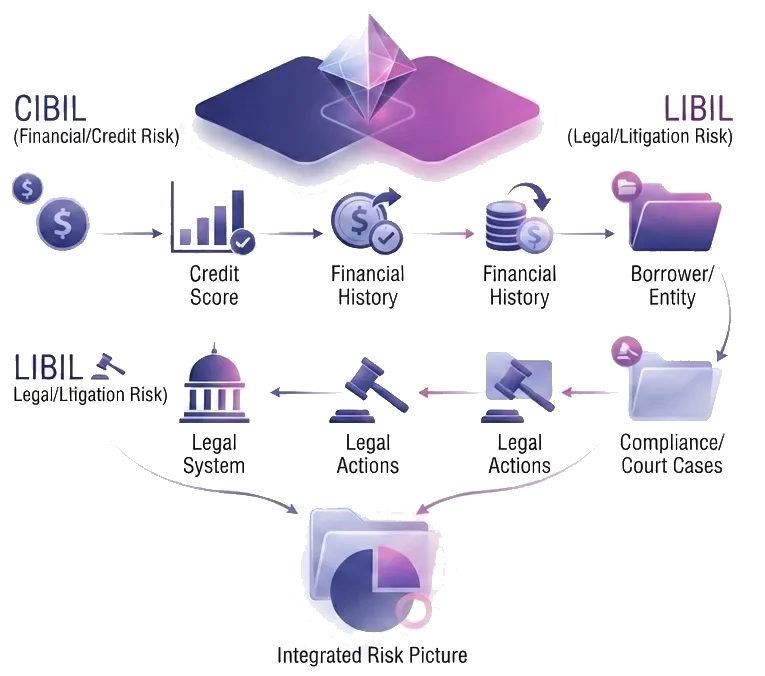
Transaction risk management in investment banking spans several dimensions at once; financial risk, legal risk, regulatory risk, litigation risk, reputational risk, and compliance risk all need to be considered before a deal progresses. Investment banks typically coordinate across issuers, promoters, directors, target companies, acquirers, group entities, legal counsel, compliance teams, and regulators to build a complete picture before a transaction advances.
Material Risks Require Layered Diligence
A structured diligence process exists precisely because material risks don't always announce themselves. A company can look financially sound while carrying legal exposure that a purely financial review wouldn't surface. That's why risk management in transaction work tends to layer multiple diligence streams rather than relying on any single one.
Financial Diligence Is Critical. But It Is Only One Part of Transaction Risk.
Financial Risk.
Financial risk covers financial performance, debt, cash flow, liabilities, and financial sustainability, the core questions a deal team asks about whether a business is fundamentally sound.
Legal and Litigation Risk.
Legal and litigation risk covers a different set of questions: lawsuits, court cases, regulatory actions, criminal proceedings, insolvency matters, contractual disputes, and promoter or director exposure that may not show up anywhere in a set of financial statements.
Compliance and Regulatory Risk.
Compliance and regulatory risk covers regulatory proceedings, enforcement actions, compliance failures, and sector-specific obligations that carry their own transaction implications.
Complementary Risk Layers.
Sound finance and risk management in a transaction context means treating these as distinct but complementary layers, not substitutes for one another. Litigation intelligence doesn't replace financial diligence, it fills in a dimension that financial diligence isn't designed to capture.
Why Litigation Intelligence Matters in IPO Due Diligence
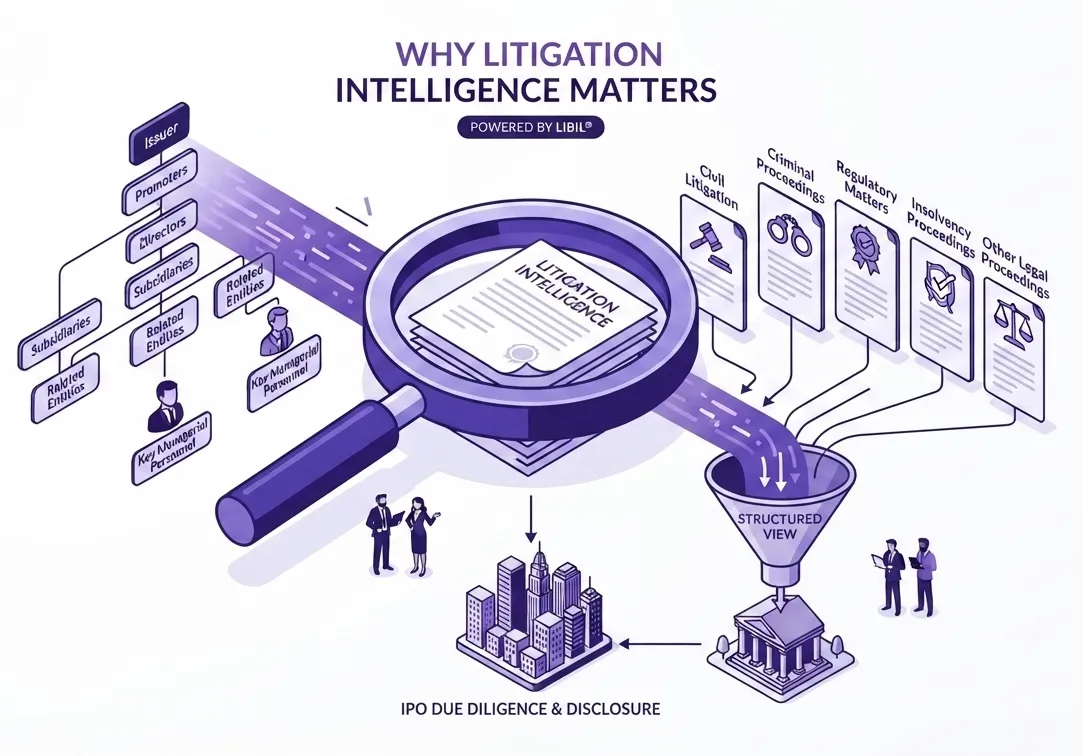
IPO due diligence requires reviewing litigation across the issuer, promoters, directors, key managerial personnel where relevant, group entities, subsidiaries, and related entities. Teams typically need to identify and organize civil litigation, criminal proceedings, regulatory matters, insolvency-related proceedings, and other relevant legal proceedings across this full universe of parties.
This structured litigation view can support litigation schedules, DRHP preparation, disclosure review, materiality assessment, legal counsel review, and issue manager diligence. LIBIL® is designed to support this discovery and structuring process, it does not determine what must be disclosed, and it does not replace issuer counsel or the issue manager's own review.
Why Litigation Intelligence Matters in M&A Due Diligence
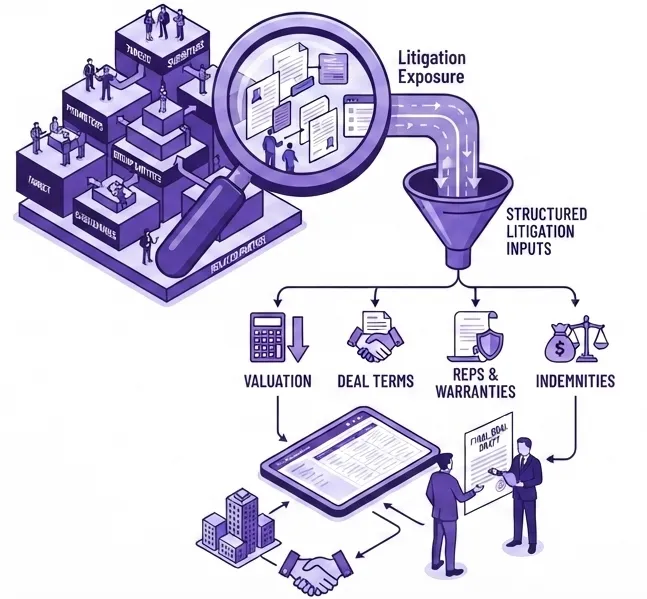
M&A due diligence carries its own litigation review requirements, spanning the target company, promoters, directors, shareholders where relevant, group entities, subsidiaries, and related parties. Legal exposure uncovered during this review can influence valuation, deal structure, representations and warranties, indemnities, escrow considerations, conditions precedent, integration planning, and post-transaction monitoring.
LIBIL® does not determine valuation or deal terms. What it can do is provide structured litigation inputs, organized, source-linked, and categorized, that transaction teams and legal counsel can work from as they negotiate and draft around identified exposure.
How LIBIL Fits in Legal Due Diligence Workflow
Identify Relevant Parties
Map the issuer, promoters, directors, and group entities that need to be reviewed.
Gather Litigation Intelligence
Search supported legal and court records for each party in scope.
Resolve Identity
Use available identifiers to distinguish the relevant subjects from namesakes and similarly named parties.
Categorize Proceedings
Organize matters into civil, criminal, regulatory, and other relevant categories.
Review Status and Context
Assess pending versus disposed status, filed-by versus filed-against context, court, case number, acts and sections, and other available metadata.
Review Severity or Risk Indicators
Where supported by the relevant report type, use structured scoring or severity information as an input to prioritization.
Legal Review
Legal counsel reviews the findings and assesses materiality and disclosure requirements.
Transaction Documentation
Relevant findings may inform disclosure schedules and diligence files prepared by the legal team.
LIBIL® functions as a decision-support tool throughout this workflow, not a source of legal opinion.
Key Capabilities of LIBIL
Comprehensive Litigation Search
Access to supported legal and court records, courts, tribunals, and FIR-linked sources, across the individuals and entities in a diligence scope.
Identity Resolution
Alias and name-variation matching and cross-source deduplication to help distinguish relevant subjects from potential namesakes.
Case Categorization
Organizing proceedings into civil, criminal, and regulatory categories, and by pending or disposed status.
Filed-By / Filed-Against Context
Additional context on a subject's relationship to a given case.
Match Confidence
Scoring on name, father's name, and address matches, helping reviewers assess how confidently a record has been linked to the correct subject.
Structured Reports
Instant, detailed, and lawyer-verified report formats, including the IPO-style manual report built for high-stakes review.
These capabilities reflect what's confirmed in LIBIL®'s current product architecture; nothing here should be read as a claim beyond documented, live functionality.
Press & Recognitions
-
 Forbes india
Legitquest: On a quest to building a legal technology framework in India
-
 financialexpress
LegitQuest: Now, millions of law case records at your fingertips
-
 yourstory
Google picks 16 Indian startups for its 5th accelerator programme
-
 entrackr
Funding in Indian startups this week (05 Apr-10 Apr)
-
.webp) Economic Times
Economic TimesLegitquest raises $660,000 in ongoing round from existing investors InfoEdge, WaterBridge Ventures
-
 Inc42
Inc42Info Edge To Invest INR 4 Cr In Legal Tech Startup LegitQuest
-
 Business Standard
Startup Investments (Holding) to invest Rs 4 cr in Legitquest
-
 Capital Market
Startup Investments (Holding) to invest Rs 4 cr in Legitquest
-
 Vise Stories
Legitquest Raises $660K in Ongoing Round from Existing Investors
Trusted by the top names in the industry
Build a More Complete View of Transaction Risk
Investment banks and their advisors can explore how litigation intelligence fits into existing IPO and M&A due diligence workflows, as a structured layer that supports legal counsel and deal teams, not a replacement for them.


