
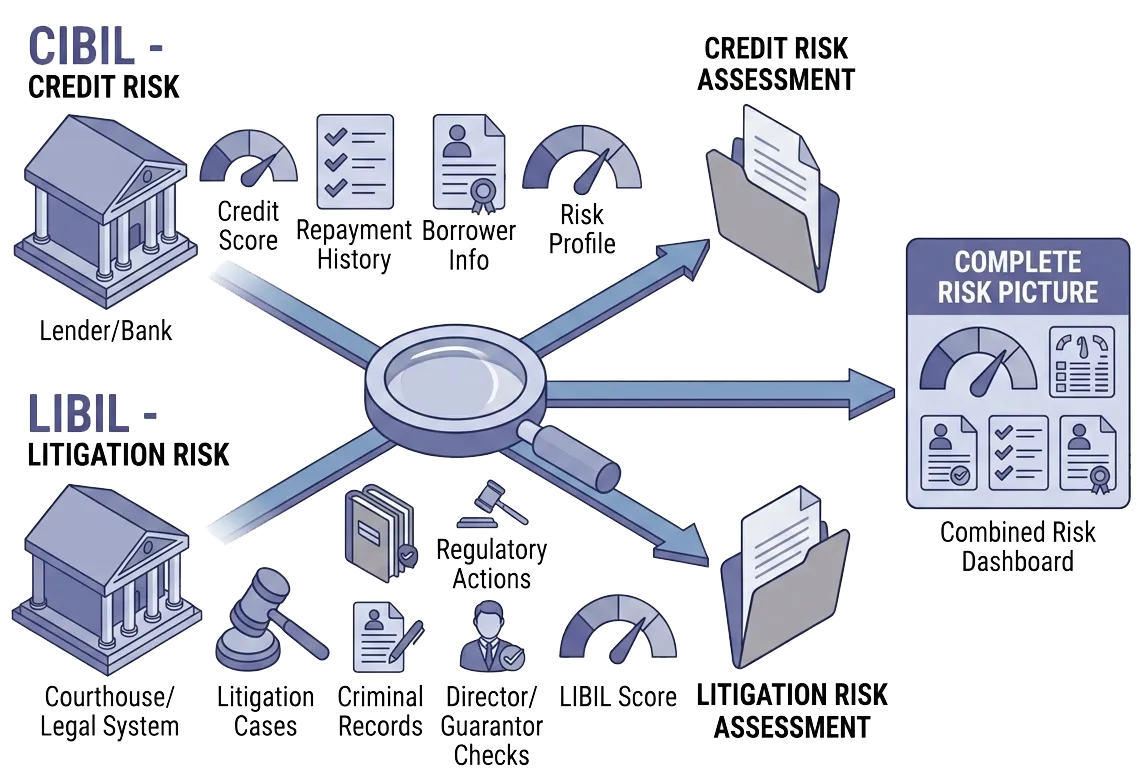

































































What Does a CIBIL Score Tell a Financial Institutions?
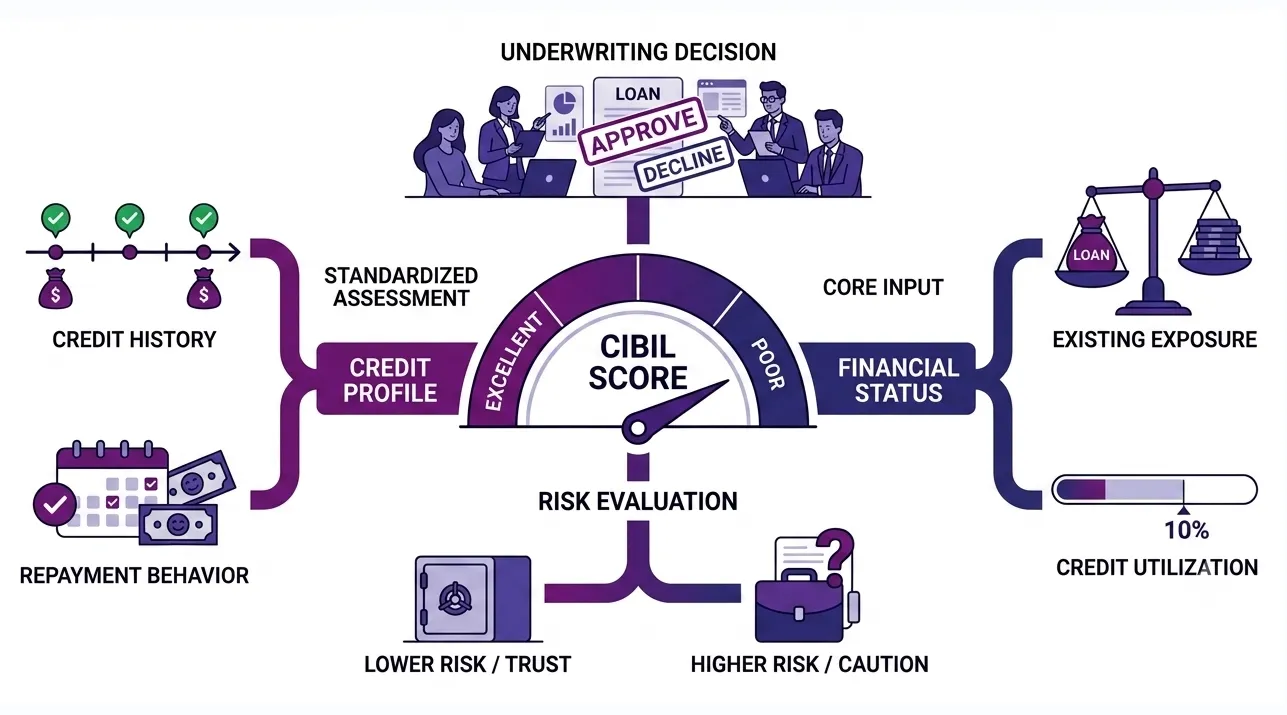
A CIBIL Score is a widely used credit indicator that helps lenders understand aspects of a borrower's credit profile, including credit history, repayment behavior, existing credit exposure, credit utilization, and general creditworthiness indicators. Banks and NBFCs routinely run a cibil score check as a standard step in credit evaluation, and the accompanying cibil report adds detail on account-level history, enquiries, and outstanding obligations.
This information is genuinely useful. A cibil score check and cibil report give underwriting teams a structured, standardized way to assess how a borrower has managed credit obligations in the past. That's precisely why credit bureau data remains a core input into virtually every lending decision.
What a CIBIL Report Cannot Tell You
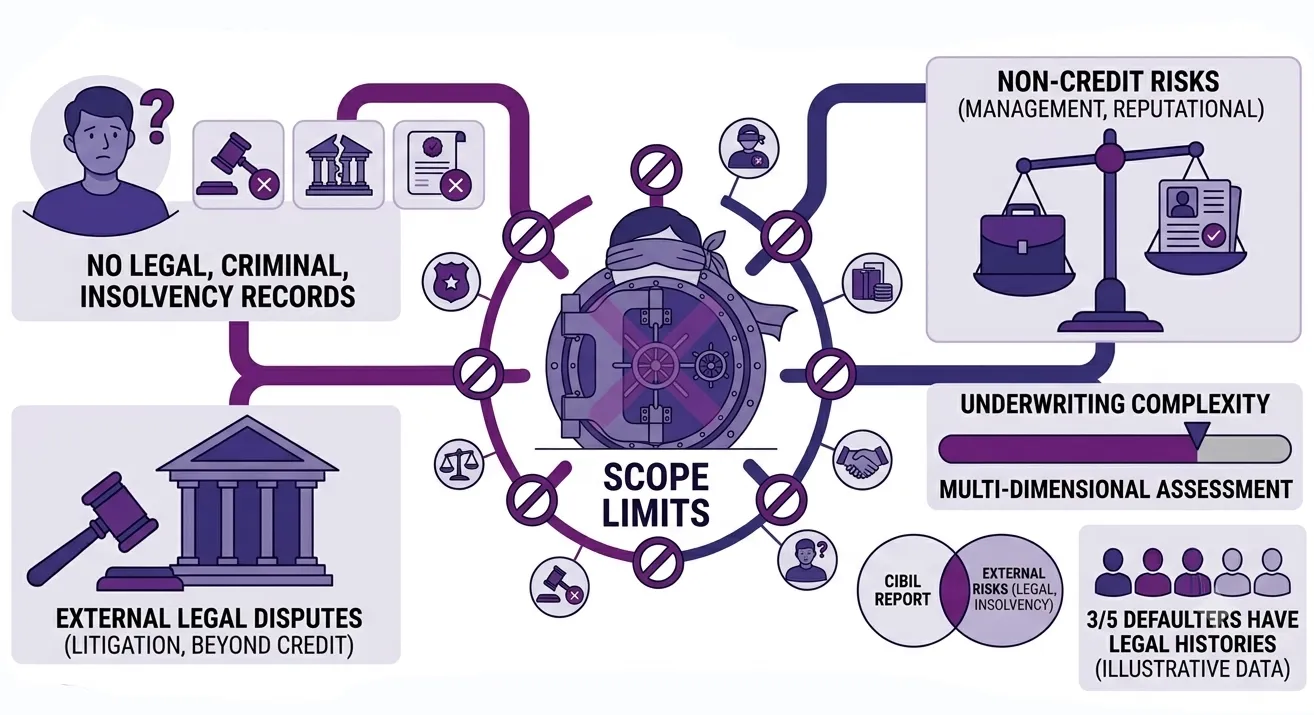
A CIBIL Report is not designed to surface a borrower's legal exposure, litigation, criminal proceedings, regulatory actions, insolvency proceedings, legal disputes, or promoter and director-level exposure sitting outside the credit system entirely.
This isn't a shortcoming of credit bureau data; it's simply outside its scope. A credit report provides one important dimension of risk. Litigation intelligence provides another. Neither is a substitute for the other, they answer different questions about the same borrower or entity as 3 out of 5 credit defaulters have a legal history.
Why a Good CIBIL Score Does Not Mean Zero Risk
-
A few illustrative, hypothetical scenarios help explain why a strong credit profile shouldn't be read as a complete risk assessment on its own:
- A borrower with a strong repayment history who is currently a party to significant pending litigation.
- A company with a healthy CIBIL Score whose promoters are involved in an ongoing business dispute.
- A guarantor with clean credit history who is named in a material legal proceeding.
- A business with satisfactory credit metrics that is facing a regulatory action.
- A borrower with good repayment behavior who is connected to insolvency-related proceedings through a related entity.
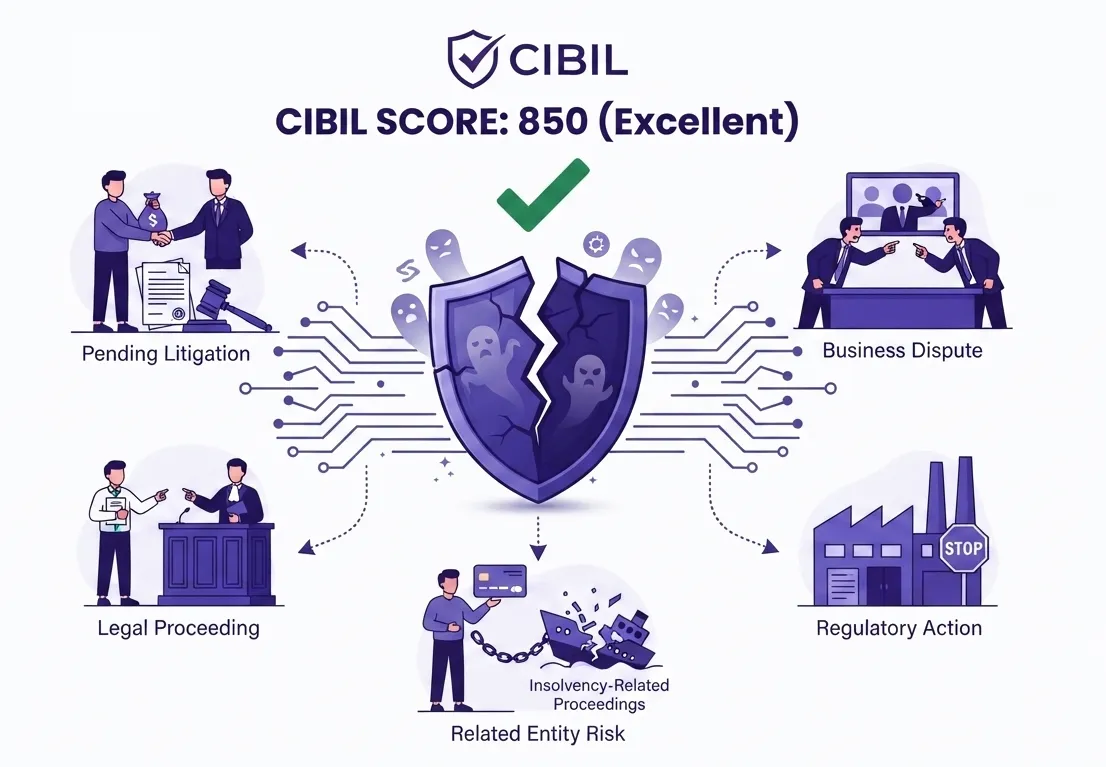
These patterns suggest that litigation exposure and credit outcomes can be closely linked. While litigation alone does not determine whether a borrower will default, a history of legal and financial disputes can provide valuable signals of underlying risk making it an important dimension for lenders to consider alongside the CIBIL Score.
The Risk Signals That May Sit Outside a Credit Report
Litigation Exposure.
Pending and disposed civil cases involving borrowers, promoters, directors, and guarantors, which may not appear anywhere in credit bureau data.
Criminal Proceedings.
Potential criminal exposure where supported source data is available, relevant to reputational and governance risk.
Regulatory Actions.
Enforcement or regulatory-related records from bodies whose actions typically don't flow into credit bureau reporting.
Insolvency and Default-Related Proceedings.
Legal proceedings that can add context to a borrower's or connected entity's financial position beyond what a repayment history shows.
Promoter and Director Exposure.
Understanding whether the individuals behind a borrowing entity carry legal exposure that could affect the business or the relationship going forward.
Entity Relationships.
Understanding connected parties and related entities, since exposure at a related entity can be relevant even when it doesn't touch the borrowing entity directly.
Each of these signals needs to be interpreted in context by a bank's credit, risk, and legal teams; none of them, on their own, determines an outcome.
Where Litigation Intelligence Fits Into Banking Workflows
Litigation intelligence, as delivered through a platform like LIBIL®, is designed to slot into an existing credit and risk workflow rather than replace any part of it.
Customer / Borrower Identification
Identify the borrower along with promoters, directors, guarantors, and relevant group entities.
Traditional Credit Assessment
Review the CIBIL Score, CIBIL Report, financial statements, banking history, and existing liabilities, the standard credit workflow banks already run.
Litigation Intelligence
Search supported sources for civil cases, criminal cases, regulatory proceedings, insolvency proceedings, default-related litigation, and other supported legal records tied to the individuals and entities in scope.
Identity Resolution
Match names and identifiers to distinguish records that genuinely belong to the borrower, promoter, director, or guarantor from records belonging to namesakes.
Risk Triage
Review case status, case type, filed-by / filed-against context, match confidence, and severity or risk indicators where available, to prioritize what needs closer attention.
Human Review
Credit teams, risk teams, legal teams, and compliance teams review flagged matters and apply institutional judgment.
Decision
Multiple sources of information , credit, litigation, regulatory, and fraud signals together , inform credit approval, risk escalation, enhanced due diligence, collateral requirements, monitoring, or recovery strategy.
Key Banking Use Cases
Retail Lending
Litigation signals can complement standard borrower checks, particularly for higher-value retail exposures where a fuller risk picture is warranted.
SME / MSME Lending
Understanding litigation exposure at the promoter and business-entity level matters here, since SME risk is often closely tied to the individuals running the business.
Corporate Lending
Borrower, promoter, director, guarantor, and group-entity exposure all become relevant in larger corporate lending relationships, where the diligence universe is naturally wider.
High-Value Lending
Larger exposures generally warrant a deeper diligence layer, and litigation intelligence can be one part of that enhanced review.
Credit Monitoring
Ongoing litigation developments involving an existing borrower can serve as an additional monitoring signal alongside standard account performance tracking.
Collections & Recovery
Legal intelligence can help collections and recovery teams understand existing legal proceedings and relevant context, used appropriately and within the bank's own policies.
Fraud Detection
Litigation and criminal proceeding signals can complement broader fraud detection workflows by adding legal context that traditional fraud systems may not surface on their own, though litigation intelligence does not automatically detect fraud, and any flagged signal still requires investigation.
How LIBIL® Supports Banking Risk Management
-
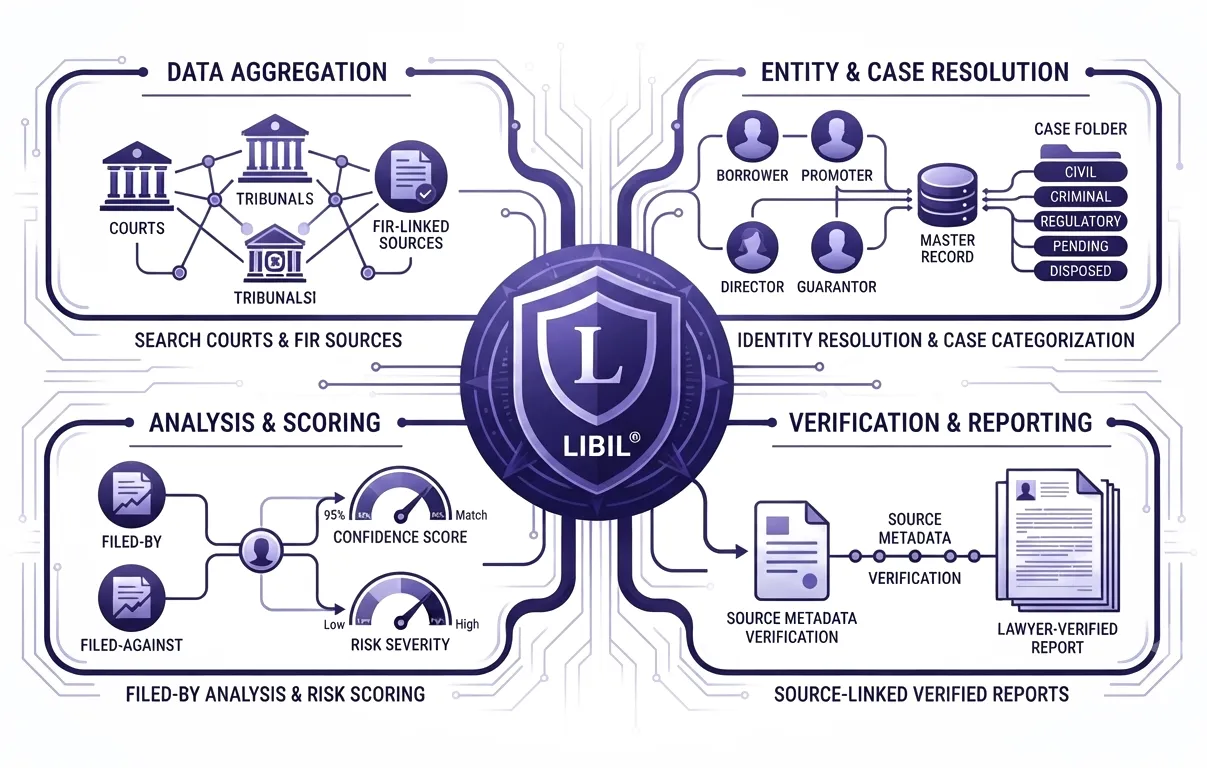
Within its supported source coverage, LIBIL® is built to support banking risk management by providing:
- Search across supported courts, tribunals, and FIR-linked sources
- Identity resolution to match records to the correct borrower, promoter, director, or guarantor
- Case categorization by type, civil, criminal, regulatory, and by status, pending or disposed
- Filed-by / filed-against analysis for case-level context
- Match confidence scoring on name and identifier matches
- Risk or severity indicators to help prioritize review
- Source-linked case metadata for verification
- Structured reports in instant, detailed, and lawyer-verified formats depending on the stakes involved
LIBIL® provides decision-support intelligence. It does not approve or reject loans, replace credit bureaus, replace KYC or AML processes, replace legal review, or guarantee fraud detection or creditworthiness determinations. Those functions remain with the bank's own credit, compliance, fraud, and legal teams.
Press & Recognitions
-
 Forbes india
Legitquest: On a quest to building a legal technology framework in India
-
 financialexpress
LegitQuest: Now, millions of law case records at your fingertips
-
 yourstory
Google picks 16 Indian startups for its 5th accelerator programme
-
 entrackr
Funding in Indian startups this week (05 Apr-10 Apr)
-
.webp) Economic Times
Economic TimesLegitquest raises $660,000 in ongoing round from existing investors InfoEdge, WaterBridge Ventures
-
 Inc42
Inc42Info Edge To Invest INR 4 Cr In Legal Tech Startup LegitQuest
-
 Business Standard
Startup Investments (Holding) to invest Rs 4 cr in Legitquest
-
 Capital Market
Startup Investments (Holding) to invest Rs 4 cr in Legitquest
-
 Vise Stories
Legitquest Raises $660K in Ongoing Round from Existing Investors
Trusted by the top names in the industry
Build a More Complete Risk Picture Beyond Credit Scores
Banks and lending teams can explore how litigation intelligence complements existing credit assessment, KYC, and fraud workflows, as an additional layer of decision-support, not a replacement for any of them.


