
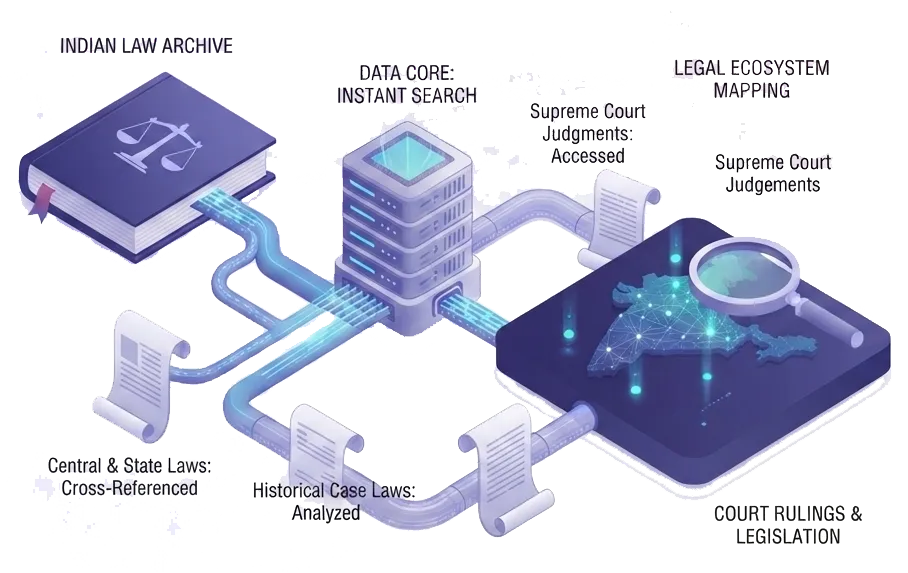

































































Why the Judiciary Needs a Modern Legal Research Platform
The volume of judgments across Indian courts grows every year. Supreme Court and High Court benches deliver thousands of decisions annually, statutes are amended, tribunals issue rulings, and precedents shift often faster than traditional research methods can track.
For judges, judicial officers, and court researchers, this creates a familiar set of challenges:
Locating the most relevant precedent among an expanding body of case law
Cross-referencing judgments across multiple courts and benches
Keeping pace with recent legal developments and amendments
Reducing the time spent on preliminary research so more time goes toward analysis
Accessing reliable, well-organized legal information from a single source
A modern legal research platform doesn't change how judicial reasoning works, it changes how quickly relevant information can be found, verified, and applied. That is the problem Legal Research Database is built to address.
Trusted Across the Judicial Ecosystem
Institutional trust is not incidental when it comes to legal research tools, it's a prerequisite. Judicial officers, High Courts, District Courts, judicial academies, court researchers, and law clerks all depend on legal research platforms that are accurate, current, and dependable.
Judicial Officers and High Courts
Judicial officers and High Court registries use Legal Research Platform to support day-to-day research needs, from locating a specific judgement and order to reviewing how a legal principle has been interpreted across benches.
District Courts and Judicial Academies
District courts and judicial academies rely on structured access to case law and statutes to support both active casework and training. A well-organized Indian legal database makes it easier to build institutional research capacity over time.
Court Researchers and Law Clerks
Court researchers and law clerks are often the first in line to conduct legal research in any judicial workflow. Legal Research Platform is designed to help them retrieve relevant judgments and supporting material efficiently, without compromising accuracy.
A Vast Indian Legal Database
At the core of Legal Research is a comprehensive Indian legal database that brings together case law and legal judgements material in one place, so research doesn't require moving between multiple disconnected systems.
Supreme Court, High Courts, and Tribunals
The Indian legal database within the Law Research Database spans Supreme Court judgements, High Court decisions, tribunal orders, and District Court records, giving users a consolidated view of how the law has developed across all jurisdictions in India.
Statutes, Regulations, Notifications, and Circulars
Beyond case law, the database includes statutes, regulations, notifications, and circulars, allowing legal research to move fluidly between primary legislation and the judgments that interpret it. This unified structure reduces the time spent reconciling information from separate sources and supports more coherent, connected legal research workflows.
Access Supreme Court Judgements and Precedents Faster
Finding the right precedent quickly is central to effective legal research. Law Research Database is structured to help users locate Supreme Court judgements, High Court decisions, and related case law without unnecessary friction.
Judgement by Supreme Court, Organized for Research
Every judgement by Supreme Court benches within the database is indexed and cross-referenced, making it possible to move from a single case to its connected judgments, similar cases, and relevant bench decisions in a structured way. For High Court case search, the same principle applies, decisions are organized so that jurisdiction-specific research doesn't require separate, manual cross-checking.
Citation History and Judgment Timelines
Legal Research Database also surfaces citation history and judgment timelines, so researchers can understand how a precedent has been treated over time, whether it has been followed, distinguished, or referred to in subsequent judgement and order records. For those looking for the latest judgement of the Supreme Court on a given subject, the database is updated continuously, reducing the risk of relying on outdated case law.
AI-Powered Legal Research,
Guided by Legal Expertise
Law Research Platform uses AI to support, not substitute, the legal research process. AI-assisted search helps users move through a large Indian legal database more efficiently: surfacing related judgments, identifying connected legal principles, and narrowing results based on the specifics of a query.
Key Capabilities for Judicial Research
AI Legal Research
Surfaces relevant judgments and legal principles faster
Intelligent Judgment Search
Locates Supreme Court judgements and High Court decisions by context, not just keywords
Citation Analysis
Tracks how a precedent has been cited, followed, or distinguished
Connected Case Discovery
Links related judgments, bench decisions, and similar cases
Legal Database Coverage
Spans Supreme Court, High Courts, tribunals, District Courts, and statutes
Daily Updates
Adds new judgments and legal developments continuously
Advanced Filters
Narrows results by court, date, bench, and subject matter
Document Organization
Structures judgments, orders, and statutes for easy retrieval
Built for Every Role in the Judicial Ecosystem
Judges
Quick access to a comprehensive Indian legal database supports faster verification of precedents and legal provisions during research, without adding complexity to existing workflows.
Judicial Officers
Structured search across Supreme Court judgements, High Court decisions, and statutes helps judicial officers manage research efficiently across a high volume of cases.
Court Researchers
Connected case discovery and citation analysis help court researchers build well-supported research briefs faster, drawing from continuously updated case law.
Law Clerks
An organized, searchable Indian legal database reduces the time law clerks spend retrieving judgments and orders, freeing up time for review and analysis.
Government Legal Departments
Consolidated access to statutes, regulations, notifications, and case law supports government legal teams handling research across multiple matters and jurisdictions.
Judicial Academies
A reliable, continuously updated legal database supports training and research capacity-building, giving academies a consistent reference point for case law and legal developments.
Press & Recognitions
-
 Forbes india
Legitquest: On a quest to building a legal technology framework in India
-
 financialexpress
LegitQuest: Now, millions of law case records at your fingertips
-
 yourstory
Google picks 16 Indian startups for its 5th accelerator programme
-
 entrackr
Funding in Indian startups this week (05 Apr-10 Apr)
-
.webp) Economic Times
Economic TimesLegitquest raises $660,000 in ongoing round from existing investors InfoEdge, WaterBridge Ventures
-
 Inc42
Inc42Info Edge To Invest INR 4 Cr In Legal Tech Startup LegitQuest
-
 Business Standard
Startup Investments (Holding) to invest Rs 4 cr in Legitquest
-
 Capital Market
Startup Investments (Holding) to invest Rs 4 cr in Legitquest
-
 Vise Stories
Legitquest Raises $660K in Ongoing Round from Existing Investors
Trusted by the top names in the industry
Explore Legal Research Platform
Legal research shouldn't be slowed down by fragmented sources or outdated records. Legitquest Legal Research Tool brings together a comprehensive Indian legal database, Supreme Court judgements , High Court decisions, and AI-assisted search into a single platform built for the judiciary and the broader legal ecosystem.


