
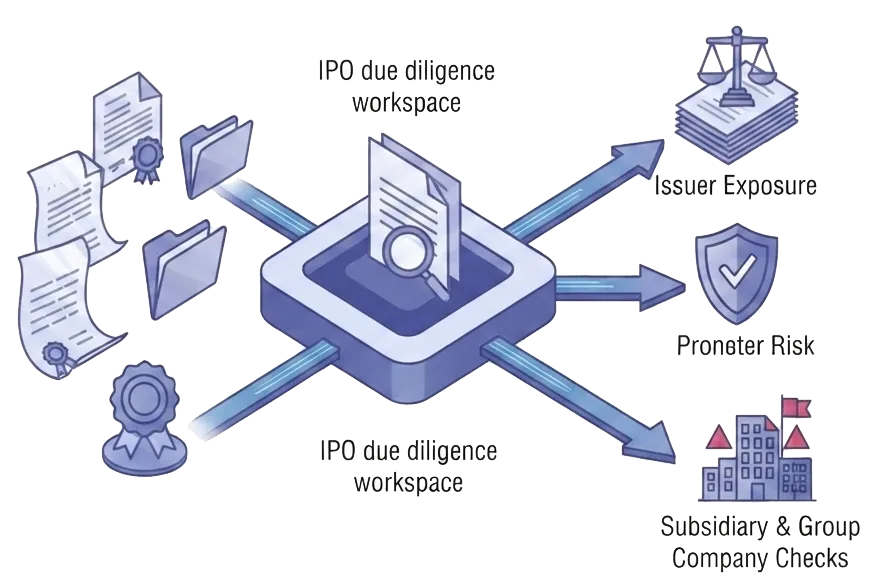

































































Why Legal Due Diligence Matters in an IPO
Litigation Exposure
A single undetected or poorly understood lawsuit can complicate or otherwise clean IPO timeline. Pending civil cases, criminal proceedings, regulatory actions, and financial defaults involving the issuer, its promoters, or its directors can all carry disclosure implications. So can litigation sitting inside subsidiaries, group companies, or related entities that aren't always top-of-mind during initial scoping.
Materiality & SEBI Regulations
This isn't a suggestion that every lawsuit uncovered during diligence needs to be disclosed. Materiality, applicable SEBI regulations, and legal judgment determine what belongs in a DRHP or RHP to mitigate risk for retail investors, a platform can surface exposure, but it cannot make that determination. What matters at this stage is that the underlying universe of litigation is discovered completely enough that legal counsel can make an informed call, rather than working from an incomplete search.
Discovery & Risk Reduction
Gaps in litigation diligence tend to surface at the worst possible moments, during regulatory review, during investor diligence, or in RHP preparation when there's little runway left to investigate a newly discovered matter. Front-loading the discovery work reduces that risk.
What Merchant Bankers Typically Need to Review
Comprehensive IPO litigation diligence rarely stops at the listed entity. A realistic review universe usually includes:
The Issuer
The company's own litigation history - civil, criminal, and regulatory, forms the baseline of the review and is usually the most heavily scrutinized layer.
Promoters
Promoter-level litigation, including criminal proceedings, regulatory actions, and financial exposure such as defaulter-related signals, carries outsized weight because promoter conduct is closely tied to governance perception.
Directors
Directors carry their own litigation history, which needs to be reviewed independently of the company and the promoters, including matters from prior directorships.
Subsidiaries and Group Companies
Litigation exposure frequently extends beyond the entity going public. Subsidiaries and group companies can carry lawsuit history that is relevant to the overall risk picture even when it doesn't sit on the issuer's own balance sheet.
Related Entities
Understanding ownership and relationship structures is what makes it possible to correctly scope who and what actually needs to be searched, without this mapping, related-party exposure is easy to miss entirely.
Multiply this across a typical IPO cohort, an issuer, several promoters, a dozen or more directors, and a handful of subsidiaries and group entities, and the scale of the review becomes clear. This is the complexity that any IPO due diligence workflow has to manage.
The Traditional IPO Litigation Due Diligence Workflow
A structured litigation due diligence process for an IPO generally follows eight steps.
Define the Scope
Identify every issuer, promoter, director, subsidiary, group entity, and other relevant party that needs to be reviewed.
Collect Identifiers
Gather legal names, alternate names or aliases, father's names where relevant, addresses, and other entity identifiers needed to search accurately.
Search Legal Records
Run searches across courts, tribunals, regulatory sources, and other supported public records for each individual and entity in scope.
Resolve Identity
Distinguish the correct individual or entity from namesakes and similarly named parties, a persistent challenge in a country with limited unique identifiers across public court data.
Categorize Findings
Classify matters found into civil, criminal, or regulatory categories, and by case status, pending or disposed.
Assess Relevance and Materiality
Legal teams and merchant bankers determine which matters warrant deeper review based on relevance to the offering.
Verify and Review
Human review, legal verification, and source-level validation confirm that flagged matters are accurately understood before they move further into the process.
Prepare Litigation Schedules
Verified findings feed into the litigation schedules that support DRHP and RHP documentation.
Where the Workflow Breaks Down
-
Run manually across dozens of parties, this workflow strains under its own scale. Common friction points include:
- Manual searches repeated across multiple court portals with inconsistent interfaces
- Large numbers of entities and individuals to search individually
- Name mismatches and namesake confusion that complicate identity resolution
- Duplicate case records surfacing from multiple sources
- Incomplete or inconsistently formatted case information
- Lower-court and district-level complexity that's harder to search than higher courts
- Cross-jurisdiction searches spanning multiple states
- Heavy reliance on spreadsheets to track findings across a large search universe
- Multiple rounds of legal review as new information surfaces
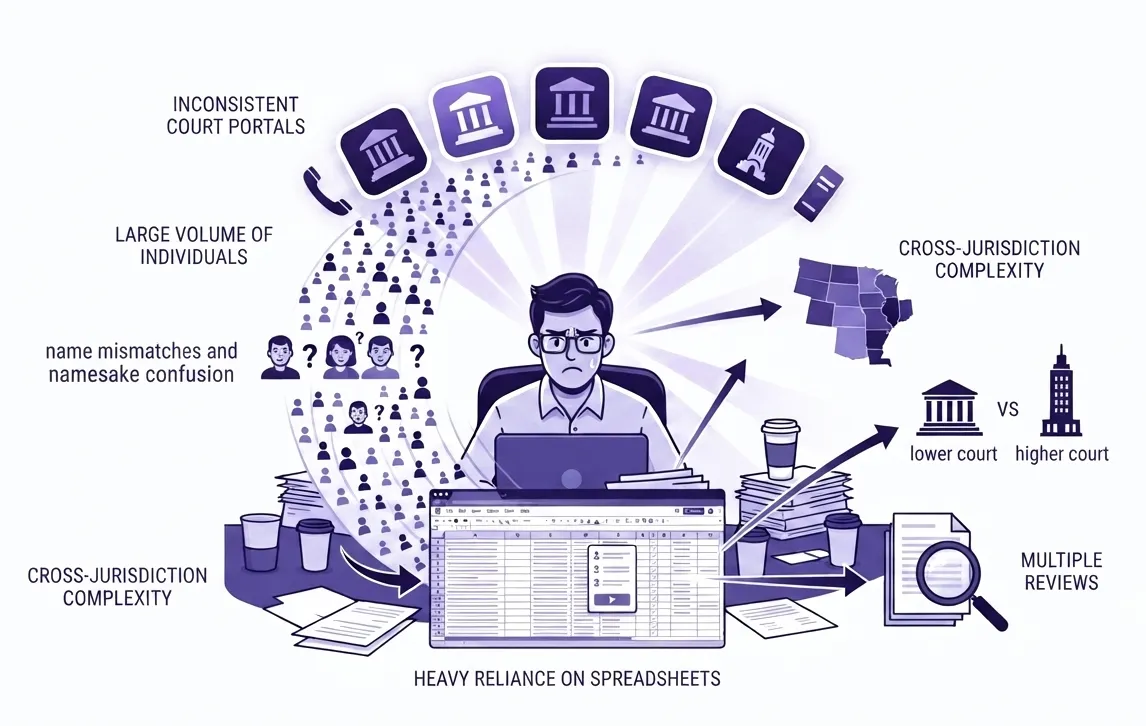
These friction points don't just slow teams down, they create real risk of delays, false positives, missed records, inconsistent categorization, and review processes that are harder to audit later. A litigation intelligence platform can reduce some of this friction, but it does not eliminate the need for careful human review of what it surfaces.
Where LIBIL® Fits Into the IPO Due Diligence Workflow
LIBIL® is built as a litigation intelligence and legal due diligence platform, a layer that helps convert fragmented public legal records into structured, searchable, decision-ready output. In an IPO context, it's designed to support the discovery and structuring stages of the workflow described above, not to replace the judgment stages.
Specifically, LIBIL® is designed to support:
Litigation discovery
across courts, tribunals, and FIR-linked sources
Identity resolution
including alias and name-variation matching and cross-source deduplication
Case categorization
by type (civil, criminal, regulatory) and status (pending, disposed)
Case status analysis
and filed-by / filed-against context
Match confidence scoring
on name, father's name, and address, so reviewers can gauge how confidently a record has been linked to the right subject
Source-linked metadata
court, case number, CNR, acts and sections, with links back to source records
Risk prioritization
through case-level risk labels and an aggregate score or severity indicator
Report generation
in instant litigation check report, detailed litigation check report, and lawyer-verified litigation check report depending on the stakes of the decision
What LIBIL® does not do is decide what constitutes a material lawsuit for disclosure purposes, determine regulatory compliance outcomes, or issue a legal opinion. Legal interpretation, materiality assessment, disclosure decisions, and final DRHP/RHP language remain the responsibility of merchant bankers, issuer counsel, and external law firms.
Who Benefits from a Structured Litigation Intelligence Workflow?
Merchant Bankers
get a more complete starting picture of lawsuit exposure across a large and often complex diligence universe, before drafting of Red Herring Prospectus begins.
IPO Due Diligence Analysts
spend less time reconciling spreadsheets built from manual court searches and more time reviewing flagged matters.
Issuer Counsel
can work from structured, source-linked case data rather than starting each engagement from scratch.
External Law Firms
get a consistent starting dataset to verify and build legal opinions on top of.
Compliance Teams
get visibility into regulatory and defaulter-linked signals alongside litigation exposure.
IPO Issuers
benefit indirectly from a diligence process that's less likely to surface last-minute surprises close to filing.
Press & Recognitions
-
 Forbes india
Legitquest: On a quest to building a legal technology framework in India
-
 financialexpress
LegitQuest: Now, millions of law case records at your fingertips
-
 yourstory
Google picks 16 Indian startups for its 5th accelerator programme
-
 entrackr
Funding in Indian startups this week (05 Apr-10 Apr)
-
.webp) Economic Times
Economic TimesLegitquest raises $660,000 in ongoing round from existing investors InfoEdge, WaterBridge Ventures
-
 Inc42
Inc42Info Edge To Invest INR 4 Cr In Legal Tech Startup LegitQuest
-
 Business Standard
Startup Investments (Holding) to invest Rs 4 cr in Legitquest
-
 Capital Market
Startup Investments (Holding) to invest Rs 4 cr in Legitquest
-
 Vise Stories
Legitquest Raises $660K in Ongoing Round from Existing Investors
Trusted by the top names in the industry
See How Litigation Intelligence Fits Into Your IPO Due Diligence Workflow
Merchant bankers and legal teams can explore how LIBIL® supports litigation discovery, structuring, and lawyer-verified review as part of an existing IPO due diligence process.


