

































































Background Verification Needs Litigation Check
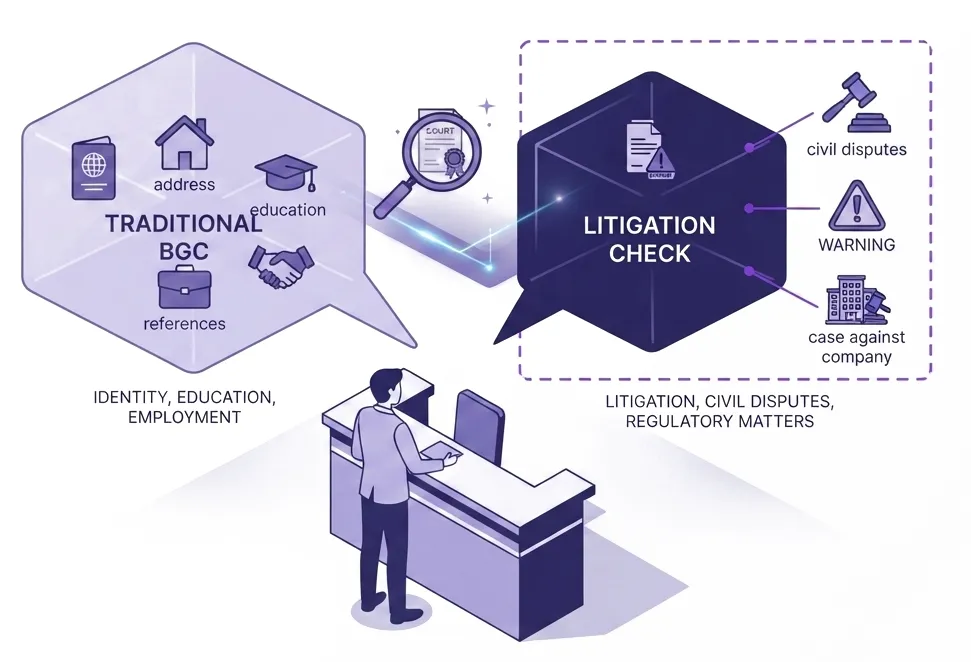
Traditional background verification typically covers identity, address, education, employment, references, and criminal background through KYC-linked databases. These checks answer "is this person who they claim to be, and did they do what they say they did?"
They don't always answer a related but different question: what litigation, civil disputes, or criminal proceedings, pending or disposed to exist against this person? A candidate may have ongoing civil litigation, a regulatory matter, or a case filed against a company they direct, none of which surface in a standard identity or employment check. This isn't a flaw in background verification as a discipline, it's a scope boundary.
The Gap in Traditional Screening Checks
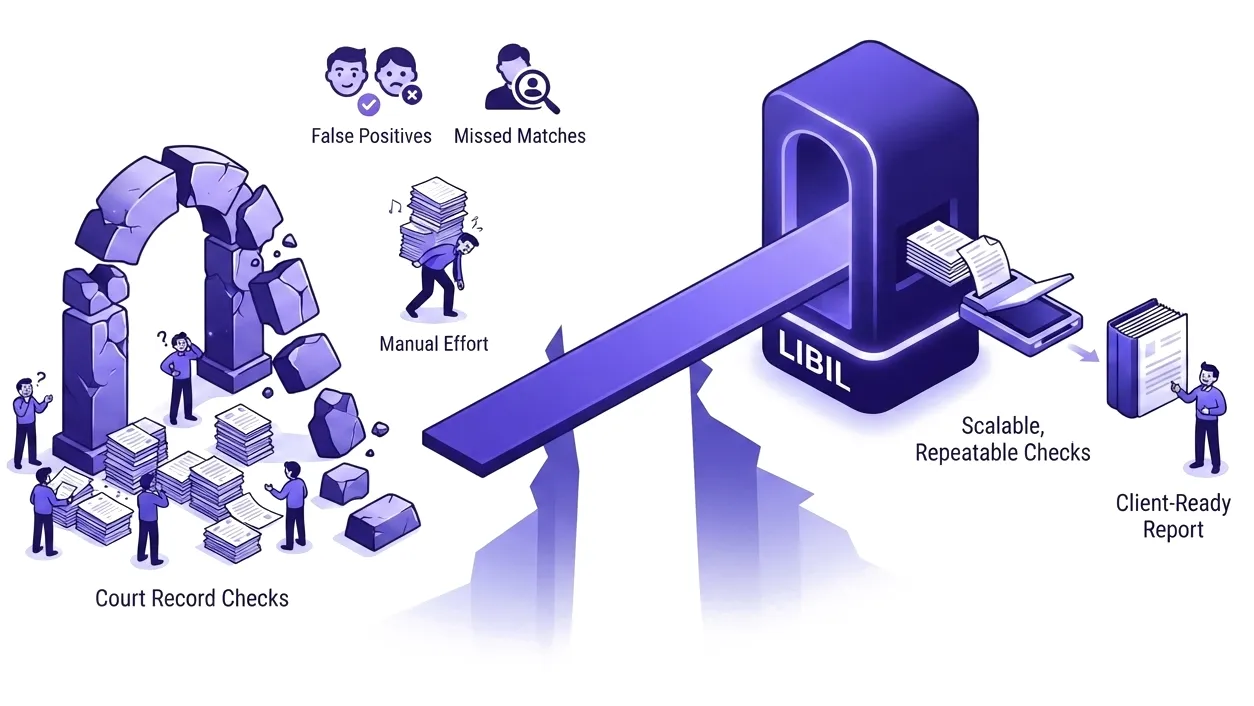
Court record checks are fragmented across jurisdictions and portals. Name variations, incomplete identifiers, and inconsistent formatting make manual searches slow and error-prone. Analysts risk both false positives (matching an unrelated namesake) and missed matches (failing to surface a genuinely relevant case). Compiling findings into a structured, client-ready report adds further manual effort.
These challenges make it difficult to fold litigation intelligence into a scalable, repeatable set of screening checks which is precisely the gap LIBIL is designed to help close.
Where Criminal Background Verification Fall Short
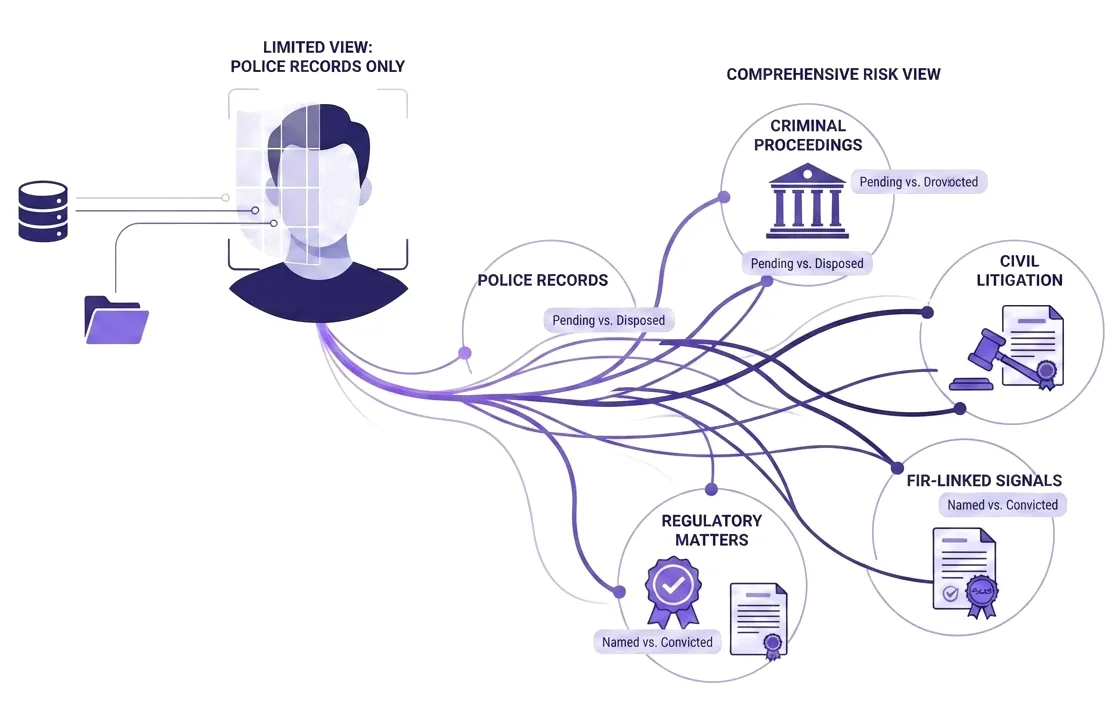
A standard employee background check typically draws on police verification records or specific criminal databases. It's a distinct and valuable part of screening, but it doesn't capture the full picture of a subject's legal exposure.
Criminal proceedings, civil litigation, regulatory matters, and FIR-linked signals are different categories of information, each with different implications. A pending case is not the same as a disposed one. A person named in an FIR-linked record is not the same as someone with a criminal conviction. A comprehensive risk view typically draws on multiple sources rather than a single criminal background check alone.
How LIBIL® Fits Into the Background Verification Workflow
Analysts input available identifiers: name, father's name, address, and other supporting details.
LIBIL applies AI-assisted matching across available identifiers to help distinguish the subject from unrelated individuals with similar names, reducing false positives common in manual court searches.
LIBIL searches supported court and legal record sources for civil and criminal record connected to the subject.
Identified matters are organised by type and status—civil, criminal check , pending, disposed, filed by, and filed against—so analysts can quickly orient to relevance.
Party-name, father-name, and address signals help analysts gauge how confidently a record maps to the subject before it's escalated.
Findings are compiled into structured litigation check outputs in Instant, Detailed, or Lawyer-Verified formats—designed to sit alongside a BGV provider's existing report package.
Cases needing closer review can be escalated for legal review, local verification, or additional investigation. LIBIL supports this workflow; it does not make the final hiring or risk decision.
How LIBIL Complements BGV Companies
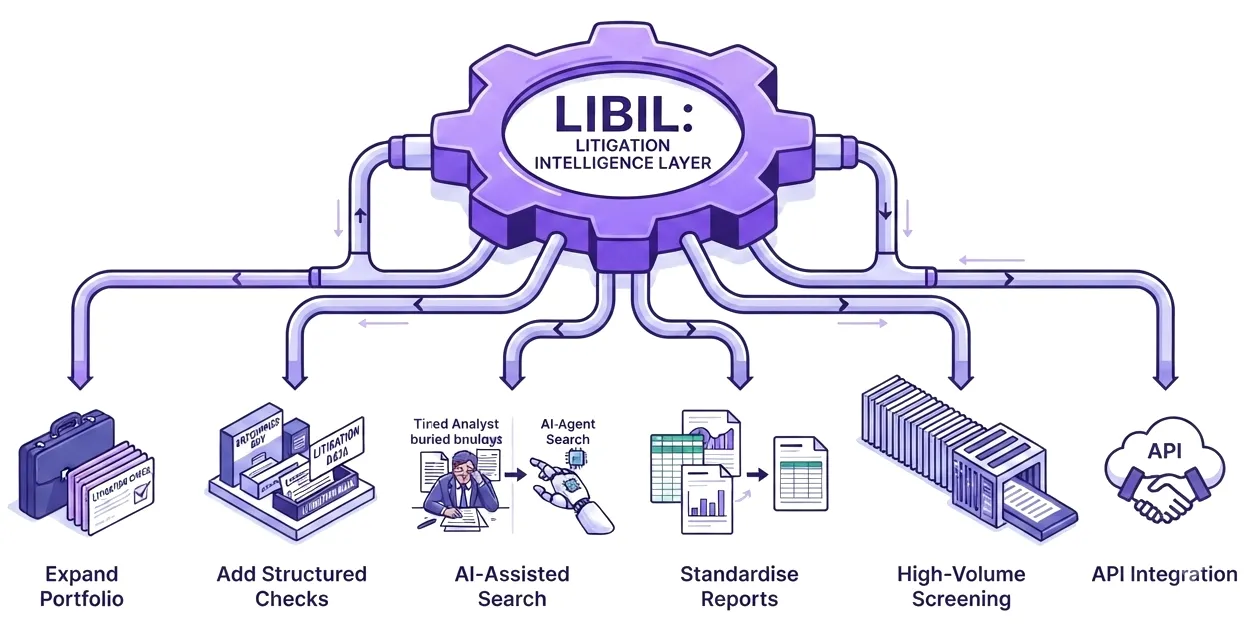
For BGV providers specifically, LIBIL functions as a specialist litigation intelligence layer rather than infrastructure to build in-house. It can help BGV firms:
-
Ways LIBIL can help BGV firms:
- Expand service portfolios with a dedicated litigation check offering
- Add structured litigation checks to existing enterprise packages
- Reduce manual court-portal searching through AI-assisted identity resolution
- Standardise litigation report formats across analysts and clients
- Support high-volume screening checks at enterprise scale
- Explore workflow or API integration with existing BGV platforms, subject to technical validation
Rather than maintaining court-data pipelines internally, BGV companies can plug in a purpose-built litigation intelligence layer.
Key Capabilities of LIBIL
Comprehensive Litigation Search
Searches through India's largest legal database comprising of 500M+ records from supreme court, high court, district court, tribunals.
AI Identity Resolution
Uses available identifiers to improve match accuracy and reduce false positives.
Civil and Criminal Case Categorisation
Distinguishes proceeding types for faster analyst triage.
Pending vs. Disposed Status
Clarifies where a matter currently stands.
Filed-By vs. Filed-Against Context
Shows the subject's role in each matter.
Match Confidence Signals
Helps analysts interpret how strongly a record maps to the subject.
FIR-Linked Signals
Surfaces FIR-linked text matches where supported data exists. This is not nationwide FIR coverage.
Structured Reports
Instant and detailed formats suited to different screening checks and turnaround needs.
API / Workflow Integration
Potential to integrate litigation intelligence into digital BGV workflows, subject to technical review.
Press & Recognitions
-
 Forbes india
Legitquest: On a quest to building a legal technology framework in India
-
 financialexpress
LegitQuest: Now, millions of law case records at your fingertips
-
 yourstory
Google picks 16 Indian startups for its 5th accelerator programme
-
 entrackr
Funding in Indian startups this week (05 Apr-10 Apr)
-
.webp) Economic Times
Economic TimesLegitquest raises $660,000 in ongoing round from existing investors InfoEdge, WaterBridge Ventures
-
 Inc42
Inc42Info Edge To Invest INR 4 Cr In Legal Tech Startup LegitQuest
-
 Business Standard
Startup Investments (Holding) to invest Rs 4 cr in Legitquest
-
 Capital Market
Startup Investments (Holding) to invest Rs 4 cr in Legitquest
-
 Vise Stories
Legitquest Raises $660K in Ongoing Round from Existing Investors
Trusted by the top names in the industry
Add Litigation Intelligence to Your Background Verification Workflow
Modern background check companies increasingly needs to go beyond identity and employment history. LIBIL helps BGV providers and enterprise teams add structured, AI-assisted litigation intelligence to their existing screening checks without replacing the professional judgment that hiring and risk decisions require.


