































































Why Lending Risk Is Broader Than a CIBIL Score
CIBIL Score Captures Credit History
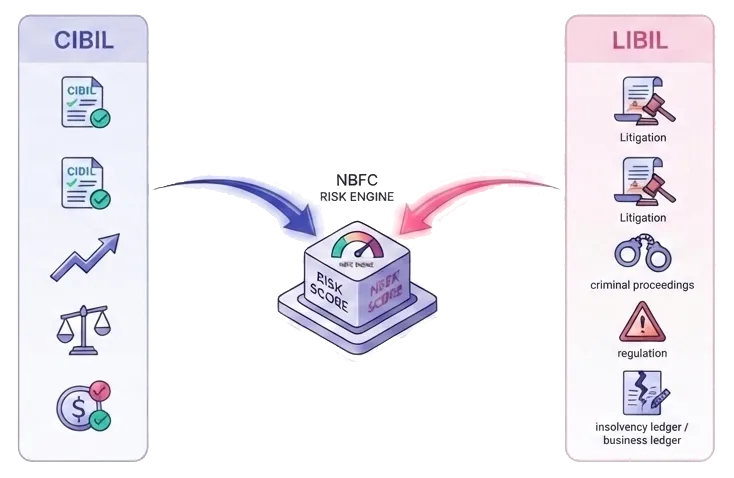
A CIBIL Score shows a borrower's credit history, repayment behavior, defaults, and existing exposure. But it doesn't reveal the full risk surrounding a borrower.
Signals Outside Traditional Credit Data
Borrowers who default may also have histories of litigation, criminal proceedings, insolvency, or business disputes, signals that sit outside traditional credit data but can indicate financial stress or other risks linked to repayment.
Comprehensive Risk Assessment
Credit history is essential. But to assess lending risk comprehensively, lenders must also look at the legal signals surrounding the borrower.
CIBIL and LIBIL® : Complementary, Not Competing
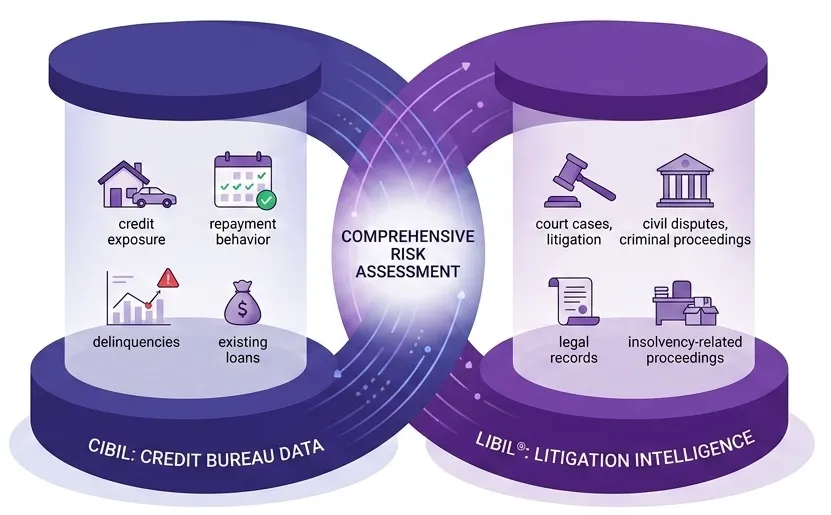
Credit bureau data can help assess credit history, repayment behavior, credit exposure, reported delinquencies, and existing loans and obligations. Litigation intelligence, as delivered through LIBIL®, is designed to provide structured visibility into supported court cases, litigation, civil disputes, criminal proceedings, regulatory matters, insolvency-related proceedings, and other supported legal records.
LIBIL® does not replace CIBIL. It complements credit bureau data with an additional legal and litigation risk layer that sits alongside, not in place of, the credit assessment NBFCs already run.
Why Litigation Checks Matters in Lending Decisions
Litigation History as a Risk Signal
Litigation history is an important risk signal for lenders. It can reveal financial stress, business instability, regulatory concerns, fraud-related risks, or disputes that may affect a borrower's ability to repay especially when a borrower faces significant civil or criminal proceedings, multiple legal cases, insolvency, regulatory action, or disputes impacting operations or cash flow.
Better-Informed Lending Decisions
The nature and severity of each case determine its relevance. Litigation checks give credit and risk teams additional context to assess borrower risk more comprehensively and make better-informed lending decisions.
Litigation Intelligence Across Loan Products
Different lending products present different risk profiles — here is how litigation intelligence integrates into each.
One Platform, Every Loan Type
LIBIL plugs into NBFC underwriting flows through APIs — adding a legal and litigation risk dimension that complements credit bureau data, KYC, banking data, and financial statements across every product.
Beyond Credit Score-Based Risk Assessment
Personal loan underwriting typically involves high application volumes, fast decisioning, automated processing, and heavy reliance on bureau and KYC data. With limited scope for manual review, litigation intelligence can be integrated directly into lending workflows and LMS platforms through APIs, enabling automated, high-volume checks without slowing down decisioning.
This allows lenders to use litigation intelligence as an additional risk signal at scale supporting automated screening, risk-based escalation, and deeper review where required, while keeping the lending process fast and efficient.
Speed vs Risk Visibility
Instant Loans create a real tension between fast decisions and complete risk assessment. Digital lenders offering Instant Loans typically rely heavily on automated data sources to make rapid decisions, and the challenge is enriching that automated underwriting without introducing unnecessary manual intervention that undermines the speed the product depends on.
Litigation checks can fit into Instant Loans workflows with API through risk-based escalation, exception handling, fraud investigations, post-approval monitoring, and review of selected high-risk segments, rather than as a check applied uniformly to every instant application.
Why Legal Risk Can Become Credit Risk
NBFCs providing small business loans carry a different risk profile than individual consumer lending. SME and MSME borrowers bring both a business and the people running it into the risk picture, and legal or litigation exposure can affect business continuity, cash flow, promoter stability, supplier relationships, customer relationships, regulatory standing, and ultimately repayment capacity.
This is why lenders evaluating small business loans often need to look at both the business entity and the people behind it, promoters, directors, guarantors, and related entities. Litigation intelligence can complement commercial bureau information, banking data, financial statements, GST data where available, KYC, and standard credit assessment for small business loans, without replacing any of those sources.
How Litigation Intelligence Can Help Identify Early Warning Signals
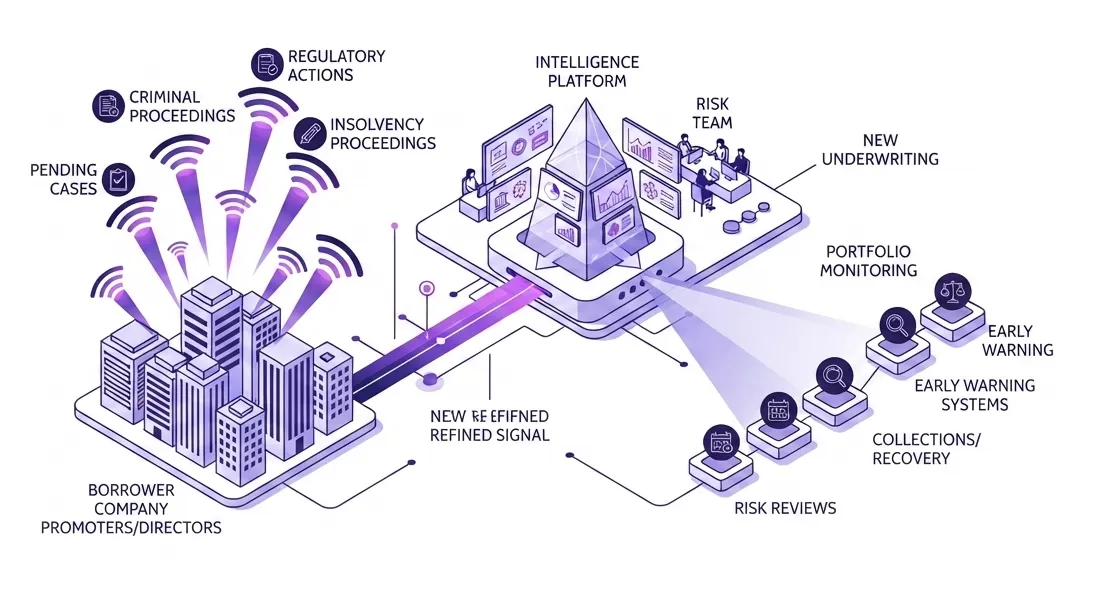
New litigation involving a borrower, multiple pending cases, criminal proceedings, regulatory actions, insolvency-related proceedings, or litigation involving promoters or directors can all serve as additional risk signals. These signals may be useful for new loan underwriting, portfolio monitoring, early warning systems, collections, recovery, and periodic risk reviews.
It's worth stating plainly: litigation is not equivalent to default and should not be treated as a definitive prediction of repayment failure. It's one input among several that a risk team weighs in context.
Can Criminal Record Check Help Reduce NPAs?
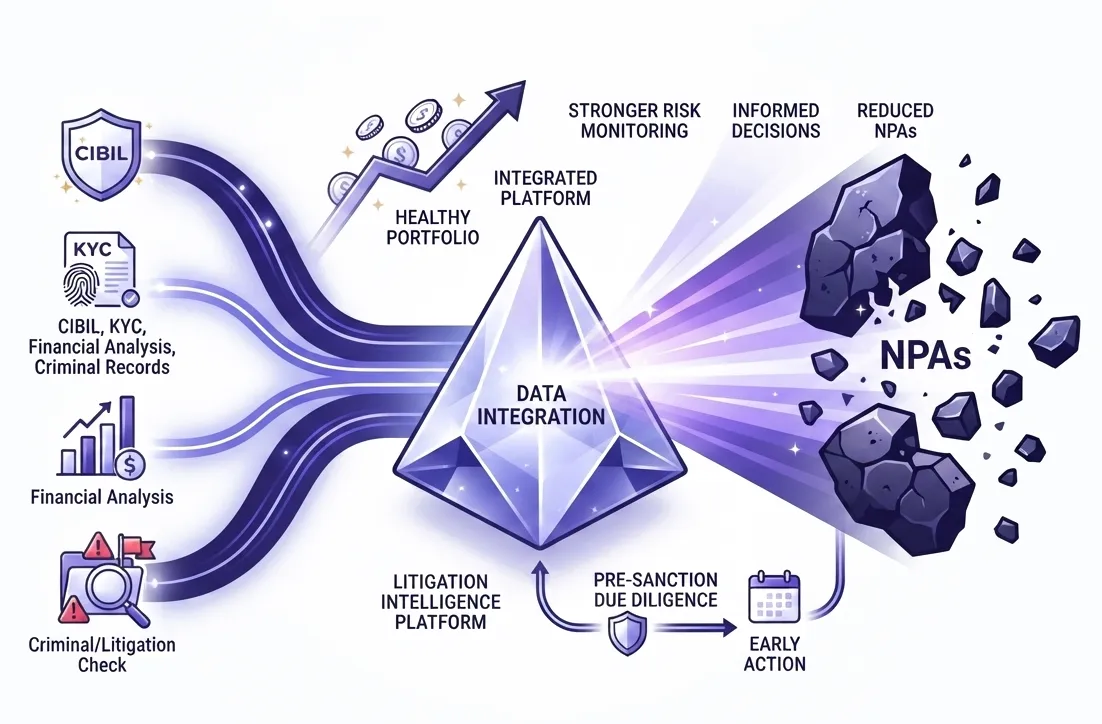
Yes. Criminal and litigation history can provide lenders with additional risk signals that may help identify potential red flags before and after disbursement. When combined with CIBIL, KYC, financial analysis, fraud checks, and other credit signals, litigation intelligence can help NBFCs make more informed lending decisions and strengthen risk monitoring.
LIBIL® can support pre-sanction due diligence, risk-based escalation, portfolio monitoring, early-warning investigations, and recovery workflows helping lenders identify relevant legal signals, investigate potential risks, and act earlier.
LIBIL® Fits Into the NBFC Lending Workflow
LIBIL® is designed to complement existing lending systems, including CIBIL and credit bureau checks, KYC, income verification, banking analysis, fraud detection, underwriting, risk scoring, and collections. It's a litigation intelligence layer, not to replace any of them.
Lending Workflow Journey
How LIBIL® Strengthens This Workflow
LIBIL® strengthens this workflow by helping teams discover relevant records, resolve identity matches, understand case status, prioritize risks, and trace findings back to original court records.
A Broader View of Borrower Risk
While no single data source can eliminate NPAs, integrating litigation intelligence into lending and monitoring workflows can give lenders a broader view of borrower risk and support better-informed decisions.
Lending Use Cases for LIBIL®
Personal Loans
Litigation intelligence may complement credit bureau and KYC checks for selected borrower segments, particularly higher-value applications or flagged exceptions.
Instant Loans
Litigation signals may support risk-based escalation and exception handling without slowing down the majority of automated decisions.
Small Business Loans
Lenders can assess the business, promoters, directors, and related entities together rather than relying solely on the business's own credit profile.
SME / MSME Lending
Litigation exposure can provide additional context around business continuity and promoter risk that commercial credit data alone may not surface.
Loan Against Property / Secured Lending
Litigation information can provide additional borrower context relevant to secured lending decisions, within LIBIL®'s supported coverage.
Guarantor Checks
Guarantors can be screened for litigation exposure using the same identity resolution and search capabilities applied to primary borrowers.
Portfolio Monitoring
New litigation events involving existing borrowers can serve as an additional signal feeding into ongoing risk review.
Collections and Recovery
Structured litigation information can provide context for recovery and legal escalation workflows, used appropriately and subject to each NBFC's own policies and professional review.
What an NBFC Can Learn From Combining CIBIL and LIBIL®
CIBIL / Credit Bureau
How has the borrower handled credit?
KYC
Who is the borrower?
Financial Data
Can the borrower repay?
Banking Data
What does cash flow look like?
Fraud Checks
Is there potential fraud or identity risk?
LIBIL® Litigation Intelligence
What legal or litigation exposure may exist?
Human Review
What does the overall risk picture mean?
A better lending decision comes from combining multiple relevant signals rather than relying on any single score or database; this holds whether the product in question is a small consumer loan or a larger commercial exposure.
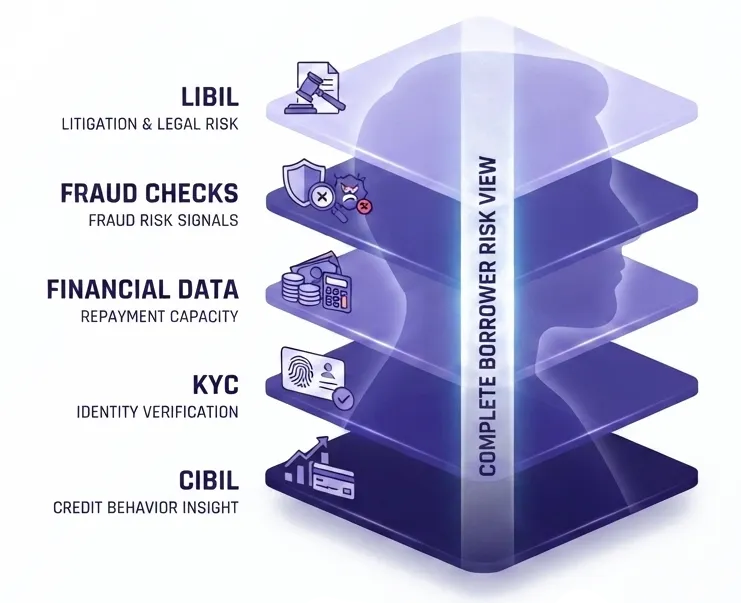
How LIBIL® Complements CIBIL in NBFC Risk Management
CIBIL contributes credit behavior insight. KYC contributes identity verification. Financial data contributes to a view of repayment capacity. Fraud checks contribute fraud risk signals. LIBIL® contributes litigation and legal risk context. Together, these layers combine into a more complete borrower risk view than any single source could provide on its own.
The goal isn't to replace existing risk systems, it's to add another relevant layer of information that NBFCs can weigh alongside what they already use.
Press & Recognitions
-
 Forbes india
Legitquest: On a quest to building a legal technology framework in India
-
 financialexpress
LegitQuest: Now, millions of law case records at your fingertips
-
 yourstory
Google picks 16 Indian startups for its 5th accelerator programme
-
 entrackr
Funding in Indian startups this week (05 Apr-10 Apr)
-
.webp) Economic Times
Economic TimesLegitquest raises $660,000 in ongoing round from existing investors InfoEdge, WaterBridge Ventures
-
 Inc42
Inc42Info Edge To Invest INR 4 Cr In Legal Tech Startup LegitQuest
-
 Business Standard
Startup Investments (Holding) to invest Rs 4 cr in Legitquest
-
 Capital Market
Startup Investments (Holding) to invest Rs 4 cr in Legitquest
-
 Vise Stories
Legitquest Raises $660K in Ongoing Round from Existing Investors
Trusted by the top names in the industry
Build a More Complete View of Borrower Risk
NBFCs can explore how litigation checks complement CIBIL, KYC, financial analysis, and existing credit risk workflows across personal loans, instant loans, and small business loans, as an additional layer of decision-support, not a replacement for any of them.


