





























































Why FIR Verification Remains an Enterprise Risk Gap
India has no single, centralized system for an online fir status check. FIR records live across state police portals, local station registers, and fragmented public disclosures, each with different formats, different update cycles, and different levels of digitization.
For enterprise teams, that fragmentation isn't just inconvenient. It's a compliance exposure.
Fragmented Police Records, State by State
Coverage varies significantly by state, and in many jurisdictions, digitized FIR data is limited or unavailable altogether. A fir check that works cleanly for one region may return nothing for another, not because no eFIR exists, but because the underlying record was never digitized or indexed.
No Centralized FIR Database in India
There is no unified national repository that guarantees a complete fir number check across every state. Teams that assume otherwise risk making decisions on a false sense of completeness.
Manual FIR Number Check Processes Don't Scale
Local police verification, third-party vendor searches, and manual record collection are slow, inconsistent, and difficult to standardize across a growing volume of cases.
This creates real friction in:
When FIR visibility is inconsistent, so is your risk posture.
How LIBIL® Strengthens Your FIR Online Check Workflow
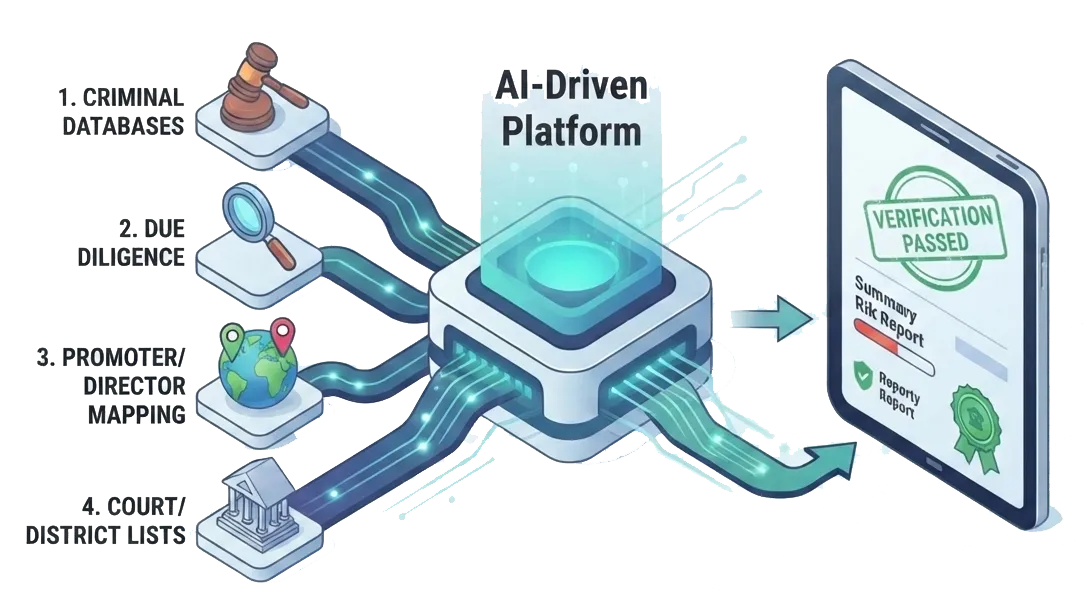
LIBIL® treats FIR signals as an enrichment layer within litigation intelligence, not a standalone product. When you run an fir online check through LIBIL®, the platform:
Searches supported FIR-linked sources for relevant matches
Surfaces matching phrases connected to the subject
Displays a match confidence indicator for each result
Links FIR-linked signals directly to related litigation records
Clearly indicates when FIR data is unavailable for a given search
Discloses data limitations transparently, rather than implying completeness.
Integrated inside every LIBIL® report tier
Key Capabilities of the LIBIL® FIR Check
FIR Text Match
Surfaces matching phrases from supported FIR-linked sources against the subject's identifiers
Match Confidence Scores
Assigns a confidence indicator to each FIR-linked match
Integration with Litigation Checks
Combines FIR-linked signals with court and litigation data in one report
Data Availability Disclosure
Explicitly states when FIR data is not available for a jurisdiction or subject
Compliance Disclaimer
Frames every FIR-linked result as decision-support, not verification
Press & Recognitions
-
 Forbes india
Legitquest: On a quest to building a legal technology framework in India
-
 financialexpress
LegitQuest: Now, millions of law case records at your fingertips
-
 yourstory
Google picks 16 Indian startups for its 5th accelerator programme
-
 entrackr
Funding in Indian startups this week (05 Apr-10 Apr)
-
.webp) Economic Times
Economic TimesLegitquest raises $660,000 in ongoing round from existing investors InfoEdge, WaterBridge Ventures
-
 Inc42
Inc42Info Edge To Invest INR 4 Cr In Legal Tech Startup LegitQuest
-
 Business Standard
Startup Investments (Holding) to invest Rs 4 cr in Legitquest
-
 Capital Market
Startup Investments (Holding) to invest Rs 4 cr in Legitquest
-
 Vise Stories
Legitquest Raises $660K in Ongoing Round from Existing Investors
Trusted by the top names in the industry
Strengthen Your Criminal Record Check Online with LIBIL
Fragmented FIR records shouldn't be the reason risk goes unnoticed. Bring FIR-linked signals into the same workflow as your litigation intelligence with full transparency about what's covered and what isn't.


