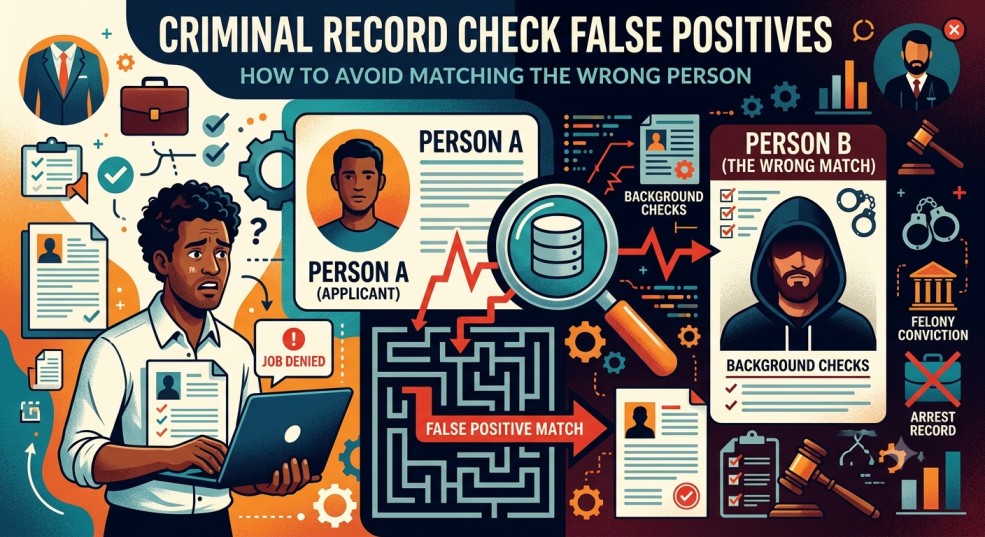
Imagine a background check returns a serious criminal proceeding.
The case exists. The court record is genuine. The information has been captured correctly.
There is only one problem.
It belongs to somebody else.
This is one of the most important risks in criminal record screening because the error can look convincing. The underlying legal information may be perfectly accurate while the identity match is wrong.
For an employer, lender or vendor risk team, that distinction is enormous.
A criminal record check should therefore answer one question before attempting to assess legal risk:
Are we looking at the right person?
If that answer is weak, everything that follows is built on uncertain ground.
What Is a False Positive in a Criminal Record Check?
A false positive occurs when a legal record is incorrectly associated with the person or entity being screened.
Consider a simple example.
A company screens Arun Kumar.
A court search returns a criminal proceeding involving someone called Arun Kumar.
A basic name-matching process flags the candidate.
But the person in the court record lives at a different address and has no connection to the candidate.
The court record itself is not false.
The match is.
That distinction is central to reliable criminal history screening.
Why Wrong Matches Become a Serious Business Problem
At small volumes, a reviewer may manually investigate every possible match.
At scale, that becomes harder.
Suppose an organisation screens 20,000 profiles per month.
If just 5% require 15 minutes of additional manual review because of ambiguous matches, that means:
1,000 profiles × 15 minutes = 250 hours of additional review.
If 10% need investigation:
2,000 profiles × 15 minutes = 500 hours.
These are illustrative calculations, not LegitQuest benchmarks. But they demonstrate why match quality affects more than accuracy.
It affects operating cost, turnaround time and the amount of human attention spent investigating people who may have nothing to do with the surfaced records.
Where Do Criminal Record Check False Positives Come From?
The problem usually begins with identity.
|
Matching Problem |
What Can Go Wrong |
|
Common names |
A case belonging to another person is surfaced |
|
Name variations |
Genuine records may appear under a different spelling or format |
|
Incomplete identifiers |
There may not be enough information for a confident match |
|
Address variations |
The same address can appear differently across records |
|
Record format differences |
Information may not be presented consistently across sources |
|
Multiple possible matches |
Reviewers may struggle to determine which record belongs to the subject |
This explains why “search harder” is not necessarily the solution.
Searching more records can increase coverage.
It can also produce more possible matches.
The real challenge is resolving identity across those records.
Name Search Is Discovery. Identity Resolution Is Verification.
This distinction is useful for mature risk teams.
A name search asks:
“Which records might relate to this person?”
Identity resolution asks:
“Which of these records can reasonably be connected to this person?”
Those are different jobs.
LegitQuest's LIBIL® uses identity resolution across name variations, addresses and record formats while searching supported Supreme Court, High Court, district court, tribunal, order and FIR records.
The purpose is to reduce both sides of the matching problem:
False positives: the wrong person's record is attributed to the subject.
False negatives: a relevant record is missed because identifying information appears differently.
Good screening has to manage both.
Why False Positives Can Be More Dangerous Than They Look
A false positive does not merely create another row in a report.
It can alter what happens next.
In employment screening, a candidate may be unnecessarily escalated.
In lending, a borrower may enter enhanced review because of an unrelated proceeding.
In vendor onboarding, compliance teams may spend time investigating a third party that has no connection with the identified case.
The problem becomes particularly serious when organisations use legal screening at high volume.
A small matching weakness repeated across 50 profiles is inconvenient.
Repeated across 50,000 profiles, it becomes a process problem.
That is why identity accuracy should be treated as part of risk infrastructure rather than simply a search feature.
A Confident Match Still Needs Case Context
Getting the identity right solves the first problem.
It does not solve the entire screening problem.
Once a record has been matched, the reviewer still needs to understand what has been found.
LIBIL® categorises identified records into civil, criminal, regulatory and tax matters and distinguishes between pending and disposed proceedings.
That matters because even a correct match can be interpreted incorrectly.
A genuine criminal proceeding is not automatically evidence of guilt.
A pending matter is not a conviction.
A disposed matter still needs to be understood in context.
Match Confidence Should Determine the Next Action
Not every possible match deserves the same response.
A practical approach is to think in terms of confidence.
High-confidence match: identity information strongly aligns and the case can move to contextual review.
Ambiguous match: some information aligns, but the record requires additional verification.
Weak match: the available information is insufficient to confidently attribute the record to the subject.
The important principle is simple:
Uncertainty should trigger verification, not assumption.
For deeper reviews, LegitQuest's Detailed Litigation Check Reports include case match scoring alongside the LIBIL® Score, reasoning and narrative case summaries.
This gives reviewers additional structure when a first-pass result needs more examination.
Source Verification Is the Last Line of Defence
Even a strong identity match should remain traceable to evidence.
LIBIL® uses source-linked reporting so findings can be traced back to their underlying records.
This becomes especially important when a finding may influence a consequential business decision.
A compliance team should be able to ask:
Where did this information come from?
What does the underlying record actually say?
Why was it matched to this person?
Does the evidence justify escalation?
An unexplained “criminal record found” flag cannot answer those questions.
A source-linked record can.
What Should Happen When the Match Is Unclear?
The answer should not be to force certainty.
LegitQuest structures screening across different depths.
Instant Litigation Check Reports support high-volume first-pass screening.
Where a result needs more context, Detailed Litigation Check Reports add the LIBIL® Score with reasoning, case match scoring and narrative case summaries, typically within 2 to 4 hours.
For very high-exposure decisions, Lawyer Verified Reports provide deeper lawyer-prepared review and typically take 3 to 5 business days.
Accuracy Starts Before Risk Scoring
Businesses often focus on the final output of a criminal record check.
How many cases were found?
What is the litigation score?
Is the case pending?
Those questions matter.
But they come after a more fundamental one:
Do these records belong to the person we are actually evaluating?
A sophisticated risk model cannot repair a bad identity match.
That is why reliable criminal record screening begins with identity resolution and continues through case classification, contextual assessment, source verification and appropriate human review.
The most dangerous result is not always a missing case.
Sometimes it is a completely genuine case attached to the wrong person.
Frequently Asked Questions
What is a false positive in a criminal record check?
A false positive occurs when a legal record is incorrectly associated with the person or entity being screened, even though the underlying record itself may be genuine.
Why do false positives happen in criminal record checks?
Common names, name variations, incomplete identifiers, address differences and inconsistent record formats can all create ambiguous or incorrect matches.
How can businesses reduce criminal record check false positives?
Businesses can use identity resolution, review multiple identifying attributes, assess match confidence, examine case context and verify important findings against underlying source records.
Is matching a person's name enough to confirm a criminal record?
No. A name match is a starting point rather than confirmation. Additional identity information should be considered before attributing a proceeding to the subject.
How does LegitQuest address identity matching?
LIBIL® uses identity resolution across name variations, addresses and record formats to help reduce false positives and false negatives.
What should happen if a criminal record match is uncertain?
An uncertain result should be verified rather than assumed to belong to the subject. Where appropriate, the profile can be escalated from first-pass screening to a Detailed or Lawyer Verified review.


