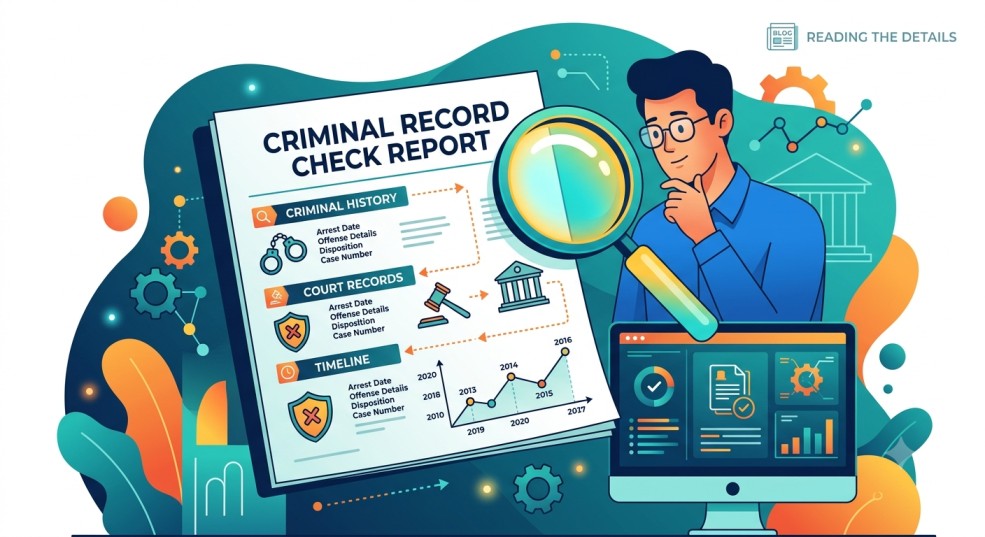
A criminal record check report shows four cases.
What does that actually tell you?
Very little.
Before those four cases become useful to a risk team, several questions still need answers.
Do all four belong to the person being screened? Are they criminal proceedings or other forms of litigation? Are they pending or disposed? What is the person's relationship to each matter? Does one case deserve more attention than the other three? Can the reviewer trace the information back to the source?
This is the difference between receiving a criminal record check report and actually reading one.
For employers, lenders, background verification firms, vendor risk teams and other organisations, the quality of the decision depends less on the number of records surfaced and more on how those records are interpreted.
Do Not Start With the Number of Cases
A case count is usually the easiest part of a report to understand.
It can also be one of the easiest to misuse.
Consider:
Profile A: 7 cases
Profile B: 2 cases
It is tempting to assume Profile A deserves more attention.
Now add context.
Profile A's records may largely consist of disposed civil matters.
Profile B may have two pending criminal or regulatory proceedings that the organisation considers more relevant to its decision.
Suddenly, 7 versus 2 tells you almost nothing.
A criminal history report should therefore be read in layers rather than as a scorecard.
The 7 Questions to Ask When Reading a Criminal Record Check Report
|
Report Element |
Question to Ask |
|
Identity match |
Does this record actually belong to the subject? |
|
Case category |
Is it criminal, civil, regulatory or tax related? |
|
Case status |
Is the proceeding pending or disposed? |
|
Subject's position |
What is the subject's relationship to the proceeding? |
|
Case pattern |
Is this isolated or part of broader litigation exposure? |
|
Risk context |
Does the finding warrant closer review? |
|
Source record |
Can the finding be traced to the underlying court record? |
Read in this order, a report begins to tell a story.
Read only as a case count, much of that story disappears.
1. Start With Identity Match
This is the first checkpoint because everything else depends on it.
Suppose a report identifies a criminal proceeding involving someone named Rohit Sharma.
The person being screened is also Rohit Sharma.
That is not enough to conclude that the record belongs to him.
Common names, spelling variations, address differences and inconsistent record formats can create ambiguous matches.
LegitQuest's LIBIL® uses identity resolution across name variations, addresses and record formats when searching supported Supreme Court, High Court, district court, tribunal, order and FIR records.
2. Read the Case Category Before Assessing Risk
The next field to examine is what type of proceeding has actually been identified.
LIBIL® categorises matched records into:
Civil
Criminal
Regulatory
Tax
This distinction matters because a legal record is not a single category of business risk.
A commercial dispute, criminal proceeding, regulatory matter and tax case can have very different relevance depending on whether the report is being used for lending, employment, vendor onboarding or transaction due diligence.
The report should therefore help the reviewer classify before interpreting.
3. Pending and Disposed Are Statuses, Not Verdicts
The next temptation is to overread case status.
Pending means the proceeding has not reached final disposal.
It does not mean the subject is guilty.
Disposed means the matter has reached a recorded disposal.
It does not automatically mean the underlying history is irrelevant.
Status provides context. It does not provide the complete interpretation.
For mature risk teams, the better question is:
“What does the status tell us about this proceeding, and what do we still need to understand?”
That prevents “pending” from becoming an automatic red flag and “disposed” from becoming an automatic dismissal.
4. Understand the Subject's Relationship to the Case
Another important part of reading court records is understanding how the subject appears in the proceeding.
LegitQuest's Instant Litigation Check reporting can distinguish matters filed by and filed against the subject.
That can materially change interpretation.
A company involved in litigation because it initiated proceedings to recover money is in a different position from one facing a proceeding against it.
The fact that both appear in court records does not make the circumstances equivalent.
This is another reason raw case totals can mislead.
5. Look for the Pattern, Not Just the Individual Record
A single case may require investigation.
But a criminal history or litigation report can also reveal a broader pattern.
Imagine reviewing 10 proceedings individually.
Each may appear relatively modest in isolation.
Viewed together, however, the profile may show repeated litigation across different courts or categories.
The reverse can also happen: a large case count may come from related or relatively low-relevance matters.
The reviewer therefore needs to move between two views:
Case level: What does this individual proceeding show?
Profile level: What does the complete litigation history show?
That second view is where structured risk assessment becomes useful.
6. Understand What the LIBIL® Score Is Telling You
For deeper reviews, LegitQuest's Detailed Litigation Check Reports include the LIBIL® Score with reasoning, alongside narrative case summaries.
The value of a standardised score is consistency.
If a risk team reviews hundreds or thousands of reports, every reviewer should not have to invent a completely different way of prioritising litigation exposure.
But the score should not replace the underlying cases.
7. Trace Important Findings Back to the Court Record
A criminal record report becomes much more defensible when its findings can be verified.
LIBIL® uses source-linked reporting, allowing reviewers to trace findings back to the underlying record.
This matters whenever the report could influence a consequential decision.
An HR team considering a senior hire may need legal review.
A bank evaluating a larger credit exposure may need to understand the proceeding before escalation.
A vendor risk team may want to verify a case before changing onboarding requirements.
When Does a Criminal Record Check Report Need Escalation?
Not every report requires the same depth.
For high-volume screening, Instant Litigation Check Reports provide a first-pass view.
When findings require more context, Detailed Litigation Check Reports add the LIBIL® Score with reasoning and narrative case summaries, typically within 2 to 4 hours.
For very high-exposure decisions, Lawyer Verified Litigation Check Reports provide deeper lawyer-prepared review and typically take 3 to 5 business days.
The Best Criminal Record Report Is Not the One With the Most Data
A report with 50 rows of court information may look comprehensive.
But volume is not the same as clarity.
The useful criminal record check report is the one that helps a reviewer distinguish the right person from the wrong one, criminal matters from other litigation, pending cases from disposed matters, isolated records from broader exposure, and ordinary findings from cases that deserve deeper review.
That is how court data becomes decision-useful information.
Frequently Asked Questions
What does a criminal record check report show?
A criminal record check report can show identified legal proceedings associated with a subject, including information such as case category, status, court details and underlying source records.
What should I read first in a criminal history report?
Start with identity. Confirm that the surfaced records reasonably match the person or entity being screened before interpreting the cases themselves.
Does a pending criminal case mean the person is guilty?
No. Pending describes the status of the proceeding. It does not establish guilt.
What does a disposed case mean in a criminal record report?
Disposed means the proceeding has reached a recorded disposal. The underlying case and outcome should still be understood before deciding whether it is relevant.
What is the LIBIL® Score?
The LIBIL® Score provides a standardised assessment of litigation exposure for applicable LegitQuest reports, supported by reasoning. It is designed to assist review rather than make the final business decision.
When should a criminal record report be escalated?
Escalation may be appropriate when identity is uncertain, potentially relevant proceedings are identified, the decision carries higher exposure or additional legal interpretation is needed.


