


































































Why Litigation Outgrows Spreadsheets and Email
Missed Court Dates & Scattered Documents
Most legal teams start with spreadsheets, shared drives, and email threads and outgrow them fast. Court dates get missed. Documents live on someone's laptop instead of a shared system.
Chasing Updates with External Counsel
Coordinating with external counsel means chasing updates instead of seeing them in real time. None of this is a people problem; it's what happens when a growing litigation portfolio runs on tools that weren't built to manage it.
That's the gap a purpose-built litigation management system is designed to close.
Meet Patrol® - The Litigation Management System
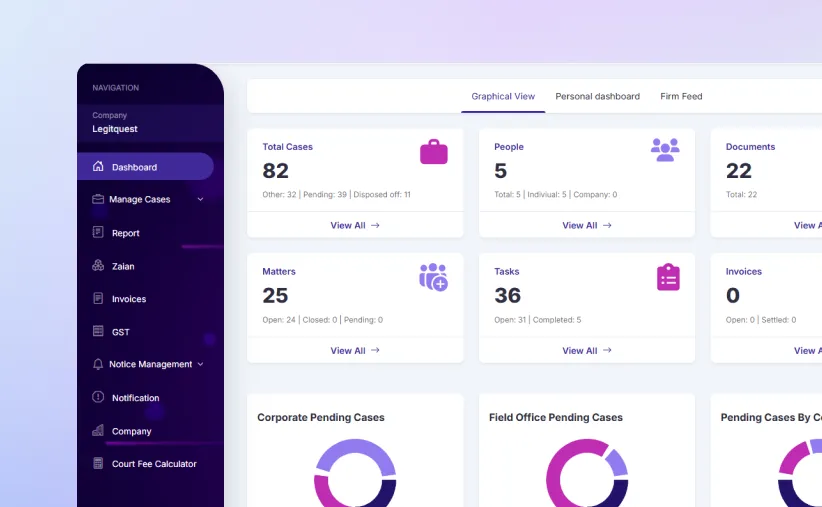
Patrol® gives your organization a single source of truth for cases, hearings, tasks, documents, teams, and external counsel - replacing scattered updates with one shared workspace.
As a litigation management system, it's built specifically for legal workflows, not adapted from generic project-management software.
Whether you're evaluating case management software for lawyers at a law firm or an in-house department, Patrol® is designed to scale with your caseload rather than get in its way.
What law firm case management software Manages For You
Centralized Matter Management
Every case, document, and update lives in one workspace instead of scattered emails and folders.
Court Date & Hearing Tracking
Hearings, tasks, and follow-ups sync automatically to your calendar, so nothing slips through.
Document Management
Each matter has its own organized file set - open, edit, and access documents without hunting across drives.
Generative AI Chat
Ask questions about a matter directly within Patrol® and get instant, context-aware answers, drawn from both Patrol®'s data and Legitquest's legal database.
Dashboards & Reports
Automated reports and interactive dashboards summarize activity across District Courts, Tribunals, High Courts, and the Supreme Court, replacing manual status updates.
Team Collaboration
Manage, track and monitor your court case status together at scale. Assign tasks to each other.
Together, these capabilities are what make Patrol® function as legal case management software rather than a generic tracker - every feature is built around how litigation actually moves through an organization.
Built for Every Legal Team
Patrol® supports law firms, corporate legal departments, banks, and financial institutions. As law firm collaboration tools , it fits firms managing client matters across multiple offices; as law practice management software for in-house departments, it brings litigation, compliance, and vendor risk into one operational view.
Role-based access and audit trails keep sensitive matters visible only to the right people, regardless of team size.
Whether your team searches for legal practice management software to standardize firm-wide workflows or law practice management software to unify litigation and compliance in-house, Patrol® is built to fit both.
Press & Recognitions
-
 Forbes india
Legitquest: On a quest to building a legal technology framework in India
-
 financialexpress
LegitQuest: Now, millions of law case records at your fingertips
-
 yourstory
Google picks 16 Indian startups for its 5th accelerator programme
-
 entrackr
Funding in Indian startups this week (05 Apr-10 Apr)
-
.webp) Economic Times
Economic TimesLegitquest raises $660,000 in ongoing round from existing investors InfoEdge, WaterBridge Ventures
-
 Inc42
Inc42Info Edge To Invest INR 4 Cr In Legal Tech Startup LegitQuest
-
 Business Standard
Startup Investments (Holding) to invest Rs 4 cr in Legitquest
-
 Capital Market
Startup Investments (Holding) to invest Rs 4 cr in Legitquest
-
 Vise Stories
Legitquest Raises $660K in Ongoing Round from Existing Investors
Trusted by the top names in the industry
Bring Every Litigation Matter Into One Secure Platform
See how Patrol® helps legal teams centralize e court case status , automate workflows, improve collaboration, and gain real-time visibility across their entire litigation portfolio.
Book a personalized demo of Patrol® - legal collaboration software .


