





































































Why courts adopt LegitQuest
-
 Bench-focused summaries
Get concise, neutral case briefs and headnotes that surface holdings, ratio, and material facts - formatted for quick judicial review. -
Accurate citation tracking
See how a decision has been treated over time, with reversal signals and negative treatment flags to protect the integrity of judicial reasoning. -
Context-aware search
Search by issue, procedural posture, bench, citation, or full-text and receive results prioritized by precedential value and jurisdiction. -
Secure, confidential access
Enterprise security and role-based access controls ensure sensitive matter research remains confidential within the court. -
Multi-jurisdiction coverage
Access national and state-level law, notifications, rules, and authoritative secondary sources relevant to your bench.

Key Features of LegitQuest’s Legal Research Tool

iSearch - AI-powered search for quick and accurate results from a vast legal database

iGraphics - Transform complex legal data into insightful visual representations
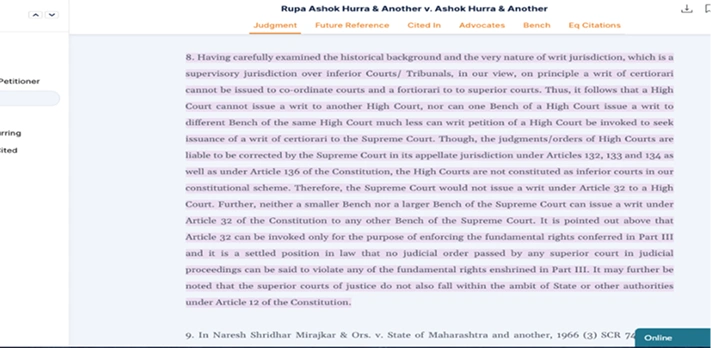
iDraf - Use 1-click insight judgement system to gain intelligence quickly
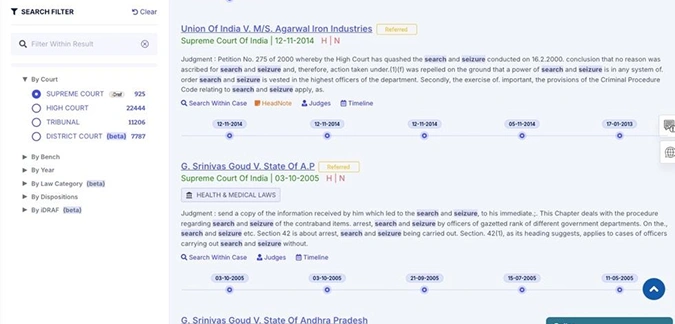
Headnotes & Timelines - Access a quick case summary and timeline
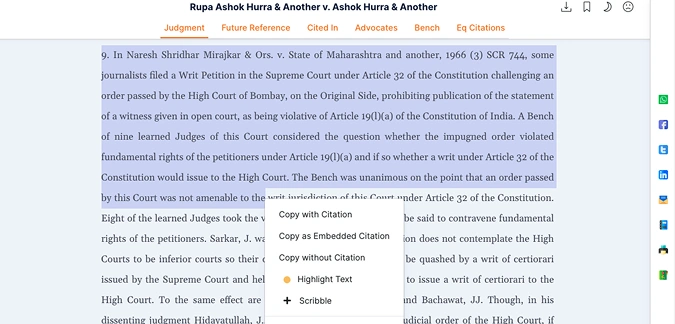
Highlight/Scribble/Citation - Mark key text in judgments, add comments while skimming and copy content with or without citation
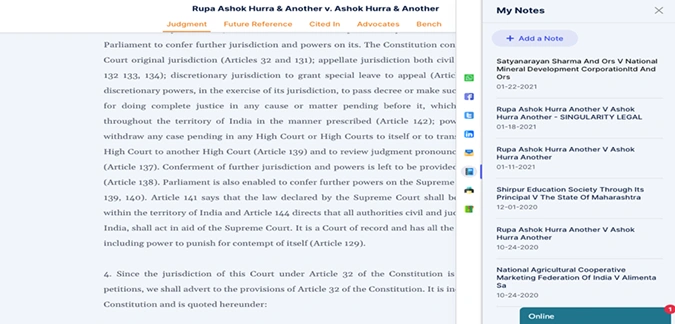
Notes - Make personalized notes on specific topics
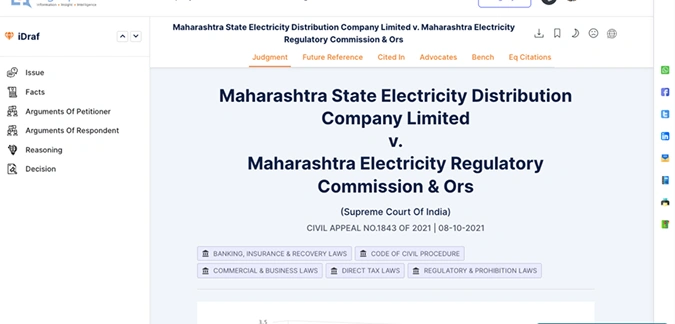
Categorization of Law - Over 21,000+ laws organized into 37 categories
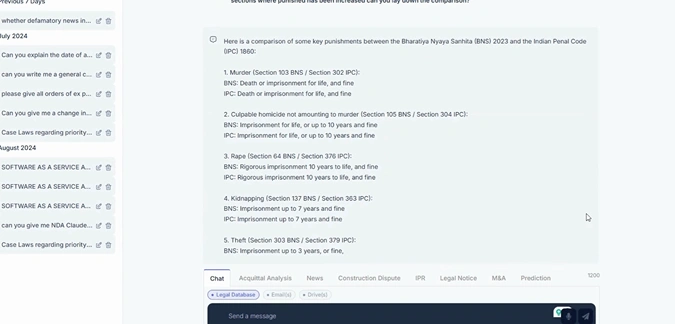
Generative AI Chat - Gain real-time insights from case laws instantly

Chatbot - Live chat available for your easy product use
How it helps the bench

Faster research
Reduce time spent locating and reading dozens of cases - get to the core authorities quickly and draft reasoned orders with confidence.

Consistent reasoning
Use precedent maps and lineage checks to maintain doctrinal consistency across judgments.

Risk reduction
Citation validation and negative-treatment flags help avoid reliance on overruled or misapplied authority.
Better institutional knowledge
Searchable matter folders and shared annotations preserve learnings across clerks and benches.
Trusted by the top names in the industry
Press & Recognitions
-
Forbes india
Legitquest: On a quest to building a legal technology framework in India
Jun 10, 2022 Read More
-
financialexpress
LegitQuest: Now, millions of law case records at your fingertips
April 27, 2020 Read More
Ready to bring efficiency to judicial research?
FAQs
Judicial decision making depends on a clear understanding of facts, accurate legal context, and the consistent application of precedent. Courts are required to evaluate complex arguments, review prior rulings, and interpret statutes in a way that ensures fairness and uniformity. In this process, legal research and analysis for judges provides a critical foundation. By offering structured access to legal materials and well organized references, it allows judges to focus on interpretation and reasoning rather than spending time on manual information gathering.
A strong legal research and analysis for judges framework helps bring clarity to large volumes of legal data. Instead of navigating fragmented sources, courts can rely on organized insights that highlight relevant precedents and contextual relationships between cases. This not only improves efficiency but also supports consistency in judicial outcomes, as decisions are grounded in well structured and easily accessible information. Over time, this approach strengthens the overall quality of legal reasoning and helps maintain confidence in the judicial process.
At the same time, the effectiveness of judicial research is closely tied to the quality of submissions presented before the court. Legal practitioners play a key role in shaping how arguments are understood and evaluated. Lawyers who rely on legal research tools for lawyers are better equipped to prepare precise and well supported submissions. These tools enable them to identify relevant authorities, cite precedents accurately, and present arguments in a way that aligns with established legal principles.
Using legal research tools for lawyers also improves the overall efficiency of court proceedings. When submissions are backed by accurate references and clearly structured arguments, judges can review them more effectively, reducing the time required to verify information or clarify context. This creates a more streamlined interaction between the bench and the bar, where both sides are working with reliable and well organized legal material.
In many cases, judicial evaluation extends beyond pure legal interpretation and requires an understanding of the broader factual and risk context surrounding a matter. This is particularly relevant in complex disputes or corporate related cases where background information can influence how arguments are assessed. Supporting legal teams often incorporate due diligence in corporate law to provide this additional layer of clarity. By presenting verified information and structured risk insights, they help courts gain a more complete picture of the issues at hand.
Integrating due diligence in corporate law into case preparation also ensures that factual frameworks are consistent and well documented. This reduces ambiguity and allows judges to focus on applying legal principles to a clearly defined set of facts. It also supports transparency in proceedings, as all relevant information is presented in an organized and verifiable manner.
When these elements come together, legal research and analysis for judges, legal research tools for lawyers, and due diligence in corporate law create a more cohesive and efficient legal ecosystem. Each component contributes to improving how information is gathered, presented, and interpreted, ensuring that both the bench and the bar are supported by accurate and structured insights.
Ultimately, strengthening research capabilities on both sides of the legal process leads to better outcomes. Courts can deliver more consistent and well reasoned decisions, while legal practitioners can present stronger and more precise arguments. This alignment not only enhances efficiency but also reinforces the integrity and reliability of the legal system as a whole.


