





































































Why choose our client due diligence
-
 Single source litigation coverage
searches Supreme Court, all High Courts, District Courts and major tribunals so you reduce blind spots that standard corporate searches miss. -
FIR and enforcement visibility
links FIRs, defaulter lists and regulator records with court matters to reveal enforcement exposure. -
Speed and auditability
use minute-level Instant Reports for screening and Detailed Reports for scored, narrative outputs suitable for audit trails and disclosure. -
Flexible delivery
Instant and Detailed APIs plus a self-serve client portal so you can embed client due diligence into any workflow. -
Enterprise controls
exportable PDF reports, case links and access logs to meet compliance and KYC recordkeeping requirements.

How client due diligence works
-
Provide identifiers such as name, and optionally father name, address, PAN or Aadhaar to improve precision.
-
Apply filters like state, district or court type when you need to narrow results.
-
Our system runs structured database searches together with live pulls from court systems and institutional sources. Matches are returned with case summaries and linked FIR or defaulter records where available.
-
Review the Instant or Detailed Report, export the PDF and attach the narrative to your onboarding or deal file. Escalate to manual review when necessary.
LIBIL - Litigation Check Reports
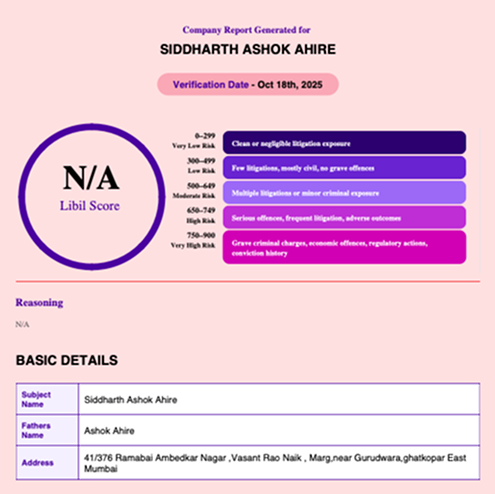
Instant Report
-
Best for: bulk onboarding, vendor screening, high throughput background checks.
-
Quick results in 1 to 2 minutes.
-
Basic case summaries and match indicators for immediate triage.
Detailed Reportt
-
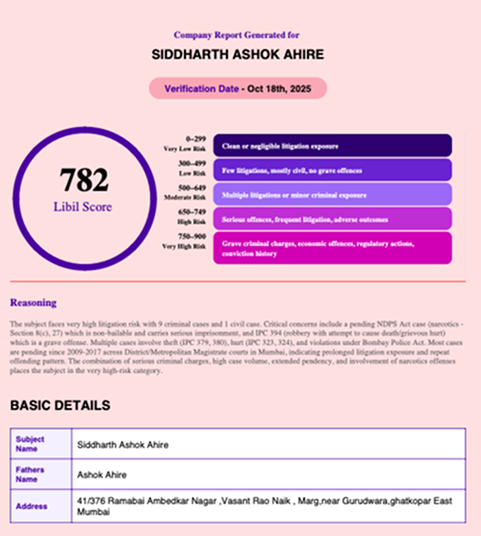
Best for: compliance-critical hires, vendor risk escalation, investigative due diligence.
-
Includes LIBIL Score, case match scoring, narrative reasoning and detailed case summaries.
-
Typical turnaround is approximately 2 hours.
Manual Verification
-
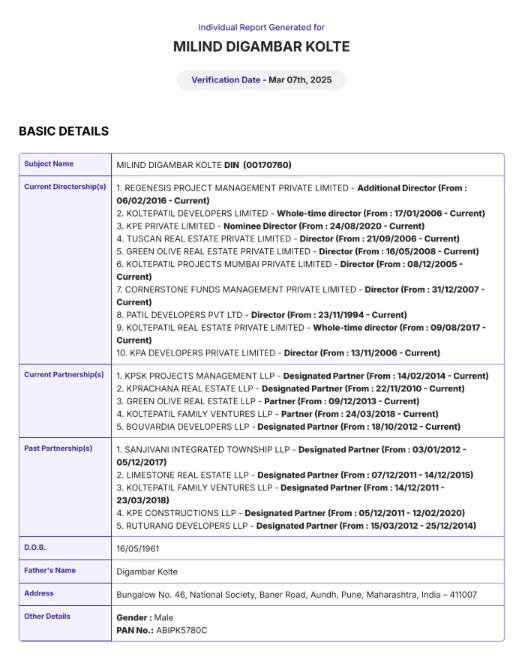
Bespoke analyst-prepared reports for regulatory filings, IPO disclosure or deep investigations. Contact sales for scope and timelines.
Use cases for client due diligence

Onboarding and KYC for banking, NBFCs and payment platforms. Use Instant Reports for lead screening and Detailed Reports for large ticket or sensitive clients.

AML and financial crime investigations. Run Detailed Reports to map litigation exposure, FIRs and related parties.

Vendor and third party risk. Screen suppliers and partners and schedule periodic rechecks to keep risk profiles current.
M&A and transactional diligence. Use manual or Detailed Reports to populate litigation schedules and disclosure memos.
Credit underwriting and lending. Integrate LIBIL Score and case match metrics into credit memos and decision engines.
Trusted by the top names in the industry
Press & Recognitions
-
Forbes india
Legitquest: On a quest to building a legal technology framework in India
Jun 10, 2022 Read More
-
financialexpress
LegitQuest: Now, millions of law case records at your fingertips
April 27, 2020 Read More
Ready to start client due diligence?
Qualified attorneys and legal experts employed by companies in India can request access to demonstrations and trials. Limited free trial spots are available. Provide your professional email address to receive priority access.
FAQs
Client due diligence is the process of verifying a client’s background, legal history, and potential risks before establishing a business relationship. It ensures regulatory compliance and protects businesses from fraud and litigation.
LIBIL scans massive legal databases to uncover a client's litigation history, legal disputes, and asset involvement. It automates background checks using AI and generates real-time, court-verified reports.
Yes. LIBIL is used by leading banks, NBFCs, law firms, and enterprise teams for risk assessments, onboarding, and legal verification.
Absolutely. LIBIL offers seamless API integration so your compliance team can access due diligence insights within your existing CRM or onboarding platforms.
Yes. All reports are generated from verified legal records sourced from over 10,000 courts across India, ensuring legal accuracy and compliance.
Most reports are generated instantly, allowing you to conduct comprehensive due diligence in under 5 minutes.
Yes. LIBIL is built for scale and can process bulk client data for large organizations and compliance teams.
Establishing trust with new clients is a critical step for any organization, especially in environments where compliance, reputation, and long term relationships are at stake. Decisions made during the onboarding phase often have lasting implications, which is why relying on accurate information and consistent screening processes is essential. This is where client background verification becomes a foundational element in evaluating new engagements. It enables organizations to move beyond surface level details and gain a clearer understanding of a client’s credibility, history, and potential risk factors before formalizing any relationship.
A structured approach to client background verification helps ensure that every evaluation follows a consistent framework. Instead of relying on fragmented checks or informal assessments, organizations can adopt a more systematic process that captures relevant data, verifies authenticity, and highlights any areas of concern. This consistency not only improves the quality of decision making but also supports compliance requirements by creating a documented and traceable process. Over time, such an approach helps build stronger internal controls and reduces the likelihood of oversight.
In regulated onboarding environments, the need for a more comprehensive evaluation becomes even more pronounced. Organizations are often required to demonstrate that they have taken adequate steps to assess and mitigate risk before entering into relationships. Combining client background verification with customer due diligence creates a more robust and structured evaluation framework. While background verification focuses on assessing credibility and historical data, due diligence adds another layer by examining financial exposure, regulatory compliance, and overall risk profile. Together, these processes provide a more complete view, allowing organizations to make well informed decisions with greater confidence.
For companies operating in high risk sectors or dealing with sensitive transactions, deeper levels of screening are often necessary. In such cases, incorporating criminal background verification into the evaluation process enhances overall risk visibility. This additional layer helps identify serious concerns that may not be captured through standard checks alone. By understanding both civil and criminal aspects of an individual or entity’s history, organizations can better assess the potential impact on their operations and reputation.
Another advantage of integrating criminal background verification into the broader screening framework is the ability to maintain consistency across different types of evaluations. Whether the organization is onboarding a client, engaging a partner, or reviewing an internal stakeholder, having a unified approach ensures that all relevant risks are considered. This reduces the chances of gaps in the process and supports a more holistic view of risk management.
Ultimately, trust is built on transparency and informed decision making. By embedding structured verification and due diligence processes into onboarding workflows, organizations can create a more secure and dependable environment. This not only protects them from potential risks but also strengthens relationships with clients who value accountability and professionalism.


