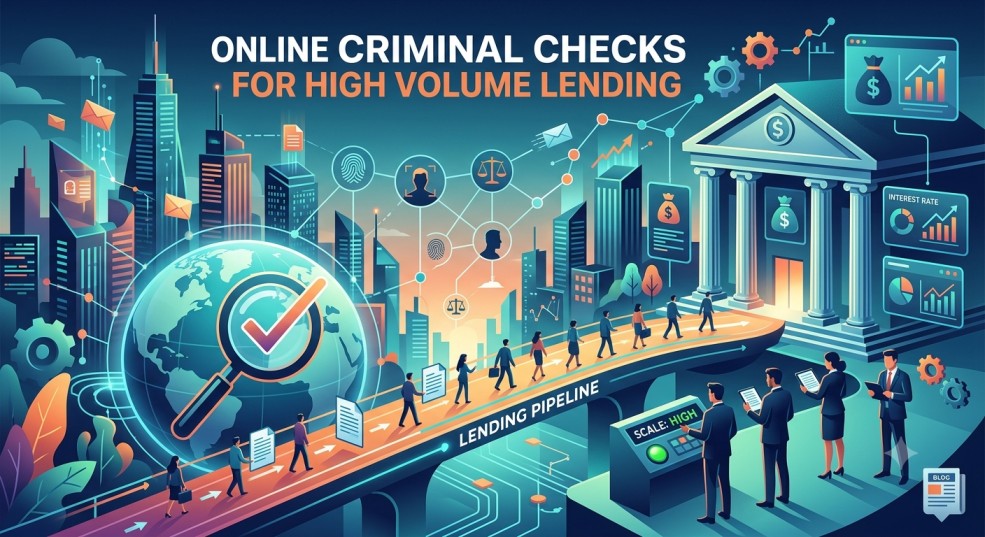
A bank processing 100 loan applications can investigate exceptions manually.
A bank processing 100,000 applications has a different problem.
At that scale, the question is not simply whether criminal and litigation checks are useful. It is whether those checks can fit into the lending process without turning every application into a legal investigation.
That distinction matters.
Legal history can provide additional context around a borrower, promoter or guarantor. But lending teams already work with credit history, KYC, financial information and other underwriting inputs. Criminal and litigation screening has to complement that process rather than create another manual bottleneck.
For high-volume lending, the smarter model is therefore not:
Investigate every borrower deeply.
Why Manual Criminal Checks Break at Lending Scale
Consider a lender processing 50,000 applications per month.
If manual court and legal record searches take only 10 minutes per application:
50,000 × 10 minutes = 8,333 hours of review.
At 20 minutes:
50,000 × 20 minutes = 16,667 hours.
These are illustrative calculations, not LegitQuest benchmarks. But they reveal the operating problem clearly.
The issue is not simply headcount.
India's litigation information is fragmented across court systems, tribunals, FIR records and other sources. Names can appear differently across records. Addresses vary. Unrelated people can share names. Cases may also be duplicated across systems.
Manual review therefore creates three costs at once:
time, inconsistency and difficulty prioritising what actually matters.
High-Volume Lending Needs a Funnel, Not a Bigger Review Team
A scalable model separates prescreening from investigation.
|
Lending Stage |
Objective |
Appropriate Screening Depth |
|
Lead/application intake |
Identify potential legal signals |
Instant screening |
|
Identity resolution |
Confirm likely borrower matches |
Match names, addresses and record variations |
|
Risk triage |
Separate routine from relevant findings |
Categorise and assess exposure |
|
Escalated credit review |
Understand potentially material cases |
Detailed Report |
|
Higher-ticket exposure |
Add deeper legal scrutiny where justified |
Lawyer Verified review |
|
Final underwriting |
Combine legal context with other credit inputs |
Human credit/risk decision |
Step 1: Screen Early, Before Expensive Review Begins
LegitQuest positions Instant Litigation Check Reports for lead-level prescreening in lending.
That placement in the funnel matters.
If relevant legal information can be surfaced earlier, the lender can determine which applications require additional attention before investing deeper underwriting resources.
LIBIL® searches supported Supreme Court, High Court, district court, tribunal, order and FIR records.
For lending teams, the objective at this stage is not to reach a legal conclusion.
It is to answer:
Is there a litigation, enforcement or defaulter-related signal here that deserves closer examination?
Step 2: Solve Identity Before Assessing the Borrower
High-volume screening creates a matching problem.
Suppose 50,000 borrowers are screened and hundreds share common names.
A search result against “Raj Kumar” is not useful merely because the applicant is also called Raj Kumar.
The lender first needs confidence that the legal record relates to the same person.
LIBIL® applies AI-based identity resolution across name variations, addresses and record formats to reduce false positives and false negatives.
This is particularly important at scale.
Even a small percentage of ambiguous matches can create hundreds or thousands of unnecessary manual reviews when the application volume becomes large.
The first risk question should therefore be:
“Is this our borrower?”
Only then should the credit team ask:
“What does the case mean?”
Step 3: Separate Case Discovery From Risk Triage
Finding a legal record does not tell the lender how relevant it is.
LIBIL® categorises matched proceedings as civil, criminal, regulatory or tax matters and identifies whether they are pending or disposed.
That allows the screening process to move beyond a binary “case/no case” output.
Consider three borrowers:
Borrower A: 5 identified cases
Borrower B: 2 identified cases
Borrower C: 1 identified case
A case-count model might prioritise Borrower A.
But suppose A's matters are largely disposed civil proceedings, while C's single record is a pending proceeding considered relevant to the credit review.
The order of attention may change.
That is why high-volume lending needs triage rather than case counting.
Step 4: Escalate Exceptions Instead of Deep-Diving Every Application
This is where the economics of the model become stronger.
Suppose a lender processes 50,000 applications.
Instead of manually investigating all 50,000, first-pass screening can identify the subset requiring deeper review.
The exact escalation rate will vary by portfolio and screening policy, but the principle remains the same:
large population → structured screening → smaller exception population → deeper investigation.
LegitQuest recommends Detailed Litigation Check Reports for large-ticket or borderline credits.
These reports add the LIBIL® Score with reasoning and narrative case summaries, with a typical turnaround of 2 to 4 hours.
For very high-exposure situations such as higher-ticket business loans, Lawyer Verified Reports provide deeper lawyer-prepared review.
This creates proportionality between the cost of diligence and the exposure being considered.
Step 5: Keep Legal History in Its Proper Place
An online criminal check should not become another automatic loan-decline rule.
Litigation does not prove that a borrower will default.
A pending criminal proceeding does not establish guilt.
A litigation score is not a credit score.
The role of criminal and litigation intelligence is narrower and more useful: provide additional legal context that conventional credit information may not capture.
LegitQuest describes the lending objective as detecting litigation, enforcement and defaulter signals tied to borrowers, promoters or guarantors.
Those signals can inform review.
They should not replace underwriting.
The Borrower May Not Be the Only Subject Worth Screening
High-volume retail lending may primarily focus on the borrower.
Business lending can be more layered.
For certain exposures, relevant legal risk may sit with a promoter or guarantor rather than only with the borrowing entity.
This changes how the screening workflow should be designed.
The question becomes:
Which people and entities actually matter to this credit exposure?
That is more useful than applying the same search configuration mechanically to every lending product.
APIs Are What Turn Criminal Checks Into Lending Infrastructure
High-volume screening cannot depend on teams manually downloading reports and copying findings between systems.
LegitQuest makes Instant and Detailed report data available through APIs for integration into KYC, core banking and compliance systems. LIBIL® outputs can also feed risk management tools and credit decision engines.
That changes the role of litigation screening.
It stops being a separate legal task performed after the fact and becomes another input inside the lending workflow.
For high-volume lenders, that integration is what makes scale operationally realistic.
Frequently Asked Questions
How can banks run criminal checks on borrowers at scale?
Banks can use first-pass Instant Reports to screen large application volumes and escalate relevant findings to Detailed Reports for deeper review.
What should banks look for in an online criminal check?
Banks can review identity match quality, criminal and other litigation, pending or disposed status, relevant enforcement or defaulter signals and underlying source records.
Does a criminal case mean a loan should be rejected?
No. A criminal proceeding does not automatically determine creditworthiness or establish guilt. It is an additional legal signal that should be reviewed alongside conventional underwriting information.
Why is identity resolution important in high-volume lending?
Common names, name variations and inconsistent addresses can create false matches or missed records. Identity resolution helps determine whether the surfaced record actually relates to the borrower.
When should a bank use a Detailed Litigation Check Report?
LegitQuest recommends Detailed Reports for large-ticket or borderline credits where first-pass findings require additional context.
Can LIBIL® integrate with a bank's existing lending systems?
Yes. Instant and Detailed report data can be delivered through APIs for KYC, core banking and compliance systems, while LIBIL® outputs can feed risk management tools and credit decision engines.


