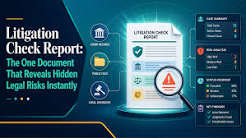
Legal risks don’t usually announce themselves.
They sit quietly in ongoing cases, past disputes, or scattered court records, often unnoticed until they become a problem. And by then, the cost isn’t just operational… it’s financial, reputational, and sometimes irreversible.
This is exactly why a litigation check report has become such a critical tool.
In environments where decisions need to be fast, but still accurate, organizations can’t afford to piece together legal histories manually. They need a clear, consolidated view of risk.
A single document that brings everything into focus.
So, what makes a litigation check report so powerful, and why are legal and compliance teams relying on it more than ever?
What Is a Litigation Check Report, and Why It Matters
A litigation check report is a structured summary of an individual’s or entity’s legal history, focused specifically on litigation and case-related information.
But it’s more than just a list of cases.
It provides a consolidated view of legal exposure, helping organizations understand:
- Whether a person or entity is involved in ongoing litigation
- The nature and type of disputes
- Historical legal patterns or recurring issues
- Potential risks that may impact decision-making
This kind of visibility is essential in high-stakes scenarios, hiring, partnerships, investments, or regulatory evaluations.
Because when legal risks are fragmented across multiple sources, they’re easy to miss.
A litigation check report brings them together… instantly.
Why Legal Risks Often Go Undetected
If legal data exists, why is it so hard to identify risks?
The challenge lies in how that data is accessed.
Traditionally, legal teams have had to:
- Search across multiple court databases
- Track cases manually across jurisdictions
- Rely on incomplete disclosures
- Interpret unstructured information
This creates gaps.
Some cases are missed. Others are misinterpreted. And often, there’s no easy way to connect the dots between different records.
In fast-moving environments, this becomes a serious limitation.
Because decisions are made with partial visibility, and hidden risks remain hidden.
How a Litigation Check Report Changes the Process
A litigation check report simplifies what used to be a complex and time-consuming task.
Instead of scattered searches, it provides:
- A centralized summary of litigation data
- Structured information that’s easier to analyze
- A more consistent format for reviewing legal exposure
- Faster access to relevant insights
This doesn’t just save time, it improves clarity.
Legal and compliance teams can quickly assess whether a case is material, recurring, or potentially high-risk. And because the information is organized, it becomes easier to communicate findings across teams.
In other words, it turns raw legal data into something usable.
Where Litigation Check Reports Deliver the Most Value
The real strength of a litigation check report becomes evident when applied in real-world scenarios.
Hiring and Background Verification
Before onboarding senior employees or key personnel, organizations need to assess legal exposure. A litigation check report provides quick insights into past or ongoing disputes that could indicate risk.
Mergers and Acquisitions
During M&A, understanding the legal standing of target companies and their stakeholders is critical. A report helps uncover litigation risks that may affect valuation or deal structure.
IPO and Pre-IPO Due Diligence
Regulators and investors expect transparency. Litigation check reports support accurate disclosures by identifying cases that must be evaluated and reported.
Vendor and Partner Due Diligence
Engaging with third parties without understanding their legal background can be risky. A report helps organizations make more informed partnership decisions.
Financial Crime and Risk Investigations
For financial institutions, early detection of legal red flags is essential. Litigation reports provide a starting point for deeper investigation.
Across all these use cases, the goal is the same, reduce uncertainty and improve decision quality.
Key Advantages of Using a Litigation Check Report
The value of a litigation check report goes beyond convenience. It directly impacts how organizations manage risk.
Speed Without Compromising Insight
Instead of spending days gathering information, teams can access a structured overview in minutes.
Better Risk Visibility
A consolidated report reduces blind spots and ensures that key legal issues aren’t overlooked.
Consistency in Evaluation
Standardized formats make it easier to compare findings across individuals or entities.
Reduced Manual Effort
Less time spent on data collection means more time for analysis and decision-making.
Improved Communication Across Teams
Clear, structured reports make it easier to share insights with stakeholders, management, and regulators.
Making the Most of a Litigation Check Report
While litigation check reports are powerful, their effectiveness depends on how they’re used.
Here are a few practical best practices:
- Don’t rely solely on the report, interpret it
Context matters. Understand the nature and relevance of each case. - Integrate reports into broader due diligence workflows
Combine litigation insights with financial and compliance assessments. - Prioritize material risks
Focus on cases that could impact operations, reputation, or regulatory standing. - Use reports early in the decision-making process
Early insights allow more time to respond to potential risks. - Maintain consistency in how reports are reviewed
Standard processes improve reliability and reduce bias.
These practices ensure that the report becomes a strategic tool, not just a reference document.
The Role of Legal Intelligence in Generating Reliable Reports
Behind every effective litigation check report is access to structured legal data.
This is where platforms like LegitQuest’s LIBIL support the process in a meaningful way.
By enabling access to organized legal and case-related information, LIBIL helps teams:
- Explore litigation histories across individuals and entities
- Access structured legal data for more efficient analysis
- Reduce reliance on fragmented or manual searches
- Align litigation checks with broader due diligence and risk workflows
In this context, a litigation check report isn’t just a document, it’s the output of a more reliable and structured approach to legal intelligence.
And that makes all the difference.
Why Instant Visibility Matters More Than Ever
Today’s business environment doesn’t leave much room for delay.
Decisions, whether hiring, investing, or partnering, often need to be made quickly. But speed without clarity creates risk.
A litigation check report bridges that gap.
It provides instant visibility into legal exposure, allowing organizations to act faster without compromising on diligence.
And in high-stakes scenarios, that balance between speed and accuracy isn’t just helpful, it’s essential.
Better Decisions Start with Clear Legal Insight
At its core, a litigation check report is about clarity.
It takes complex, scattered legal data and turns it into something actionable. Something that supports decisions rather than complicates them.
For legal, compliance, and risk professionals, this clarity is invaluable.
Because hidden legal risks don’t stay hidden forever, they surface when it matters most.
With structured insights and tools like LIBIL supporting the process, organizations can identify those risks early, respond effectively, and move forward with confidence.
And sometimes, all it takes is one well-prepared document to make that possible.


