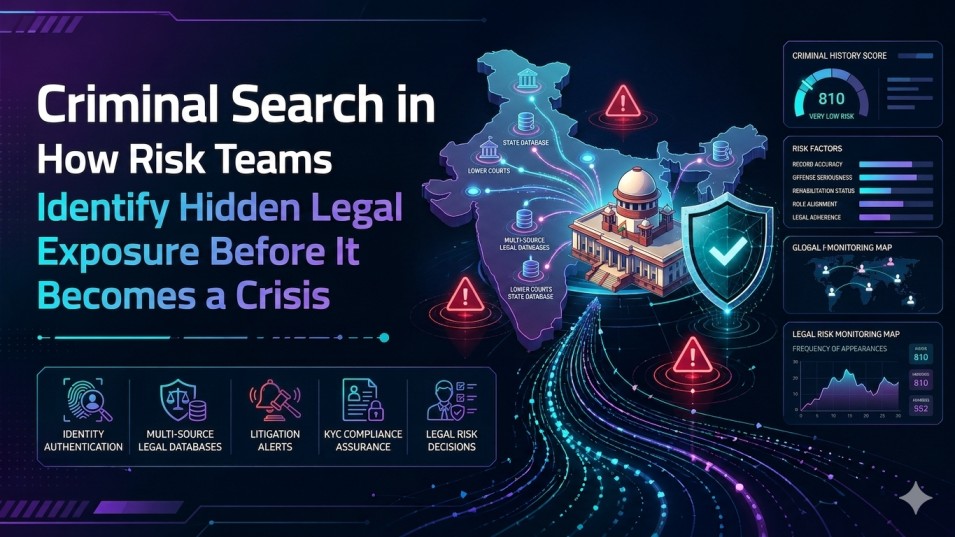
In many organizations, risk doesn’t arrive with a warning label. It often appears quietly , through a vendor onboarding process, a senior executive hire, a lending relationship, or a business partnership that initially seemed routine.
Then, weeks or months later, hidden legal issues begin to surface.
A pending criminal matter linked to a director. An undisclosed litigation history tied to a business associate. A compliance review uncovering enforcement-related records that were never identified during onboarding.
For legal and compliance teams, these situations create more than operational disruption. They can trigger reputational concerns, regulatory scrutiny, internal investigations, and difficult questions around due diligence processes.
That’s one reason criminal search workflows are becoming increasingly important across Indian enterprises. Organizations are no longer relying solely on basic verification checks or fragmented public searches. Instead, they’re adopting more structured approaches to identifying potential legal exposure before decisions are finalized.
The shift is not about suspicion. It’s about informed decision-making in environments where legal risk can directly impact business continuity, governance, and trust.
Why Criminal Search Has Become a Strategic Risk Function
Traditionally, criminal checks were associated mainly with recruitment processes. Companies used them to screen candidates for sensitive roles or verify declarations made during hiring.
But the scope has expanded significantly.
Today, criminal search workflows are relevant across multiple business functions, including:
- Corporate investigations
- Vendor onboarding
- Financial risk assessment
- Lending and underwriting
- Executive due diligence
- Third-party compliance reviews
- High-value contractual engagements
The reason is simple: legal exposure is no longer viewed as an isolated legal department issue. It is increasingly tied to enterprise-wide risk management.
In sectors such as banking, financial services, consulting, infrastructure, and technology, organizations often deal with multiple external stakeholders whose legal history may influence regulatory, operational, or reputational outcomes.
At the same time, India’s legal ecosystem is highly fragmented. Court records, litigation data, and case information are distributed across multiple jurisdictions and systems. Identifying relevant records manually can become both time-consuming and inconsistent.
This creates a practical challenge for risk teams:
How do you identify potentially relevant legal exposure efficiently while maintaining accuracy and procedural consistency?
That’s where structured criminal search processes become operationally important.
The Problem with Traditional Criminal Search Approaches
Many organizations still depend on fragmented or manual approaches to legal verification.
These may include:
- Basic internet searches
- Limited database checks
- Manual court website reviews
- Third-party declarations
- Region-specific investigations
While these methods may work for low-risk situations, they often create visibility gaps when organizations require deeper legal insight.
One major issue is inconsistency.
Court data in India is spread across different judicial systems, jurisdictions, and formats. Searching across multiple courts manually can require significant effort, especially when dealing with common names or incomplete identifying information.
Then there’s the challenge of contextual interpretation.
Finding a case reference alone doesn’t always provide meaningful insight. Risk teams must often determine:
- Whether the record actually relates to the individual or entity being reviewed
- The nature of the matter
- The seriousness of the allegations
- Whether the issue remains active or unresolved
- Whether it creates material business risk
Without structured workflows, organizations may either overlook important information or spend excessive time reviewing irrelevant records.
Another challenge involves scale.
Large enterprises, staffing firms, financial institutions, and compliance-heavy organizations may process hundreds or thousands of onboarding decisions each month. Manual legal searches are difficult to standardize at that volume.
As a result, many teams are now moving toward technology-enabled legal intelligence workflows that improve visibility while reducing operational friction.
Criminal Search Is No Longer Just About Detection
One of the biggest misconceptions around criminal search is that it exists purely to “find criminal records.”
In reality, mature organizations use criminal search processes to support broader risk assessment objectives.
For example, during executive hiring, the concern may not simply be whether a case exists. The larger question is whether unresolved legal exposure could affect leadership credibility, investor confidence, or regulatory relationships.
Similarly, in financial services, a criminal history record search may form part of a larger due diligence framework involving litigation reviews, compliance checks, and reputational assessment.
This broader context matters because legal risk rarely operates in isolation.
A criminal matter linked to fraud allegations, financial misconduct, or regulatory violations may influence:
- Lending decisions
- Vendor relationships
- Partnership approvals
- Internal governance reviews
- Audit scrutiny
That’s why organizations increasingly treat criminal search as part of an integrated legal intelligence process rather than a standalone verification exercise.
The Growing Role of Structured Legal Intelligence
Modern risk teams are under pressure to make faster decisions without compromising diligence standards.
This has increased the demand for structured legal intelligence tools that help teams review litigation and criminal exposure more efficiently.
Instead of relying entirely on scattered manual searches, organizations are increasingly using platforms that consolidate legal information into searchable workflows.
The value here is not just speed. It’s consistency and visibility.
Structured criminal search workflows can help teams:
- Review records across multiple jurisdictions
- Identify potential litigation linkages
- Reduce duplication in manual review processes
- Improve documentation and audit readiness
- Escalate high-risk findings more systematically
This becomes particularly useful in large organizations where multiple departments , legal, HR, compliance, procurement, and investigations , may need access to the same legal intelligence during decision-making.
For example, consider a scenario involving third-party onboarding for a financial institution.
A vendor may appear commercially viable on paper, but deeper legal review reveals ongoing criminal litigation connected to financial misconduct allegations. Identifying this exposure early allows the organization to escalate the review process before contractual commitments are finalized.
That’s the operational value of structured criminal search workflows: improving visibility before risk becomes harder to contain.
Why Context Matters in Criminal History Record Search
Another important evolution in this space is the growing emphasis on context-based review.
Legal records without proper analysis can sometimes create confusion rather than clarity.
A name match alone does not automatically indicate meaningful risk. Many individuals may share similar identifiers, especially across large datasets and multiple jurisdictions.
This is why modern criminal search processes increasingly focus on:
- Match validation
- Record relevance
- Linked identifiers
- Jurisdiction analysis
- Structured case summaries
The objective is not simply to retrieve data but to support more informed interpretation.
This distinction is particularly important for enterprise risk teams, where inaccurate conclusions can create legal, operational, or reputational complications of their own.
How Organizations Are Building More Reliable Criminal Search Workflows
Organizations improving their legal due diligence frameworks often focus on a few practical priorities.
Standardizing Review Processes
Instead of relying on ad hoc checks, mature teams establish repeatable workflows for:
- Hiring reviews
- Vendor screening
- Third-party onboarding
- Executive assessments
Consistency reduces decision gaps and strengthens audit defensibility.
Combining Legal Intelligence with Risk Assessment
Criminal search becomes more effective when connected with broader litigation intelligence and due diligence reviews.
Rather than treating criminal checks as isolated tasks, organizations increasingly integrate them into larger risk evaluation frameworks.
Prioritizing Documentation
Risk and compliance decisions often need to withstand future scrutiny from regulators, auditors, or internal governance teams.
Structured reporting and documented review processes help organizations maintain transparency and accountability.
Using Technology to Improve Efficiency
As case volumes and onboarding demands increase, legal and compliance teams are exploring platforms that streamline criminal history record search workflows without compromising review quality.
This is where legal intelligence platforms such as LegitQuest are becoming relevant for enterprise teams managing large-scale legal research and due diligence operations.
LegitQuest provides structured access to litigation and legal intelligence workflows that support legal, compliance, and risk professionals during investigations and review processes. Its criminal record check workflows are designed to help organizations review legal exposure through searchable and organized legal data environments, particularly when managing high-volume or risk-sensitive assessments.
Importantly, the value is not merely in accessing records. It lies in improving visibility, consistency, and decision support across legal and compliance operations.
Criminal Search Will Continue to Evolve Alongside Enterprise Risk
As organizations face increasing regulatory expectations and more complex stakeholder ecosystems, legal visibility is becoming a critical operational requirement rather than an optional safeguard.
That shift is changing how enterprises think about criminal search.
The conversation is no longer limited to background verification. It now includes:
- legal intelligence,
- litigation visibility,
- structured due diligence,
- and proactive risk identification.
For legal and compliance professionals, the challenge moving forward will be balancing speed, scale, and accuracy while maintaining defensible review processes.
Organizations that approach criminal search strategically , with structured workflows, contextual analysis, and stronger legal visibility , are likely to make more informed decisions long before legal exposure develops into a larger business issue.
In an environment where hidden risk can emerge unexpectedly, better legal intelligence is becoming less about reaction and more about preparedness.


