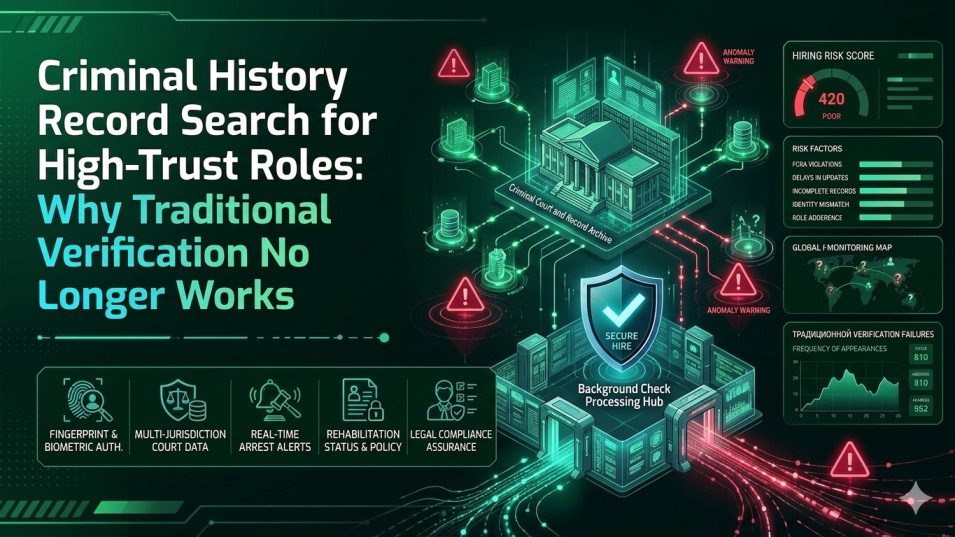
Hiring for high-trust roles has become significantly more complex than it was even a few years ago. Organizations today operate in an environment shaped by stricter compliance expectations, growing reputational risks, faster digital onboarding, and increasing scrutiny around corporate governance. In this landscape, relying solely on traditional background verification methods is starting to create operational blind spots many businesses can no longer afford.
For legal teams, compliance officers, HR leaders, and financial institutions, the challenge is no longer just verifying identity or employment history. The bigger concern is understanding whether an individual may be connected to unresolved litigation, criminal proceedings, or legal disputes that could expose the organization to future risk.
This is where criminal history record search has become increasingly important. Instead of treating verification as a routine administrative step, organizations are beginning to view it as part of a broader legal and risk intelligence process.
Why High-Trust Roles Demand Deeper Verification
Not every role carries the same level of organizational risk. Positions involving financial authority, access to confidential information, regulatory responsibilities, procurement control, or leadership decision-making require a much deeper level of scrutiny.
Consider roles such as:
- Senior finance executives
- Compliance officers
- Legal consultants
- Banking relationship managers
- Procurement heads
- Directors and promoters
- Third-party vendors handling sensitive operations
In these cases, a single missed legal red flag can create consequences that extend well beyond internal HR concerns. The impact may involve regulatory investigations, reputational damage, financial exposure, or governance failures.
Traditional verification models were designed for a different business environment — one where hiring cycles were slower, digital records were limited, and legal intelligence was not easily accessible. Today, organizations need greater visibility into litigation exposure and criminal records linked to individuals before onboarding decisions are finalized.
That shift is exactly why criminal history record search is becoming part of modern enterprise due diligence practices.
Understanding Criminal History Record Search in a Modern Context
A criminal history record search is not simply about checking whether someone has been convicted of a crime. In practice, organizations are often trying to understand a broader legal context surrounding an individual.
This may include:
- Criminal court records
- Pending litigation
- FIR-linked information
- Court proceedings
- Legal disputes connected to the individual
- Enforcement-related matters visible through public legal records
The objective is not to make assumptions based on incomplete information. Rather, it is to improve risk visibility before critical decisions are made.
For legal and compliance teams, this becomes particularly important in sectors where governance expectations are high. Financial institutions, regulated enterprises, and large corporations are increasingly expected to demonstrate stronger due diligence standards during onboarding and vendor evaluation processes.
A structured criminal history record search helps organizations move beyond surface-level verification and toward more informed decision-making.
The Problem with Traditional Verification Approaches
Many organizations still rely on fragmented verification methods that were built around manual processes. While these approaches may satisfy basic documentation requirements, they often struggle to provide comprehensive legal visibility.
One of the biggest limitations is the dependence on isolated data checks. Traditional verification workflows may focus heavily on:
- Identity validation
- Address checks
- Employment verification
- Educational qualification confirmation
While these are still necessary, they do not always reveal ongoing litigation risks or criminal proceedings connected to an individual.
Another challenge is the fragmented nature of legal data in India. Court records are spread across multiple jurisdictions and platforms, making manual review difficult and time-consuming. Without structured legal intelligence systems, important records can easily be missed.
Operational delays are also common. Legal and compliance teams frequently face pressure to complete onboarding quickly while maintaining adequate risk controls. Manual legal verification processes can slow decision-making, especially when multiple jurisdictions must be reviewed.
There is also the issue of inconsistency. Different teams may follow different verification standards, resulting in uneven risk assessment practices across the organization.
In high-trust environments, these gaps create avoidable exposure.
Why Legal Intelligence Is Becoming Central to Due Diligence
Organizations today are increasingly shifting toward legal intelligence-driven workflows rather than relying purely on document-based verification.
The reason is simple: modern risk assessment requires context.
A criminal history record search becomes more useful when supported by structured legal data, searchable court records, and organized litigation insights. Instead of reviewing disconnected information manually, teams can assess records in a more systematic and informed way.
This is particularly valuable during:
- Executive hiring
- Director onboarding
- Vendor due diligence
- Financial risk assessments
- Sensitive internal investigations
- Compliance reviews
For example, a compliance team evaluating a senior leadership candidate may need to understand whether the individual has been linked to ongoing legal disputes in multiple jurisdictions. A fragmented verification process may fail to identify these records efficiently, especially when name variations or incomplete data create search complications.
Structured legal intelligence workflows help reduce this visibility gap.
They also improve consistency across decision-making processes by enabling teams to follow standardized legal review procedures.
The Growing Importance of Speed and Accuracy
Another major challenge organizations face is balancing speed with accuracy.
Hiring timelines have become shorter. Vendor onboarding expectations are faster. Financial institutions process large volumes of applications daily. Yet the legal and reputational risks associated with incomplete verification continue to rise.
This creates tension between operational efficiency and risk management.
A delayed verification process can slow business operations. But a rushed process with inadequate legal checks can expose the organization to much larger long-term consequences.
That is why many enterprises are looking for more structured approaches to criminal search and litigation intelligence workflows. Faster access to organized legal records helps teams make timely decisions without entirely sacrificing diligence.
At the same time, accuracy remains critical.
Indian legal records often involve:
- Similar names
- Spelling variations
- Multiple jurisdictions
- Inconsistent record formatting
Without proper record organization and contextual analysis, false matches can create confusion or unnecessary escalation. Modern legal intelligence workflows are therefore increasingly focused on improving both search precision and contextual understanding.
How Structured Criminal Search Workflows Improve Decision-Making
A well-structured criminal search process does more than identify records. It supports better organizational judgment.
When legal and compliance teams can review court-linked information within a structured framework, they are better positioned to:
- Escalate legitimate risks appropriately
- Avoid unnecessary delays
- Improve governance standards
- Strengthen audit readiness
- Maintain consistency across investigations
This becomes especially important in regulated industries where onboarding decisions may later be reviewed by auditors, regulators, or internal governance teams.
A more organized criminal history record search process also improves documentation practices. Instead of relying on scattered manual checks, organizations can maintain clearer records of how legal risk assessments were conducted.
That transparency matters not only for compliance purposes but also for internal accountability.
Where LegitQuest Fits into This Evolving Landscape
As organizations move toward more intelligence-driven legal workflows, platforms like LegitQuest are helping legal and risk teams work with structured litigation and criminal record insights more efficiently.
Rather than approaching verification as a standalone HR task, the platform supports broader legal intelligence and due diligence workflows through searchable legal records and litigation-focused research capabilities.
Its criminal record check framework is designed to help organizations review court-linked information through a more organized process. This can support teams handling:
- Compliance-sensitive onboarding
- Litigation risk reviews
- Corporate investigations
- Vendor due diligence
- High-trust hiring decisions
Importantly, the value lies not only in access to legal records but also in improving visibility and workflow consistency for enterprise teams dealing with complex legal verification requirements.
For organizations managing large-scale onboarding or risk assessment processes, structured legal intelligence can reduce operational friction while supporting more informed decision-making.
Practical Considerations for Organizations
As criminal history record search becomes more integrated into enterprise risk management, organizations should think carefully about how verification processes are structured internally.
A few practical considerations include:
Define Risk-Based Verification Standards
Not all roles require the same level of legal review. High-trust positions should follow deeper due diligence workflows aligned with organizational risk exposure.
Improve Coordination Between HR, Legal, and Compliance Teams
Verification should not operate in isolation. Legal and compliance teams often need visibility into high-risk onboarding decisions.
Prioritize Documentation and Audit Trails
Organizations should maintain clear records of verification steps, especially for sensitive roles and regulated industries.
Focus on Context, Not Just Raw Data
Legal records require careful interpretation. Structured analysis is often more valuable than isolated search results.
Invest in Scalable Legal Intelligence Workflows
As organizations grow, manual verification processes become harder to manage consistently. Structured legal intelligence systems can help improve operational efficiency over time.
Why Criminal History Record Search Will Continue to Evolve
The expectations surrounding corporate due diligence are changing rapidly. Organizations are under growing pressure to demonstrate stronger governance, better compliance controls, and more informed risk management practices.
In a way, criminal history record search is no longer just a verification exercise. It is becoming part of a broader legal intelligence strategy that supports responsible decision-making across hiring, onboarding, investigations, and compliance operations.
Traditional verification methods still have a role to play, but they are no longer sufficient on their own for high-trust roles where legal exposure can directly affect organizational stability.
The future of due diligence will likely depend on how effectively organizations combine legal intelligence, structured workflows, and practical risk visibility into their decision-making processes.
For legal, compliance, and risk teams, the focus is shifting from simply collecting information to understanding it in context and acting on it responsibly.


