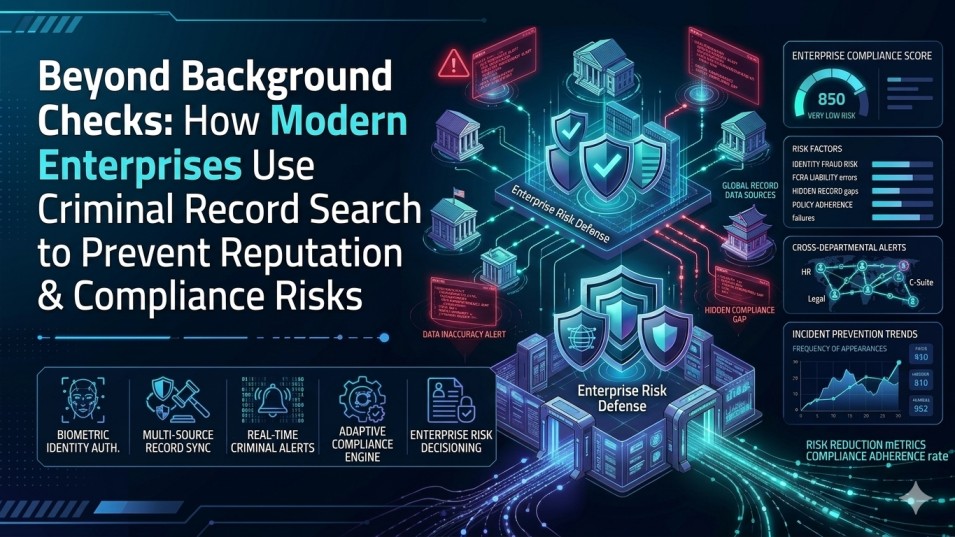
A single overlooked legal issue can create consequences far beyond one hiring decision.
For enterprises operating in highly regulated sectors, the impact of hidden criminal litigation, unresolved legal exposure, or inaccurate due diligence can quickly escalate into compliance concerns, reputational damage, internal investigations, or financial risk. And in many cases, organizations realize the gap only after the issue becomes public.
That’s why criminal record search is no longer viewed as just another HR verification exercise.
Today, legal teams, compliance departments, financial institutions, and corporate investigation units increasingly rely on structured legal intelligence to identify risk early — before onboarding employees, approving vendors, entering partnerships, or making strategic business decisions.
The shift is subtle but important. Organizations are moving beyond traditional background checks and toward deeper legal visibility supported by litigation intelligence, court-linked records, and more structured due diligence workflows.
Why Criminal Record Search Has Become a Strategic Risk Function
For years, criminal verification was often treated as a limited hiring formality. A candidate would undergo a basic background screening process, usually focused on identity verification, employment history, education checks, and local police verification.
But modern enterprise risk environments are far more complex.
Today’s organizations face pressure from multiple directions:
- Increasing regulatory scrutiny
- Higher expectations around governance and accountability
- Faster onboarding cycles
- Third-party and vendor-related risks
- Greater reputational sensitivity in digital environments
As a result, enterprises are now expected to conduct more informed and defensible due diligence processes.
This is where criminal record search becomes operationally important — not just for hiring, but for broader legal and compliance decision-making.
A structured criminal history review can help organizations identify:
- Ongoing criminal litigation
- Court-linked legal exposure
- Potential fraud or financial misconduct indicators
- Risks associated with key personnel or external parties
- Patterns that may warrant deeper investigation
For legal and compliance teams, the objective isn’t simply to “find a criminal record.” It’s to gain clearer visibility into legal risk before making business-critical decisions.
The Problem with Traditional Background Verification Approaches
Traditional verification methods still play an important role. However, many organizations have discovered that conventional workflows often struggle to keep pace with the scale and complexity of modern risk management requirements.
One major challenge is fragmented legal data.
Court records, litigation details, and legal proceedings in India are distributed across multiple jurisdictions and systems. Accessing relevant information manually can be time-consuming, inconsistent, and difficult to standardize across enterprise workflows.
Another issue is operational delay.
When organizations depend entirely on manual searches or disconnected verification methods, turnaround times increase significantly — particularly during large-scale hiring drives, vendor onboarding exercises, or compliance investigations.
There’s also the challenge of visibility.
A basic verification process may confirm identity details or employment records while missing broader litigation exposure that could later become operationally relevant. In regulated sectors such as banking, financial services, insurance, and large corporate environments, that visibility gap can create substantial downstream risk.
False matches and inconsistent record interpretation can create additional complications.
Common names, spelling variations, incomplete identifiers, and fragmented case information often make it difficult to distinguish between unrelated individuals. Without structured legal intelligence workflows, organizations may either overlook relevant information or spend excessive time validating records manually.
These limitations explain why many enterprises are reassessing how criminal record search fits into larger compliance and legal risk strategies.
How Modern Enterprises Are Approaching Criminal Record Search Differently
The most mature organizations no longer treat criminal checks as isolated verification tasks.
Instead, they integrate criminal record search into broader legal intelligence and risk assessment frameworks.
This approach focuses on three key priorities:
- Better legal visibility
- Faster decision-making
- More structured risk evaluation
Rather than relying solely on fragmented searches, enterprises increasingly prefer centralized workflows that can help teams review litigation-related information more systematically.
For example, during senior-level hiring, organizations may conduct a deeper legal review to identify whether individuals are linked to ongoing criminal proceedings, enforcement-related matters, or court-recorded disputes that could create reputational concerns later.
Similarly, during third-party onboarding, compliance teams often evaluate vendors and business partners not only from a financial perspective but also through a legal risk lens.
The objective is not to replace legal judgment with automation. Instead, it’s to give legal and compliance teams more structured information so they can make informed decisions efficiently.
This is particularly important in sectors where onboarding speed and risk governance must operate simultaneously.
Criminal Record Search Beyond Hiring
One of the biggest shifts in recent years is that criminal history record search is now being used well beyond employee onboarding.
Organizations increasingly apply legal intelligence workflows across multiple operational areas.
Vendor and Third-Party Due Diligence
Third-party ecosystems have become a major source of enterprise risk.
A vendor, contractor, distributor, or service provider facing serious legal exposure can indirectly create compliance complications for the organizations they work with.
As a result, many enterprises now include criminal search and litigation review as part of broader vendor due diligence processes.
Financial and Lending Risk Assessment
Financial institutions often need clearer legal visibility before approving partnerships, onboarding high-value clients, or conducting sensitive investigations.
Court-linked criminal intelligence can help teams assess whether additional scrutiny may be required before proceeding with financial decisions.
Internal Investigations and Escalation Reviews
Legal and compliance teams may also use criminal record search during internal reviews involving fraud concerns, misconduct investigations, or whistleblower-related escalations.
Structured legal intelligence allows investigators to examine publicly available litigation-related information more efficiently and consistently.
Why Structured Legal Intelligence Matters
The challenge isn’t simply accessing legal records.
The bigger challenge is organizing and interpreting them in a way that supports enterprise decision-making.
This is where structured legal intelligence platforms are becoming increasingly relevant.
Instead of forcing teams to manually navigate disconnected records and fragmented workflows, legal intelligence systems can help centralize litigation-related information, streamline review processes, and improve operational efficiency.
In practical terms, this means:
- Faster access to relevant legal information
- More consistent review workflows
- Improved visibility for legal and compliance teams
- Better documentation for audit and governance purposes
Importantly, structured workflows also help organizations maintain consistency across high-volume operations where manual verification alone may become difficult to scale.
The Growing Role of Legal Intelligence Platforms
As organizations mature their compliance and risk functions, many are adopting technology platforms that combine legal research, litigation intelligence, and due diligence workflows into a more centralized process.
Platforms like LegitQuest are increasingly being used in this context to help teams conduct criminal record search and litigation-related assessments through structured legal intelligence workflows.
Rather than functioning as a generic background verification tool, the platform focuses on providing access to court-linked legal information, litigation intelligence, and searchable legal records that support enterprise due diligence processes.
For legal, compliance, and investigation teams, this type of structured visibility can improve how risk assessments are conducted across hiring, vendor onboarding, and sensitive business reviews.
The value is not simply speed. It’s the ability to make decisions with greater legal context and operational clarity.
Practical Considerations for Organizations Conducting Criminal Record Search
Enterprises reviewing their due diligence frameworks should consider a few practical questions:
Are criminal checks integrated into broader compliance workflows?
Is the process isolated within HR, or connected to legal and risk teams where necessary?
Is the organization relying too heavily on fragmented manual searches?
As operational scale increases, inconsistent workflows can create visibility gaps.
Are legal records being interpreted with sufficient context?
Raw records alone may not provide meaningful insight without structured review processes.
Can the organization maintain audit readiness?
Documented and repeatable workflows are increasingly important in regulated environments.
Is risk assessment proactive or reactive?
Organizations that identify legal exposure early are often better positioned to manage reputational and operational risks effectively.
Criminal Record Search Is Becoming Part of Enterprise Governance
The conversation around criminal record search has evolved significantly.
What was once treated as a narrow hiring activity is now becoming part of broader enterprise governance, legal visibility, and compliance management.
Organizations today operate in environments where reputational exposure can escalate quickly and regulatory expectations continue to increase. In that context, informed decision-making depends heavily on access to structured, reliable legal intelligence.
For legal teams, compliance professionals, and enterprise risk leaders, the goal is not to conduct more checks for the sake of process. The real objective is to improve visibility, reduce avoidable risk, and strengthen the quality of business decisions.
As enterprises continue modernizing their due diligence frameworks, criminal record search will likely play an even more important role in helping organizations navigate legal and compliance complexity with greater confidence and consistency.


