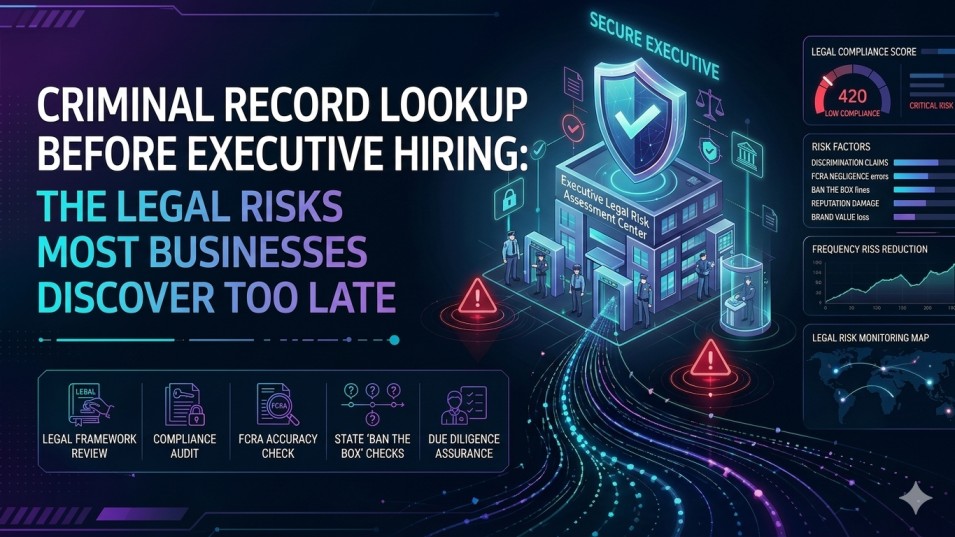
Hiring senior leadership has become far more complex than evaluating experience, leadership style, or industry reputation. Today, executive hiring decisions are deeply connected to governance, compliance accountability, and long-term business risk.
For many organizations, the real concern is not simply whether a candidate is qualified. It is whether there are legal risks connected to that individual that could surface later and create reputational, operational, or regulatory complications.
That concern is exactly why criminal record lookup is increasingly becoming part of executive due diligence workflows across enterprises, financial institutions, and compliance-driven industries.
In many cases, organizations only realize the importance of legal visibility after a problem emerges. A litigation matter linked to a senior executive may remain unnoticed during hiring, only to appear later during investor due diligence, regulatory reviews, or internal investigations. By the time those issues surface, the organization is no longer evaluating risk proactively, it is managing fallout reactively.
The growing focus on executive accountability has changed how businesses approach leadership hiring. Companies are no longer relying solely on resumes, references, or standard verification checks. They are looking for broader legal visibility before sensitive appointments are finalized.
Why Criminal Record Lookup Has Become More Relevant in Executive Hiring
Executive roles carry a level of trust that extends well beyond operational responsibilities. Senior leaders influence governance decisions, manage financial exposure, interact with regulators, and often represent the organization publicly. Because of this, businesses are becoming increasingly careful about hidden legal risks that may not appear through traditional hiring processes.
A standard background verification process may confirm employment history or educational qualifications, but it does not always provide meaningful insight into court-linked disputes or criminal proceedings associated with an individual. For organizations operating in regulated sectors, that gap can become significant.
This is especially relevant in industries where leadership credibility directly affects stakeholder confidence. Financial institutions, fintech companies, healthcare organizations, and large enterprises often operate under heightened scrutiny. Investors, regulators, and boards expect businesses to demonstrate stronger due diligence practices when appointing senior leadership.
As a result, criminal record lookup is gradually becoming part of broader legal risk assessment rather than a standalone HR exercise.
The Limitations of Traditional Executive Screening
Many organizations still approach executive hiring with fragmented verification processes. The focus typically remains on professional credentials, reference conversations, and employment validation. While these checks are important, they may not fully uncover ongoing litigation exposure or criminal proceedings linked to an individual.
One reason for this challenge is the fragmented nature of legal data itself. Court records may exist across multiple jurisdictions, and identifying relevant information manually can be difficult. Similar names, incomplete identifiers, and inconsistent records often create visibility gaps for internal teams attempting to conduct searches independently.
There is also a common assumption that senior executives naturally undergo sufficient scrutiny throughout their careers. But real-world situations often prove otherwise. Legal issues do not always become publicly visible immediately, particularly when organizations rely only on surface-level screening methods.
The problem is rarely about a complete absence of due diligence. More often, it is about incomplete visibility.
An organization may believe it has conducted adequate checks, only to later discover litigation-related concerns through external reviews or third-party investigations. At that stage, the issue becomes harder to contain because the executive has already become part of the company’s leadership structure.
When Legal Risks Surface After the Hiring Decision
One of the most difficult aspects of executive-related legal exposure is timing. Risks connected to an individual may remain unnoticed during recruitment and only emerge later when the stakes are significantly higher.
This commonly happens during events such as investment reviews, acquisitions, regulatory assessments, or media investigations. In some situations, unresolved litigation or criminal proceedings linked to a senior executive may raise concerns about governance practices or disclosure standards within the organization itself.
Even when a matter does not result in criminal conviction, the existence of legal proceedings can still affect perception. Investors may question the thoroughness of the company’s hiring process. Compliance teams may face additional scrutiny. Internal leadership may be forced to reassess decisions under pressure.
For businesses, the reputational implications can sometimes outweigh the legal issue itself.
That is why organizations are increasingly treating criminal record lookup as a preventive governance measure rather than a reactive compliance task.
The Shift Toward Legal Intelligence-Driven Due Diligence
The way organizations approach executive screening is gradually evolving. Instead of treating verification as a checklist activity, businesses are moving toward more structured legal intelligence workflows.
The objective is no longer simply to identify whether a record exists. The focus is on gaining meaningful legal visibility before decisions are finalized.
This includes understanding:
- whether litigation is ongoing,
- how relevant the matter may be to the role,
- whether records actually belong to the individual in question,
- and what level of organizational risk may exist.
That distinction matters because not every litigation matter automatically signals misconduct or disqualification. Context is critical.
A more mature due diligence approach recognizes that executive risk assessment requires both visibility and interpretation. Businesses are not looking only for data. They are looking for informed legal insight that helps support responsible decision-making.
Why Accuracy Matters in Criminal Record Lookup
One of the biggest operational challenges in criminal record lookup is ensuring accuracy. In India, name duplication is extremely common, and manual searches can easily produce misleading results if proper contextual checks are not applied.
This creates two major risks.
The first is the possibility of false positives, where unrelated records are mistakenly associated with an individual. The second is incomplete visibility, where relevant records remain undiscovered because searches lack structured filtering or jurisdictional context.
For legal and compliance teams, balancing speed and accuracy can become difficult, particularly during high-priority executive hiring processes.
A rushed review may create avoidable exposure. At the same time, slow and fragmented verification workflows can delay critical business decisions.
This is one reason organizations are increasingly adopting more structured legal intelligence systems rather than depending entirely on disconnected manual processes.
Building More Reliable Executive Due Diligence Processes
Organizations that approach executive due diligence effectively usually treat it as part of a broader governance framework rather than an isolated hiring activity.
The strongest workflows involve coordination between HR, legal, compliance, and risk teams. This allows organizations to evaluate legal exposure in a more consistent and contextual manner before appointments are finalized.
There is also growing recognition that legal visibility should not depend entirely on last-minute checks conducted under time pressure. Businesses are gradually building repeatable review processes that improve documentation, consistency, and accountability across leadership hiring decisions.
This shift reflects a wider change in corporate governance expectations. Stakeholders increasingly expect organizations to demonstrate that leadership appointments are supported by responsible and well-documented due diligence practices.
The Role of Structured Legal Intelligence Platforms
As legal data becomes more fragmented and difficult to assess manually, organizations are turning toward platforms that help streamline legal intelligence workflows.
Platforms such as LegitQuest support legal and risk teams by enabling structured access to court-linked legal intelligence and litigation visibility tools. In the context of criminal record lookup, this allows organizations to move beyond isolated searches and toward more organized review processes.
The value of these platforms is not simply speed. It is the ability to improve visibility and consistency when evaluating legal exposure connected to sensitive appointments.
For organizations handling executive hiring, financial due diligence, or compliance-driven investigations, structured legal intelligence can help reduce blind spots that often emerge through fragmented manual workflows.
Importantly, legal intelligence tools are not substitutes for professional judgment. Final hiring and compliance decisions still require careful internal evaluation. However, stronger visibility can significantly improve the quality of those decisions before risks become harder to manage.
Why Criminal Record Lookup Will Continue to Gain Importance
The expectations surrounding executive accountability are continuing to evolve. Leadership decisions are now closely tied to governance credibility, investor confidence, and long-term reputational stability.
As a result, organizations are becoming more proactive about identifying legal risks before they become public problems.
Criminal record lookup is increasingly being viewed not as a defensive exercise, but as part of responsible decision-making in modern enterprise environments. Businesses that invest in stronger legal visibility processes are often better prepared to manage governance expectations, regulatory scrutiny, and stakeholder trust.
In the years ahead, executive hiring is likely to become even more connected to structured legal intelligence and risk assessment workflows. Organizations that rely solely on traditional screening methods may continue to face blind spots that only become visible after critical decisions are already made.
And in high-stakes leadership hiring, the risks discovered too late are often the ones that create the greatest long-term consequences.


