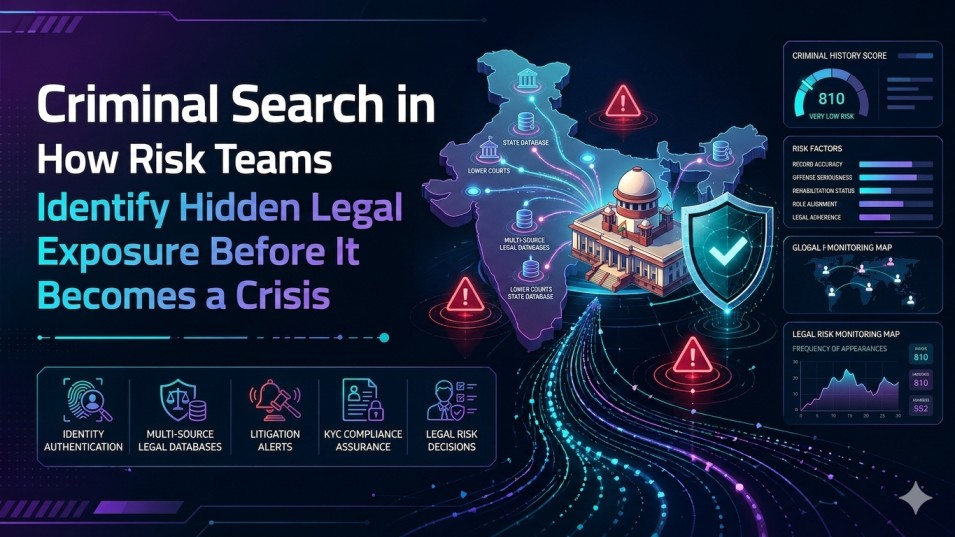
Before hiring someone, approving a high value borrower, onboarding a vendor, or entering into an important business relationship, companies often want to answer a fairly simple question:
Is there any criminal or legal history we should know about?
Finding the answer in India is not always as straightforward as searching a person's name online.
A criminal record check can involve different sources and verification methods depending on the purpose of the check. Police verification, court records, criminal case information and other legal records can all play a role in understanding a person's background.
The challenge is that a name appearing in a legal record does not automatically mean the record belongs to the person being checked.
This is where proper identity matching and context become important.
A useful criminal record check in India should help answer three basic questions:
Is there a relevant record?
Does it actually belong to the person being checked?
What does that record mean?
That last question is often the one businesses struggle with most.
A case number sitting in a spreadsheet does not tell a lender, HR manager, procurement team, or compliance officer whether the matter is serious, pending, disposed, criminal, civil, or even correctly matched.
This is why criminal record screening is increasingly becoming part of a broader background verification and litigation risk assessment process.
Table of Contents
- What Is a Criminal Record Check in India?
- How Does Criminal Record Verification Work in India?
- What Information Can a Criminal Record Check Include?
- Police Verification vs Criminal Record Check
- Why Identity Matching Matters
- Who Uses Criminal Record Checks in India?
- Common Uses of Criminal Record Checks
- Criminal Record Check vs Litigation Check
- When Is a Detailed Litigation Check Needed?
- How LegitQuest Supports Criminal and Litigation Risk Screening
- Frequently Asked Questions
What Is a Criminal Record Check in India?
A criminal record check in India is a process used to identify relevant criminal proceedings or records associated with an individual.
The exact process depends on who is conducting the check and why it is being conducted.
For example, police verification may be required for certain government, employment, passport, immigration, or other purposes. The Passport Seva system explains that police verification is used to ascertain details furnished by an applicant during passport processing.
There are also government systems designed specifically for criminal record verification. The National Crime Records Check portal, for example, enables authorized government departments to submit individual or bulk requests and receive preliminary criminal record check results based on national databases.
For businesses, however, criminal screening can form part of a wider background verification or due diligence exercise.
The purpose is not simply to find a record.
It is to understand whether a relevant record exists and whether it should affect the decision being considered.
How Does Criminal Record Verification Work in India?
There is no single process that applies to every criminal record check.
The process can vary depending on the person being checked, the organization conducting the verification, the purpose of the check, and the records that can legally be accessed.
In India, a Criminal Record Check Online should go beyond simply finding a matching name. The business value lies in connecting the right legal records to the right individual and understanding whether those proceedings are relevant to the decision.
A typical business screening process may involve the following stages:
1. Collecting Identifying Information
The first step is establishing who is being checked.
Depending on the process, this may involve information such as the person's full name, date of birth, address, father's name, or other identifying details.
The more reliable the identifying information, the easier it becomes to distinguish the subject from someone with a similar name.
2. Searching Relevant Records
The available sources are then searched for potential matches.
These can include relevant court records, police verification information, and other legally accessible records depending on the purpose and scope of the check.
India's criminal justice technology infrastructure also connects major components of the system. The Ministry of Home Affairs describes the Interoperable Criminal Justice System as integrating police, courts, prisons, forensic laboratories, and prosecution systems.
3. Matching the Record to the Person
This is a critical step.
A search may return a record for a person with the same name.
That does not automatically establish that it belongs to the subject.
The available identity information needs to be considered before the record is treated as a relevant match.
4. Reviewing the Case
Once a potential match has been identified, the case needs to be understood.
Important information can include:
- Case type
- Court
- Case number
- Filing information
- Current status
- Whether the matter is pending or disposed
- Relevant proceedings
- Available FIR information
- Relationship of the individual to the case
5. Assessing the Overall Risk
For higher risk decisions, simply listing cases may not be enough.
The reviewer may need to understand the seriousness and context of the matters before deciding what action to take.
This is where a detailed litigation check can become useful.
Digital access has made record discovery easier, but an online criminal history check still needs careful identity matching. A name appearing in a court search is a starting point, not confirmation that the record belongs to the person being screened.
What Information Can a Criminal Record Check Include?
The exact information depends on the source and scope of the search.
A structured criminal record or litigation screening report may include information such as:
|
Information |
Why It Matters |
|
Criminal case details |
Identifies relevant proceedings |
|
Case status |
Shows whether a matter is pending or disposed |
|
Court information |
Helps trace the proceeding |
|
Case references |
Makes the record easier to verify |
|
FIR information |
Can identify potential FIR related matches where available |
|
Identity match |
Helps determine whether the record belongs to the subject |
|
Match confidence |
Indicates the strength of the identity match |
|
Source information |
Helps trace findings to underlying records |
This is an important distinction.
A good criminal record check should not simply produce more data.
It should make the relevant information easier to understand.
Where FIR information is relevant and lawfully available, an fir check can add another signal to the review. The finding should still be considered alongside identity matching, case status and the wider facts.
Police Verification vs Criminal Record Check
The terms are sometimes used interchangeably, but they are not necessarily the same.
Police verification generally involves verification through the police authorities for a particular purpose.
A criminal record check is a broader description of the process of searching or verifying criminal history information.
For example, police verification can form part of passport processing. Passport Seva states that police verification may be conducted either before or after passport issuance depending on the application and circumstances.
A business conducting a broader background verification may also look at court records and other relevant legal information.
|
Police Verification |
Criminal Record Check |
|
Conducted through police authorities |
Broader screening term |
|
Used for specific official purposes |
Used across employment and business screening |
|
May involve address and antecedent verification |
Can focus on criminal case information |
|
Output depends on the relevant authority and process |
Scope depends on the screening process |
|
Not necessarily designed as a complete litigation review |
Can form part of broader legal due diligence |
So, if a company needs to understand litigation exposure rather than only police verification status, a wider check may be appropriate.
Why Identity Matching Matters
At scale, background screening becomes difficult when court records are fragmented and common names create uncertain matches. Identity-resolution and structured case information can help BGV teams determine which results genuinely belong to the subject and which need further analyst review.
Imagine a company is checking a candidate named Rajesh Kumar.
The search finds a criminal case involving someone named Rajesh Kumar.
Should the company immediately flag the candidate?
No.
There could be several people with the same name.
The person in the court record could live in another city, have a different father's name, or have other identifying details that do not match the candidate.
At scale, background check companies face a different problem from an individual search: common names, spelling variations, fragmented court sources and thousands of screening requests. Identity resolution and structured litigation reporting can help make that legal-check layer more consistent.
This is why identity matching is one of the most important parts of a criminal record check.
The objective is to reduce false positives while identifying records that genuinely require attention.
LegitQuest's detailed litigation framework specifically includes match confidence scores to assess identity match quality. It also provides case type and status summaries, detailed court metadata, and source traceability.
Who Uses Criminal Record Checks in India?
Criminal record screening is relevant to more than just HR departments.
Employers
Companies may conduct criminal background checks during employee verification, particularly for sensitive or high responsibility positions. For employers, the practical value of a criminal history records check comes from combining record discovery with identity matching, case status and context rather than treating a name match as a final finding.
Background Verification Companies
Background verification providers can use criminal history information alongside identity, employment, education, and address verification.
For employers and verification providers, criminal-history information can form one part of broader background verification. A litigation-intelligence layer adds court cases, civil disputes and criminal proceedings to the existing identity, employment, education and address checks without replacing the underlying BGV process.
Background verification companies often already verify identity, address, education and employment. Litigation intelligence can sit alongside these checks to surface relevant court proceedings without replacing the wider verification workflow.
Banks and Financial Institutions
Lenders may consider legal and criminal history as part of broader borrower and risk assessment.
Fintech Companies
Financial technology companies may need additional screening for employees, vendors, customers, or business partners depending on their risk framework.
Vendor Management Teams
Companies onboarding important suppliers may want to identify potential legal risks before entering into a long term commercial relationship.
Investors and Due Diligence Teams
Criminal and litigation information can become relevant during investment, acquisition, promoter, and corporate due diligence.
Criminal and litigation history can also be relevant outside employment. During m&a due diligence, transaction teams may review legal exposure involving the target business, promoters, founders, directors and key management as one part of the wider diligence process.
Common Uses of Criminal Record Checks
A criminal record check can be useful in several situations.
Employment Background Verification
Before hiring for sensitive positions, employers may conduct criminal history screening as part of a broader background verification process.
Vendor Risk Assessment
A supplier may have access to customer data, company systems, funds, or confidential information. A legal background check can therefore become part of vendor onboarding.
Borrower Review
Financial institutions may need deeper information before approving substantial credit exposure.
High Risk Candidate Screening
Senior executives and sensitive roles may justify a more detailed review than routine hiring.
Corporate Due Diligence
Before investing in or acquiring a company, reviewing the legal background of relevant individuals and entities can help identify potential issues.
Criminal Record Check vs Litigation Check
This distinction is important for businesses.
A criminal record check focuses primarily on criminal history.
A litigation check can be broader.
Depending on the scope, a litigation check can examine civil and criminal proceedings and provide a wider view of legal exposure.
|
Criminal Record Check |
Litigation Check |
|
Focuses on criminal history |
Broader legal history |
|
Common in background verification |
Common in due diligence |
|
Useful for employee screening |
Useful for lending and investment decisions |
|
Can identify criminal proceedings |
Can cover civil and criminal matters |
|
Primarily criminal risk focused |
Overall litigation risk focused |
For a routine employee screening, a criminal record check may be sufficient.
For a high value borrower, vendor, investment target, or sensitive executive appointment, a broader litigation assessment may make more sense.
When Is a Detailed Litigation Check Needed?
The answer depends on the decision.
If an initial criminal record check does not identify anything relevant, there may be no reason to conduct an extensive investigation.
But if a search produces multiple cases, uncertain identity matches, serious proceedings, or other potential concerns, a deeper review can be worthwhile.
The same applies when the financial or reputational consequences of a wrong decision are high.
LegitQuest's product page describes the Detailed Litigation Check Report as a way to move beyond basic case lists and provide a standardized assessment of litigation severity. It is positioned for borrower review, vendor risk assessment, and high risk candidate screening.
The report includes a LIBIL Score and Risk Band, a reasoning narrative, case type and status summary, court metadata, match confidence scores, and FIR text matches where available.
The product page states a turnaround time of 2 to 4 hours and supports delivery through a user portal and APIs.
The practical approach is simple:
Start with screening. Go deeper when the decision or the risk requires it.
That prevents every profile from becoming a lengthy investigation while still giving organizations a structured way to examine higher risk cases.
How LegitQuest Supports Criminal and Litigation Risk Screening
A criminal record check answers an important question, but it does not always answer the bigger business question:
How serious is the legal risk associated with this person or entity?
That is where the LegitQuest approach goes beyond a basic case list.
Its detailed litigation framework is designed to organize criminal and civil case information, distinguish pending and disposed matters, assess identity match confidence, provide court metadata, and surface potential FIR text matches where available.
The LIBIL Score and Risk Band provides a standardized way of looking at litigation severity, while the reasoning narrative explains the basis of the assessment. The product also emphasizes source traceability, which is particularly useful when findings need to be reviewed internally by legal, compliance, credit, HR, or risk teams.
That makes the approach relevant to organizations dealing with borrowers, vendors, employees, investors, and other higher risk profiles.
The goal is not to label someone simply because a record appears in a search.
The goal is to make the information useful.
For an HR team, that can mean better context during sensitive hiring.
For a lender, it can mean identifying potential concerns before approving credit.
For a procurement team, it can mean understanding vendor risk before onboarding.
And for a due diligence team, it can mean having a more structured view of litigation exposure before making a major decision.
Frequently Asked Questions
What is a criminal record check in India?
A criminal record check in India is a process used to identify and review relevant criminal proceedings or records associated with an individual. The exact process depends on the purpose, available records, and applicable verification requirements.
How is a criminal record checked in India?
Depending on the purpose, verification can involve police processes, court records, and other legally accessible sources. Government systems such as the National Crime Records Check portal also support criminal record verification for authorized government users.
Is police verification the same as a criminal record check?
Not necessarily. Police verification is a specific verification process conducted by police authorities, while criminal record check is a broader term for screening criminal history information.
Can a criminal record check find pending cases?
Potentially, depending on the records searched, their availability, and the scope of the check. Case status should always be reviewed rather than assuming that every record represents a conviction.
Does having a criminal case mean a person is convicted?
No. A pending case, allegation, arrest, charge, and conviction are not the same thing. The status and outcome of the proceeding should be examined before drawing conclusions.
Why is identity matching important in a criminal record check?
A person's name may match several different individuals. Identity matching helps determine whether a legal record actually belongs to the person being screened and reduces the risk of false matches.
Who uses criminal record checks in India?
Employers, background verification companies, banks, financial institutions, fintech companies, vendor risk teams, investors, compliance teams, and due diligence professionals may use criminal record checks where appropriate.
What is the difference between a criminal record check and a litigation check?
A criminal record check primarily focuses on criminal history, while a litigation check can provide a broader view of legal proceedings, including civil and criminal matters depending on the scope.
When should a detailed litigation check be used?
A detailed litigation check can be useful when an initial screening identifies potential concerns or when the decision involves significant financial, operational, regulatory, or reputational risk.


