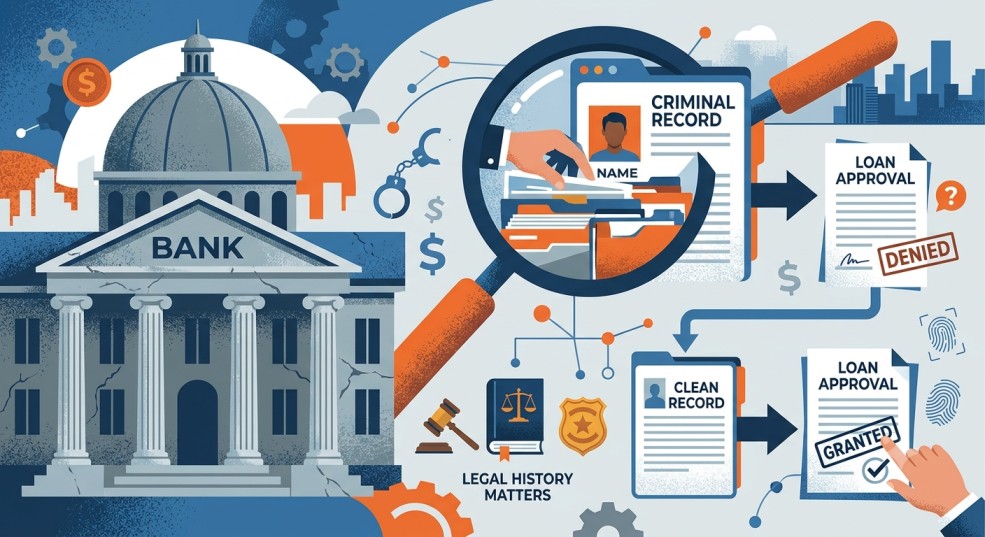
A borrower can look acceptable on conventional credit parameters and still have legal history worth examining.
That does not mean litigation predicts default. It does not.
It means credit history and legal history answer different questions.
Credit assessment may tell a bank about repayment behaviour, liabilities and financial capacity. A criminal record and litigation check can add another layer by identifying potentially relevant criminal proceedings, litigation, enforcement matters or other legal exposure connected with the borrower.
For a bank making thousands of lending decisions, that distinction matters.
The objective is not to replace credit underwriting with legal screening. It is to identify information that may justify a closer look before the exposure sits on the bank's books.
Why Credit History Does Not Tell the Entire Legal Story
A conventional lending process already considers substantial information.
Credit history. Income. Existing obligations. Banking behaviour. Collateral. Application information.
These remain central to underwriting.
But they do not necessarily answer questions such as:
Is the borrower involved in relevant litigation?
Are there criminal proceedings that warrant further review?
Are there enforcement or defaulter related signals associated with the borrower, promoter or guarantor?
That is the gap litigation intelligence can address.
The important point is not to confuse the two.
A borrower involved in litigation is not automatically a poor credit risk. Equally, a borrower with an acceptable credit profile does not necessarily have a clean legal history.
Banks need context from both sides.
What Should Banks Look for in a Criminal Record Check?
A useful borrower check should go considerably further than searching a name.
|
Risk Signal |
What the Credit Team Should Ask |
|
Identity match |
Does this legal record actually belong to the borrower? |
|
Criminal proceedings |
Are potentially relevant criminal matters present? |
|
Other litigation |
Are there civil, regulatory or tax proceedings worth reviewing? |
|
Case status |
Is the matter pending or disposed? |
|
Enforcement signals |
Are relevant enforcement related matters present? |
|
Defaulter signals |
Is there legal information that warrants further credit review? |
|
Source information |
Can the finding be traced to the underlying record? |
|
Overall exposure |
Does the pattern justify enhanced due diligence? |
No single item should determine whether the loan is approved.
The purpose is to give the credit team another set of facts to examine.
Identity Matching Comes Before Legal Risk
This is particularly important in banking.
Suppose a loan applicant called Sanjay Gupta produces six possible court matches.
The bank has not found six cases against its borrower.
It has found six records that may or may not belong to the same Sanjay Gupta.
Indian names can appear with variations. Addresses can differ across records. Unrelated individuals can share the same name. Cases can also be duplicated across court systems.
LegitQuest's LIBIL® addresses this through identity resolution across names, addresses and record formats. It searches supported Supreme Court, High Court, district court, tribunal, order and FIR records.
That changes the first question from:
“How many cases did we find?”
to:
“How confidently can these records be connected to this borrower?”
That is a much safer starting point for a credit decision.
Case Count Alone Is a Weak Lending Signal
Imagine two borrowers.
Both have four identified legal proceedings.
On a basic screening sheet:
Borrower A: 4 cases
Borrower B: 4 cases
They appear identical.
Once the records are classified, the picture may change completely.
LIBIL® categorises matched records as civil, criminal, regulatory or tax matters and identifies whether they are pending or disposed.
Borrower A may have older disposed civil proceedings.
Borrower B may have pending matters that the credit team considers relevant enough for enhanced review.
The number of cases did not change.
The quality of the information did.
That is why litigation screening is most useful when it helps banks understand the nature and context of exposure, rather than simply generating another count.
The Economics Change When a Bank Screens at Scale
A bank processing 20,000 applications cannot reasonably send every borrower through intensive manual legal due diligence.
Suppose a manual search and reconciliation process takes just 15 minutes per borrower.
At 20,000 applications, that becomes 5,000 hours of review.
At 30 minutes, it becomes 10,000 hours.
These figures are illustrative, but the operational issue is clear.
The bank needs a way to separate broad screening from deeper investigation.
This is where a tiered approach becomes commercially sensible.
Instant Screening First, Detailed Review Where It Matters
LegitQuest positions its Instant Litigation Check Reports for lead level prescreening in lending.
The purpose is to identify potential legal signals early without putting every applicant through the deepest review.
Where a borrower has a relevant finding, or the proposed credit itself carries greater exposure, the bank can move to a Detailed Litigation Check Report.
Detailed Reports add the LIBIL Score with reasoning and narrative case summaries and are typically available within 2 to 4 hours.
For higher ticket business loans and other very high exposure situations, LegitQuest also provides Lawyer Verified Litigation Check Reports, typically within 3 to 5 business days.
Why Source Linked Reporting Matters to Banks
If a legal finding contributes to an escalation, the credit or compliance team needs to know where the information came from.
LIBIL® uses source linked reporting so findings can be traced back to their underlying records.
This creates a more defensible process than an unexplained flag in a spreadsheet.
The reviewer can examine the case, understand its status and decide whether it has any reasonable connection to the lending decision.
That traceability becomes increasingly important as lending processes become more structured and data driven.
Criminal Record Screening Can Also Fit Existing Banking Systems
For large lenders, scale is not only about search speed.
The information has to move into the systems where decisions are already being made.
LegitQuest makes Instant and Detailed report data available through APIs for integration into KYC, core banking and compliance systems. LIBIL® outputs can also feed risk management tools and credit decision engines.
That allows legal risk screening to become part of an existing underwriting workflow rather than a separate manual exercise.
Legal History Is an Additional Signal, Not a Credit Verdict
The strongest use of a criminal record check in banking is not to create another automatic rejection rule.
It is to identify questions the conventional credit file may not answer.
Does the record belong to the borrower?
What kind of proceeding is involved?
Is it pending or disposed?
Is there a broader pattern of relevant litigation?
Does the exposure justify deeper review?
A bank does not need more data simply because more data is available.
It needs information that can improve the quality of a decision.
That is where criminal and litigation intelligence earns its place in credit underwriting: not as a replacement for conventional credit assessment, but as another source of context before the bank takes on exposure.
Frequently Asked Questions
Why should banks run criminal record checks on borrowers?
Criminal and litigation screening can identify potentially relevant legal proceedings, enforcement matters and other litigation signals that may not appear in conventional credit assessment.
Does litigation mean a borrower is likely to default?
No. Litigation does not automatically indicate default risk. It is an additional legal risk signal that should be interpreted alongside the borrower's wider credit and financial information.
What should banks review in a borrower litigation check?
Banks can review identity match quality, case type, case status, criminal proceedings, relevant enforcement signals, broader litigation exposure and underlying source information.
Which LegitQuest report is suitable for lending?
LegitQuest recommends Instant Reports for lead level prescreening and Detailed Reports for larger ticket or borderline credits. Lawyer Verified Reports can be used for very high exposure situations such as higher ticket business loans.
Can LIBIL® integrate with banking systems?
Yes. Instant and Detailed report data is available through APIs for integration into KYC, core banking and compliance systems. LIBIL® outputs can also feed risk management tools and credit decision engines.
Does LIBIL® decide whether a bank should approve a loan?
No. LIBIL® provides decision support litigation intelligence. Lending, risk, legal and compliance teams retain responsibility for interpreting findings and making the credit decision.


