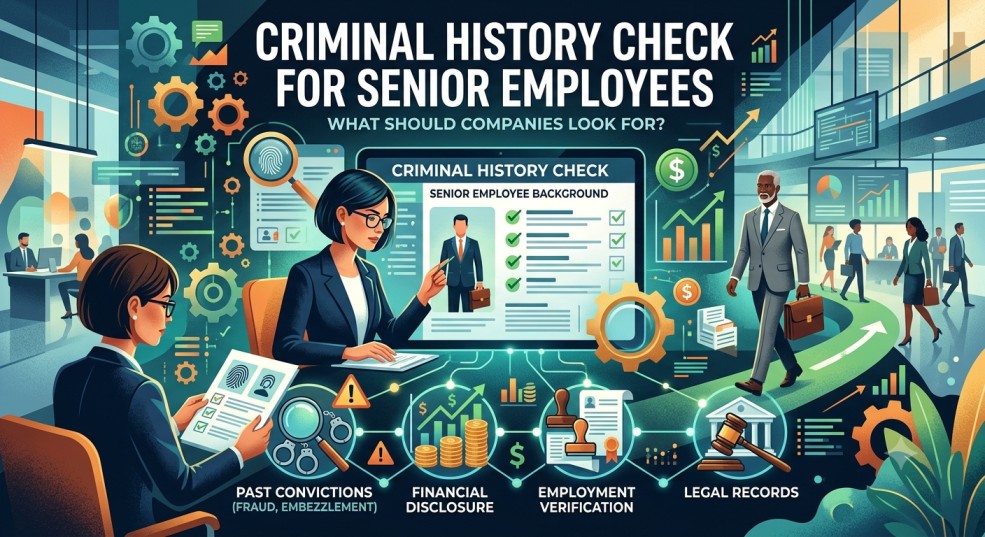
Hiring a senior employee is not simply a more expensive version of ordinary hiring.
The risk changes.
A CFO may control financial approvals. A procurement leader may influence large vendor relationships. A compliance head may carry regulatory responsibility. A CEO can represent the organisation before investors, lenders, customers and other stakeholders.
That level of authority changes what a company needs to know before making the appointment.
A criminal history check can form part of that review. But for senior hiring, simply asking whether a candidate's name appears in a court record is not enough.
The useful questions are harder:
Does the record actually belong to the candidate? What type of proceeding is involved? Is it pending or disposed? Is there a broader pattern of litigation? And does any of it matter to the responsibility the person is about to assume?
That is where a senior employee check becomes due diligence rather than box ticking.
Why Senior Employee Background Checks Need More Depth
The case for deeper screening is not that senior candidates should automatically be treated with greater suspicion.
It is about concentration of exposure.
One senior appointment can carry authority across finances, confidential information, employees, vendors, customers or strategic decisions.
Consider the difference between screening 5,000 employees and appointing one CFO.
At 10 minutes of screening per person, reviewing 5,000 profiles would require roughly 833 hours. The business needs an efficient first pass process.
For the CFO, volume is irrelevant. The potential exposure attached to one appointment can justify spending more time understanding a relevant legal finding.
The screening model therefore needs to change with the decision.
High volume calls for efficient screening. High exposure calls for deeper review.
What Should Companies Look for in a Criminal History Check?
A mature review should examine several dimensions together.
|
What to review |
Question the company should ask |
|
Identity match |
Are we confident this record belongs to the candidate? |
|
Case category |
Is the matter criminal, civil, regulatory or tax related? |
|
Case status |
Is the proceeding pending or disposed? |
|
Litigation exposure |
Is this an isolated matter or part of a wider legal history? |
|
Risk context |
Does the finding deserve closer attention given the role? |
|
Source record |
Can the finding be traced and independently reviewed? |
|
Level of review |
Is a detailed or lawyer verified check warranted? |
No single row in this table should make the hiring decision.
Together, however, they can tell the employer where deeper questions are justified.
Start With Identity, Not the Allegation
Imagine a company is hiring a senior finance executive called Rajesh Kumar.
A search returns seven court records involving people with that name.
The worst possible starting assumption is that all seven belong to the candidate.
Common names can produce false matches. The same person's name or address can also appear differently across legal records, creating the opposite problem: a genuine proceeding may not surface through a simple exact name search.
LegitQuest's LIBIL® uses identity resolution across name variations, addresses and record formats. It searches supported Supreme Court, High Court, district court, tribunal, order and FIR records.
For executive screening, this matters enormously.
A serious case attached to the wrong person is still the wrong result.
Look Beyond “Criminal Case Found”
Once identity has been established, the next task is interpretation.
LIBIL® categorises matched records into civil, criminal, regulatory and tax matters and distinguishes between pending and disposed proceedings. It also uses source linked reporting so findings can be traced back to their underlying records.
Why does this matter?
Take two senior candidates.
Both have four proceedings associated with them.
A simple report might present:
Candidate A: 4 cases
Candidate B: 4 cases
That comparison tells the hiring committee very little.
The nature, status and context of those proceedings could be entirely different. A case count cannot tell the company what the candidate's litigation history actually means.
This is why mature screening moves from counting cases to understanding cases.
Pending and Disposed Cases Need Context
A pending proceeding deserves attention because the matter has not reached final disposal.
But “pending” does not mean guilty.
Likewise, a disposed matter should not automatically be dismissed as irrelevant without understanding what happened.
The same principle applies to a risk score.
LegitQuest's LIBIL Score provides a standardised way to assess litigation exposure. It is a starting point for review, not a finding of guilt or an automatic hiring recommendation.
For a senior appointment, the underlying cases remain important.
The hiring, legal and compliance teams need context, not simply a red or green indicator.
When Should a Senior Hire Move to Deeper Review?
Not every employee needs lawyer led litigation due diligence.
Senior hiring is where a risk tiered approach becomes useful.
A deeper criminal history or litigation review may make sense when the candidate will have:
significant financial authority, access to sensitive information, substantial regulatory responsibility, influence over procurement or vendor decisions, or a role representing the organisation externally.
It can also make sense when an initial screening identifies potentially relevant litigation or produces several possible identity matches.
LegitQuest's existing guidance for senior hiring follows the same logic: screen first, then investigate more deeply where the exposure justifies it.
Instant, Detailed or Lawyer Verified: What Fits Senior Hiring?
The level of screening should follow the level of responsibility.
For broad employee screening, Instant Reports can support first pass checks at scale.
Where a candidate requires closer examination, a Detailed Litigation Check Report adds the LIBIL Score with reasoning and narrative case summaries. LegitQuest states a typical turnaround of 2 to 4 hours.
For very high exposure decisions, LegitQuest specifically positions its Lawyer Verified Litigation Check Report for use cases including executive hiring. These reports are lawyer prepared and typically take 3 to 5 business days.
A Criminal History Check Should Change the Questions, Not Automatically the Candidate
This is perhaps the most important principle in executive screening.
The existence of a court case does not establish guilt. A high litigation risk indicator does not prove misconduct. And a candidate with no surfaced proceedings should not automatically be considered risk free.
LegitQuest positions LIBIL® as decision support litigation intelligence rather than a legal opinion, leaving interpretation with the organisation's legal and compliance teams.
That is the right way to think about criminal history checks for senior employees.
The purpose is not to search for a reason to reject a candidate.
It is to make sure the company understands relevant legal history before placing significant authority in someone's hands.
For routine hiring, efficiency may dominate the screening design.
For senior hiring, the standard should be different:
Get the identity right. Understand the proceeding. Trace the source. Assess its relevance. Then make the human decision.
Frequently Asked Questions
What should companies check when screening a senior employee's criminal history?
Companies should review identity match quality, case category, case status, broader litigation exposure, underlying source information and the relevance of any finding to the responsibilities of the role.
Does a court case mean a senior candidate is guilty?
No. The existence of a proceeding does not establish guilt. Its nature, status, the candidate's role in the matter and available underlying records need to be considered.
Which senior employees may require deeper litigation screening?
Deeper review may be appropriate for executives and roles involving significant financial authority, sensitive information, regulatory responsibility, procurement influence or substantial decision making.
Why is identity resolution important for executive background checks?
Common names and variations in names, addresses and record formats can create false matches or missed records. Identity resolution helps determine whether a legal record genuinely relates to the candidate.
When should a company use a Lawyer Verified Litigation Check Report?
LegitQuest positions Lawyer Verified Reports for very high exposure situations, including executive hiring. They provide lawyer prepared review and typically take 3 to 5 business days.
Does the LIBIL Score decide whether a candidate should be hired?
No. The LIBIL Score helps standardise assessment of litigation exposure. It should be considered alongside the underlying cases and reviewed by the appropriate legal, compliance and hiring teams.


