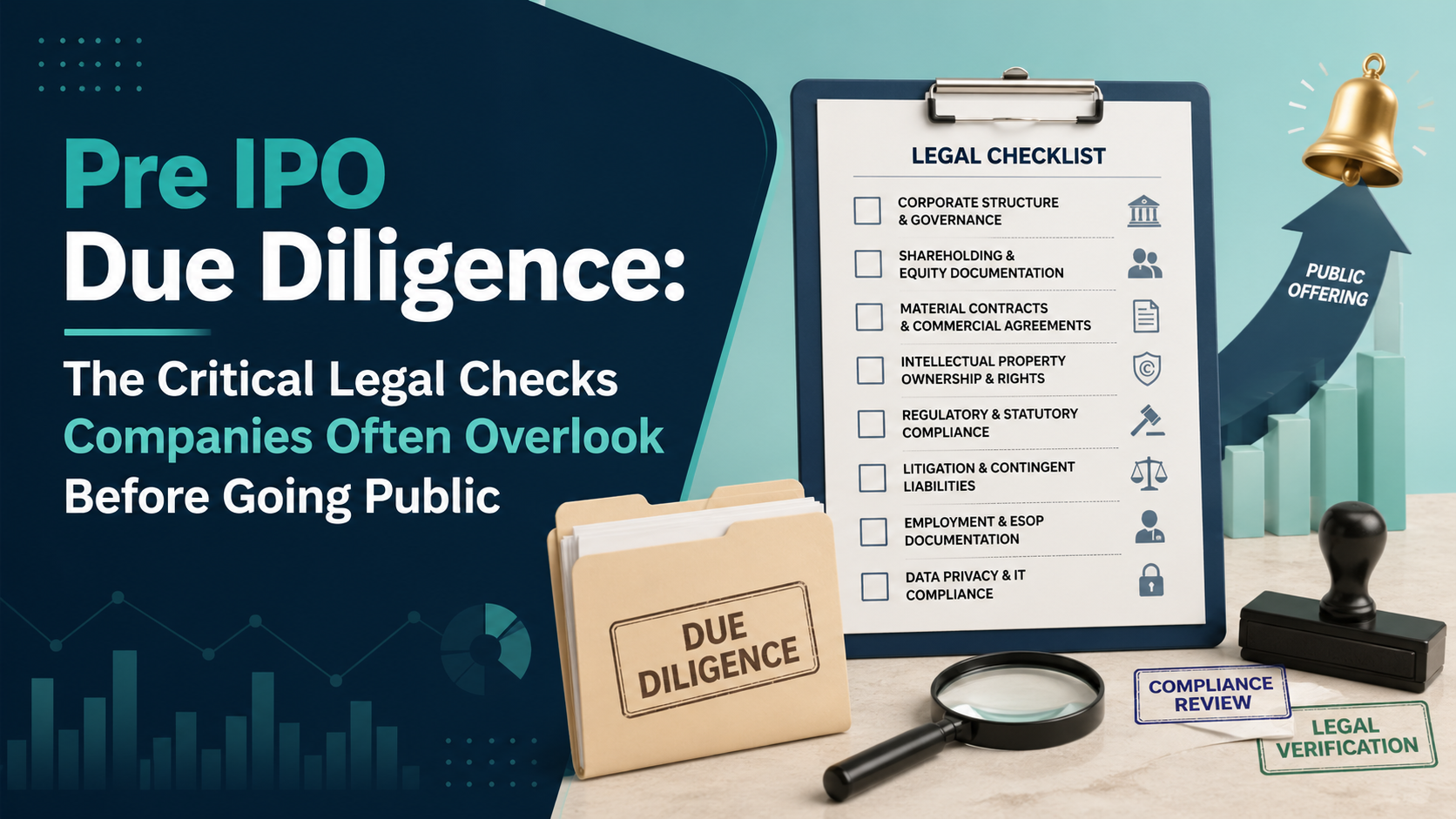
Going public is a defining moment for any company. It signals growth, maturity, and readiness for the next phase. But behind the headlines and investor excitement lies a process that’s far more rigorous than it appears.
Legal scrutiny begins long before the IPO filing.
This is where pre IPO due diligence becomes crucial. It’s not just about preparing documents, it’s about identifying risks early enough to fix them before they become obstacles.
And here’s the reality… many companies don’t realize what they’ve missed until it’s too late.
Overlooked litigation, incomplete disclosures, regulatory gaps, these aren’t just minor oversights. They can delay approvals, impact valuation, or in some cases, force companies to rethink their listing timeline altogether.
So, what are these critical legal checks that often get missed, and why do they matter so much before going public?
What Is Pre IPO Due Diligence, and Why It’s Different
Pre IPO due diligence is the process of reviewing a company’s legal, regulatory, and operational position before it formally enters the IPO pipeline.
Unlike standard IPO due diligence, which often happens under tighter timelines and external scrutiny, the pre-IPO stage offers something valuable, time to act.
This phase allows companies to:
- Identify legal risks proactively
- Clean up unresolved issues
- Strengthen governance and compliance frameworks
- Ensure disclosures are accurate and complete
In short, pre IPO due diligence is about preparation, not just verification.
Because once the IPO process begins, there’s far less room to correct mistakes.
The Legal Checks Companies Commonly Overlook
Even well-prepared organizations can miss critical legal risks during the pre-IPO phase. These gaps often stem from fragmented processes or limited visibility into legal data.
Here are some of the most commonly overlooked areas:
1. Incomplete Litigation Mapping
Many companies track major ongoing cases, but miss smaller or older ones that still carry risk.
What gets overlooked:
- Cases across different jurisdictions
- Matters involving subsidiaries or group entities
- Disputes that are pending but not actively monitored
These gaps can surface later during regulatory review, raising questions about disclosure completeness.
2. Background Risks of Directors and Promoters
Regulators and investors closely examine the legal history of key individuals.
Overlooked risks may include:
- Past criminal records
- Involvement in litigation
- Associations with disputed entities
Even if these issues don’t directly impact operations, they can influence perception and credibility.
3. Regulatory and Compliance Gaps
Routine compliance issues often go unnoticed internally, but become significant during IPO scrutiny.
Common gaps include:
- Delayed or incomplete statutory filings
- Licensing irregularities
- Non-alignment with sector-specific regulations
These issues can slow down approvals or require last-minute corrections.
4. Contractual and Commercial Liabilities
Long-term agreements and unresolved contractual obligations can create uncertainty around future liabilities.
What’s often missed:
- Ambiguous contract clauses
- Pending disputes with vendors or partners
- Financial commitments that aren’t fully documented
These risks can impact both valuation and investor confidence.
5. Historical Legal Exposure
Past legal issues, especially those that were considered resolved, can resurface during due diligence.
This includes:
- Settled disputes with lingering implications
- Regulatory actions or penalties
- Legacy compliance issues
Without a structured review, these risks can remain hidden until external scrutiny begins.
Why Traditional Approaches Miss These Risks
If these risks are so critical, why do they get overlooked?
The answer often lies in how due diligence is conducted.
Traditional approaches rely heavily on:
- Manual searches across multiple legal databases
- Internal records that may not be fully updated
- Self-disclosures from stakeholders
- Time-bound reviews with limited depth
This creates fragmentation.
Legal teams may have pieces of the puzzle, but not the full picture. And when information is scattered, it becomes harder to identify patterns, connections, or hidden exposures.
In the context of pre IPO due diligence, this lack of visibility can be costly.
Strengthening Pre IPO Due Diligence with a Structured Approach
To avoid these gaps, organizations are rethinking how they approach legal due diligence before going public.
The focus is shifting towards:
- Centralized access to legal and litigation data
- More consistent workflows for risk assessment
- Integration of legal checks into broader due diligence processes
- Early-stage verification rather than last-minute review
This structured approach helps ensure that risks are identified not just quickly, but thoroughly.
Because the goal isn’t just to complete due diligence, it’s to do it right the first time.
Where Pre IPO Due Diligence Makes the Biggest Difference
When done effectively, pre IPO due diligence influences outcomes far beyond compliance.
Early Risk Resolution
Identifying issues early gives companies the time to resolve them without impacting IPO timelines.
Stronger Investor Confidence
Transparent and well-documented disclosures build trust with investors and stakeholders.
Smoother Regulatory Review
Fewer surprises mean fewer delays during approvals and evaluations.
Better Valuation Stability
Reducing uncertainty around legal risks helps maintain credibility during pricing discussions.
In essence, pre IPO due diligence acts as a stability layer, ensuring that companies enter the public market with fewer unknowns.
Practical Ways to Improve Your Pre IPO Due Diligence Process
If you’re preparing for an IPO, a few practical steps can significantly strengthen your approach:
- Start earlier than you think necessary
The more time you have, the better you can address risks. - Don’t rely solely on internal data
External verification of legal records is essential for completeness. - Standardize your review process
Consistency ensures that no critical area is missed. - Focus on materiality and relevance
Prioritize risks that could impact valuation, compliance, or reputation. - Maintain clear documentation trails
This simplifies interactions with regulators and investors later.
These steps help turn due diligence into a proactive strategy rather than a reactive exercise.
The Role of Legal Intelligence in Pre IPO Preparation
As companies scale their due diligence efforts, the need for structured legal insights becomes more evident.
This is where platforms like LegitQuest’s LIBIL can support the process in a meaningful way.
By enabling access to organized legal data and litigation intelligence, LIBIL helps teams:
- Explore legal histories and case-related information more efficiently
- Identify litigation exposure across entities and individuals
- Reduce dependency on fragmented or manual searches
- Align legal insights with broader due diligence workflows
In the context of pre IPO due diligence, this means better clarity, and fewer surprises.
The value lies not just in accessing data, but in making it usable for informed decision-making.
Why Overlooking Legal Checks Can Delay or Derail IPO Plans
IPO timelines are often tight, and expectations are high.
When overlooked legal risks surface late, they can lead to:
- Delays in regulatory approvals
- Additional scrutiny from stakeholders
- Revisions in disclosures and documentation
- Loss of investor confidence
In some cases, companies may even need to pause or restructure their listing plans.
These outcomes aren’t just operational setbacks, they can have long-term strategic implications.
Which is why pre IPO due diligence isn’t optional. It’s essential.
Better Preparation Leads to Stronger Listings
At its core, pre IPO due diligence is about readiness.
The more clearly a company understands its legal position, the better it can navigate the complexities of going public.
Hidden risks don’t disappear, they need to be identified, assessed, and addressed with precision.
With a structured approach and access to legal intelligence through platforms like LIBIL, organizations can move forward with greater confidence.
Because a successful IPO isn’t just about timing the market…
It’s about entering it fully prepared, with no hidden surprises left behind.


