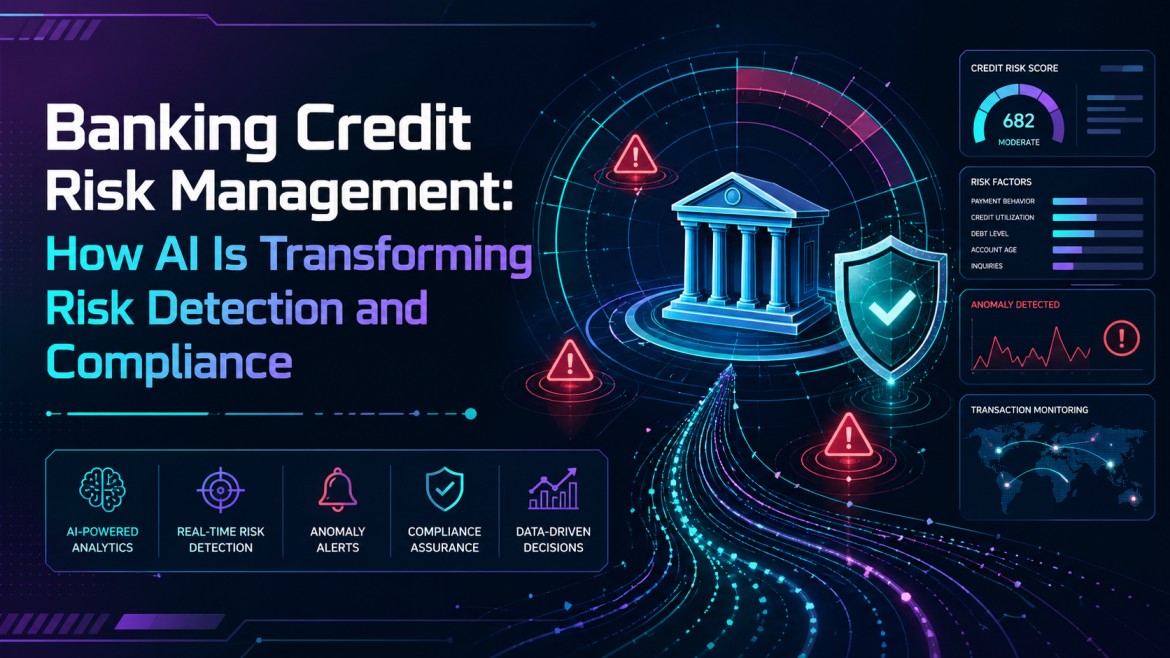
For banks, risk isn’t just something to manage, it’s something to anticipate.
Every lending decision, every client onboarding, every portfolio review carries an inherent level of uncertainty. And in today’s environment, that uncertainty is growing. Borrowers are more complex, transactions move faster, and regulatory expectations are sharper than ever.
This is why banking credit risk management is undergoing a quiet but significant transformation.
Traditional systems, once reliable, are struggling to keep pace with the volume and complexity of modern risk signals. And that’s where AI is stepping in, not to replace human judgment, but to strengthen it.
The result? Faster detection, deeper insights, and a more proactive approach to compliance.
What Is Banking Credit Risk Management, and Why It Matters
Banking credit risk management refers to the processes and frameworks banks use to identify, assess, and mitigate the risk of borrower default.
It typically involves:
- Evaluating borrower creditworthiness
- Monitoring loan performance
- Managing exposure across portfolios
- Ensuring compliance with regulatory requirements
At its core, it’s about balancing opportunity with caution.
Lend too conservatively, and growth slows. Lend too aggressively, and risk escalates.
The challenge today is that risk is no longer confined to financial data. Legal issues, regulatory exposure, and behavioral patterns are increasingly influencing credit outcomes, making traditional models less effective on their own.
The Limitations of Traditional Risk Management Approaches
Despite their long-standing use, traditional credit risk frameworks are showing clear limitations in today’s landscape.
Reactive Risk Detection
Most systems identify risk after it has already begun to materialize, rather than anticipating it early.
Dependence on Static Data
Financial statements and credit scores provide only a snapshot, not a continuous view of risk.
Limited Integration of Non-Financial Signals
Legal disputes, compliance issues, or criminal exposure are often excluded from core risk models.
Manual and Fragmented Processes
Multiple teams, disconnected systems, and manual verification slow down decision-making.
Inconsistent Risk Assessment
Variability in how data is interpreted can lead to uneven outcomes across similar cases.
These gaps create a fundamental problem, banks may have data, but not enough actionable insight.
How AI Is Reshaping Banking Credit Risk Management
AI is helping banks move from reactive risk management to proactive risk intelligence.
Instead of relying solely on predefined rules, AI systems analyze large volumes of data to identify patterns, anomalies, and emerging risks.
Here’s how this transformation is taking shape:
- Real-time data processing
AI enables continuous monitoring rather than periodic assessment. - Pattern recognition
Hidden trends and correlations become visible, even across complex datasets. - Predictive insights
Risk can be anticipated earlier, not just identified after the fact. - Improved consistency
Standardized models reduce variability in decision-making. - Scalability
Large volumes of data can be processed efficiently without increasing manual workload.
This shift allows banks to act earlier, respond faster, and manage risk more effectively.
Where AI Delivers the Most Impact
The benefits of AI-driven banking credit risk management are most evident in real-world applications.
Loan Origination and Underwriting
AI accelerates credit evaluation by analyzing multiple data points simultaneously, enabling faster and more informed lending decisions.
Early Warning Systems
Continuous monitoring helps identify signs of stress in borrower profiles before defaults occur.
Fraud Detection
AI detects unusual patterns or inconsistencies that may indicate fraudulent activity.
Portfolio Risk Management
Banks gain a more dynamic view of risk across their portfolios, allowing for proactive adjustments.
Regulatory Compliance
Automated tracking and documentation support adherence to evolving regulatory requirements.
Across all these areas, the advantage is clear, better insight leads to better control.
The Growing Role of Legal and Compliance Data
One of the most significant shifts in banking credit risk management is the increasing importance of legal and compliance-related data.
Why does this matter?
Because financial performance alone doesn’t always reflect underlying risk.
Consider this:
- A borrower involved in ongoing litigation may face financial strain
- Regulatory actions can impact operational stability
- Criminal exposure may raise serious credibility concerns
These factors can influence credit risk, but are often overlooked in traditional models.
AI-driven systems are now capable of incorporating such non-financial signals, creating a more holistic risk profile.
Practical Considerations for Banks Adopting AI
While AI offers clear advantages, its effectiveness depends on how it’s implemented.
Here are a few practical considerations:
- Focus on data quality
Accurate and reliable data is essential for meaningful insights. - Ensure transparency and explainability
Risk decisions must remain understandable, especially for compliance purposes. - Integrate AI into existing workflows
AI should enhance, not disrupt, current processes. - Expand data sources thoughtfully
Include legal and compliance data alongside financial inputs. - Maintain human oversight
AI supports decision-making, but final accountability remains with teams.
These steps help ensure that AI adoption strengthens risk management without introducing new challenges.
Where Legal Intelligence Platforms Add Value
As banks expand their data sources, accessing structured legal information becomes increasingly important.
This is where platforms like LegitQuest’s LIBIL can support banking credit risk management.
By enabling access to organized legal and litigation data, LIBIL helps teams:
- Identify litigation exposure linked to borrowers or entities
- Support due diligence during credit evaluation
- Reduce reliance on fragmented or manual legal research
- Align legal insights with broader risk and compliance workflows
Incorporating these insights allows banks to move beyond purely financial analysis and develop a more comprehensive understanding of borrower risk.
Why Risk Detection and Compliance Must Evolve Together
Risk management and compliance are no longer separate functions, they’re deeply interconnected.
Regulators expect banks to:
- Demonstrate robust risk assessment processes
- Maintain transparency in decision-making
- Identify and mitigate risks proactively
AI helps bridge the gap between these expectations and operational realities.
By improving visibility and documentation, it supports both risk detection and compliance readiness simultaneously.
And in a high-risk environment, that alignment is critical.
Smarter Risk Management Starts with Better Insight
At its core, banking credit risk management is about making decisions under uncertainty.
AI reduces that uncertainty.
By analyzing more data, identifying hidden patterns, and enabling faster responses, it helps banks move from reactive control to proactive risk management.
And when combined with structured legal intelligence, through platforms like LIBIL, the depth of insight improves even further.
Because in today’s landscape, the question isn’t just whether a borrower can repay…
It’s whether the bank has seen everything it needs to see before making that decision.


