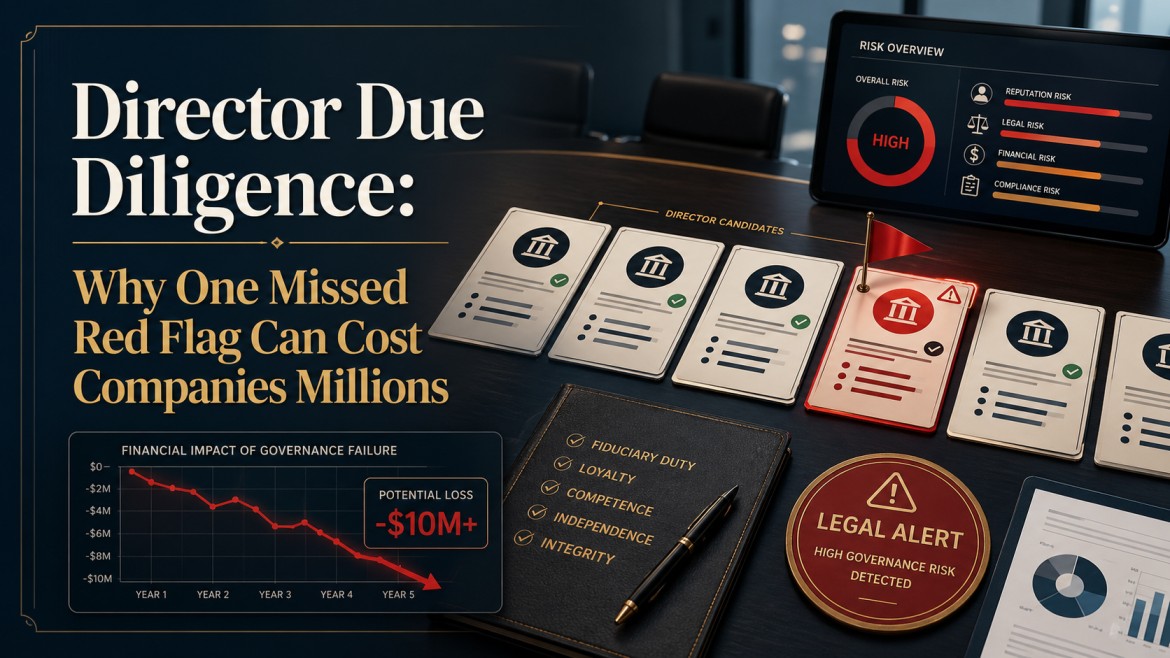
Board appointments are high-stakes decisions.
Bringing someone onto the board isn’t just about experience or reputation, it’s about trust, accountability, and long-term impact. Directors influence strategy, governance, and compliance… and any oversight in evaluating their background can carry serious consequences.
This is why director due diligence has become more critical than ever.
Yet, the challenge remains, many risks don’t show up on the surface. Legal disputes, financial irregularities, regulatory exposure… these often stay hidden unless actively uncovered.
That’s where AI is beginning to reshape the process.
By enabling deeper, faster, and more structured analysis, AI is helping organizations identify risks before they turn into costly mistakes.
What Is Director Due Diligence, and Why It Matters Today
Director due diligence involves evaluating the legal, financial, and reputational background of individuals being considered for board positions.
It typically includes:
- Reviewing litigation history
- Identifying criminal or regulatory exposure
- Assessing financial credibility and associations
- Validating disclosures and declarations
But today, the scope has expanded.
Organizations are no longer just verifying information, they’re trying to anticipate risk.
Because once a director is appointed, the cost of uncovering issues later is significantly higher, both financially and reputationally.
The Challenge with Traditional Due Diligence Approaches
Despite its importance, director due diligence often relies on methods that are limited in scope.
Common challenges include:
Fragmented Data Sources
Legal, financial, and compliance data are spread across multiple systems, making it difficult to get a unified view.
Manual Research Effort
Teams often rely on time-consuming searches, increasing the risk of missed information.
Limited Visibility into Legal Exposure
Ongoing or past litigation may not be easily accessible or fully understood.
Dependence on Self-Disclosures
Organizations often rely on what individuals choose to disclose, which may not always be complete.
Time Constraints
Board appointments are often time-sensitive, leaving little room for deep investigation.
These gaps create a fundamental issue, risk is assessed with incomplete information.
How AI Is Transforming Director Due Diligence
AI is not replacing due diligence, it’s enhancing its depth and efficiency.
By analyzing large volumes of data across multiple sources, AI helps uncover patterns and risks that would be difficult to identify manually.
Here’s how AI is changing the process:
- Faster data processing
AI can scan and organize vast amounts of legal and financial data in minutes. - Pattern recognition
It identifies connections between cases, entities, and individuals that may indicate risk. - Improved consistency
Standardized analysis reduces variability in how due diligence is conducted. - Enhanced risk detection
AI highlights anomalies or red flags that may require deeper review. - Scalability
Organizations can conduct thorough checks across multiple candidates without - increasing manual workload.
This shift allows due diligence to move from surface-level verification to deeper risk intelligence.
Where AI-Driven Director Due Diligence Adds Value
The real impact of AI becomes clearer when applied to practical scenarios.
Board Appointments and Governance Decisions
Organizations can evaluate candidates more thoroughly, reducing the risk of appointing individuals with hidden legal or financial issues.
Pre-IPO and Regulatory Readiness
Regulators closely examine board composition. AI-driven due diligence helps ensure that directors meet compliance expectations.
Mergers and Acquisitions
Assessing leadership teams is critical during M&A. AI enables faster and more comprehensive evaluation of key individuals.
Investor Confidence and Transparency
Well-documented and verified due diligence builds trust with investors and stakeholders.
Across these scenarios, the advantage lies in seeing more, and seeing it earlier.
The Importance of Legal and Financial Risk Signals
One of the key strengths of AI-driven director due diligence is its ability to incorporate multiple types of risk signals.
Beyond basic checks, organizations can evaluate:
- Litigation history that may indicate ongoing disputes
- Criminal exposure that raises credibility concerns
- Regulatory actions that suggest compliance risks
- Financial irregularities or associations that impact trustworthiness
These signals don’t always appear in isolation. Often, it’s the combination of factors that reveals the true level of risk.
AI helps connect these dots, turning fragmented data into meaningful insight.
Practical Considerations for Organizations
While AI offers clear benefits, its effectiveness depends on how it’s used.
Here are a few practical considerations:
- Ensure data quality and reliability
Accurate inputs lead to meaningful insights. - Combine AI with human judgment
AI highlights risks, but interpretation remains critical. - Standardize due diligence frameworks
Consistency improves reliability across evaluations. - Integrate legal and financial data sources
A broader dataset leads to a more complete risk profile. - Start early in the evaluation process
Early insights provide flexibility in decision-making.
These steps help ensure that AI enhances due diligence rather than complicates it.
The Role of Legal Intelligence Platforms in AI-Driven Due Diligence
As organizations adopt AI, access to structured legal data becomes essential.
This is where platforms like LegitQuest’s LIBIL play a supporting role.
By enabling access to organized legal and litigation data, LIBIL helps teams:
- Explore legal histories linked to individuals and entities
- Identify litigation exposure relevant to board candidates
- Support due diligence workflows with structured insights
- Reduce reliance on fragmented or manual research
In AI-driven environments, such structured data becomes a critical input, enhancing the accuracy and depth of analysis.
Why Missing a Risk Is More Costly Than Ever
The consequences of inadequate director due diligence are significant.
A missed red flag can lead to:
- Regulatory scrutiny or compliance issues
- Reputational damage that affects market perception
- Loss of investor confidence
- Financial losses tied to poor governance decisions
And in many cases, these risks don’t emerge immediately, they surface when scrutiny increases.
Which makes early detection even more important.
Better Board Decisions Start with Better Due Diligence
At its core, director due diligence is about clarity.
Organizations need to understand not just who they’re appointing, but the risks that come with that decision.
AI helps bring that clarity by uncovering hidden signals, connecting data points, and enabling faster, more consistent analysis.
And when combined with structured legal intelligence through platforms like LIBIL, the process becomes even more robust.
Because in board appointments, the real risk isn’t what you see, it’s what you miss.


