A company is about to hire 2,000 people.
Another is evaluating a senior executive.
A lender is screening thousands of borrowers.
All three want to know whether there is relevant criminal or litigation history behind the person they are assessing.
Should they ask for police verification or run a criminal record check online?
The answer depends on what the business is actually trying to establish.
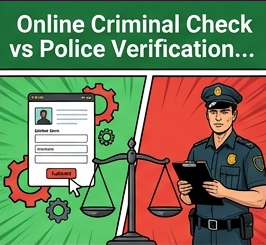
Police verification and online criminal record screening are sometimes treated as two versions of the same check. They are not. Police verification is an official antecedent verification process conducted through police authorities. A business focused criminal and litigation check is designed to search, organise and assess relevant legal records for screening and due diligence.
Understanding that difference matters because choosing the wrong process can leave a risk team with information that does not answer the question it started with.
Criminal Record Check Online vs Police Verification at a Glance
|
Factor |
Criminal Record Check Online |
Police Verification |
|
Primary purpose |
Business screening and legal risk assessment |
Official verification of character or antecedents |
|
Process |
Searches and structures relevant litigation and criminal records |
Conducted through the relevant police system |
|
Business scale |
Can support high volume screening workflows |
Follows the applicable police verification process |
|
Identity challenge |
Requires matching records to the correct individual or entity |
Identity details form part of the official application process |
|
Legal context |
Can categorise criminal, civil, regulatory and tax matters |
Focuses on police antecedent verification |
|
Risk prioritisation |
Can support tiered screening and escalation |
Not designed as a commercial litigation risk scoring system |
|
Typical business use |
Hiring, vendor onboarding, lending, M&A and investigations |
Employment or other situations requiring formal antecedent verification |
The practical difference is straightforward.
Police verification answers an official antecedent verification need.
A structured criminal and litigation check helps a business understand legal exposure around a decision.
What Does Police Verification Actually Do?
Police verification sits within India's official policing framework.
The Ministry of Home Affairs' Digital Police portal allows citizens to seek antecedent verification for prospective employees, including domestic help and drivers, tenants and other purposes. State and Union Territory police portals can also provide Police Clearance Certificate services for employee antecedent verification.
The underlying system is tied to India's police infrastructure, including the Crime and Criminal Tracking Network and Systems.
For a business, this makes police verification relevant when an official police based verification or certificate is required for the particular purpose.
But that should not be confused with a broader commercial litigation assessment.
A credit team deciding whether a borrower requires enhanced due diligence, for example, may want to know much more about the person's litigation exposure than an official antecedent process alone is designed to provide.
What Does a Criminal Record Check Online Do Differently?
This is where the business requirement changes.
India's litigation information is fragmented. Court records can sit across Supreme Court, High Court and district court systems. Tribunal proceedings, orders and FIR information can exist in different formats and sources.
A criminal record check therefore has to solve two problems:
finding the records and determining whether they belong to the subject.
LegitQuest's LIBIL® searches across supported Supreme Court, High Court, district court, tribunal, order and FIR records.
It then applies identity resolution across variations in names, addresses and record formats.
That second step is critical.
A result for “Amit Sharma” is not useful simply because the person being screened is also called Amit Sharma.
The business needs confidence that the record relates to the correct Amit Sharma.
Why Scale Changes the Decision
Suppose a background verification company needs to screen 10,000 profiles.
If a manual litigation search and reconciliation takes just 10 minutes per profile, that represents approximately 1,667 hours of work.
At 20 minutes, it becomes approximately 3,333 hours.
Those figures are illustrative, but the operational lesson is important.
Once screening reaches thousands of people, the question is no longer:
“Can somebody perform this check?”
It becomes:
“Can we perform it consistently, identify meaningful findings and escalate the right cases?”
That is the business problem behind tiered criminal and litigation screening.
A Criminal Record Is More Than a Case Count
Finding five cases does not necessarily mean five serious criminal findings.
A structured review needs context.
LIBIL® categorises matched records into civil, criminal, regulatory and tax matters and distinguishes between pending and disposed proceedings.
For deeper reviews, the LIBIL Score provides a standardised way to assess litigation exposure. Source linked reporting connects findings to their underlying records so that legal and risk teams can investigate further.
This matters because two people with three identified cases each can present entirely different legal histories.
One may have relatively minor or disposed matters.
The other may have proceedings requiring immediate legal review.
A simple case count cannot make that distinction.
So Which One Should a Business Choose?
The better question is not “Which check is better?”
It is:
What decision are you trying to support?
Choose Police Verification When an Official Antecedent Process Is Required
If the business, role or applicable process requires formal police antecedent verification, the relevant police verification process should be followed.
A private litigation screening product should not be positioned as a substitute for an official police process.
Use Online Criminal and Litigation Screening When You Need Business Risk Context
A structured criminal record check becomes valuable when the organisation needs to screen legal exposure as part of a broader commercial decision.
LegitQuest identifies five primary areas where litigation intelligence is used:
Lending and credit underwriting: screening litigation, enforcement and defaulter related signals involving borrowers, promoters and guarantors.
Background checks and onboarding: screening employees, vendors and other parties across different risk levels.
M&A due diligence: reviewing proceedings involving target companies, promoters and related parties.
Financial crime investigations: examining litigation exposure, FIRs and enforcement actions connected with people, entities and assets.
IPO due diligence: preparing litigation information required for disclosure workflows.
These are fundamentally business risk questions.
In Some Cases, the Right Answer Is Both
Consider a company hiring someone into a particularly sensitive position.
Police verification may satisfy an official or internal antecedent requirement.
But the company may also want broader litigation intelligence because the role carries significant financial, fiduciary or operational responsibility.
The two checks answer different questions.
The same principle applies to risk based onboarding.
A high volume first pass check can identify profiles requiring further investigation. LegitQuest's Instant Reports are designed for scalable screening, while relevant findings can move to Detailed Reports.
Detailed Litigation Check Reports add the LIBIL Score, reasoning and narrative case summaries and are typically available within 2 to 4 hours.
For very high exposure decisions, Lawyer Verified Reports provide deeper review and typically take 3 to 5 business days.
Why Mature Risk Teams Avoid the Either Or Question
Police verification and criminal record screening should not be forced into the same box.
One belongs to an official antecedent verification framework.
The other can help businesses investigate litigation and legal exposure around lending, hiring, onboarding, transactions and investigations.
The important question for a risk team is therefore not:
“Should we replace police verification with an online criminal check?”
It is:
“What evidence do we need for this decision, and which verification process gives us that evidence?”
For businesses dealing with high volumes or high exposure decisions, that distinction can prevent both unnecessary checks and incomplete ones.
Frequently Asked Questions
Is a criminal record check online the same as police verification?
No. Police verification is an official antecedent verification process conducted through police authorities. An online criminal and litigation check searches and structures relevant legal records for screening and due diligence.
Can an online criminal record check replace police verification?
It should not be treated as a replacement where formal police verification is required. The two processes serve different purposes.
When should a business use a criminal record check online?
It can be useful for risk based employee and vendor screening, lending and credit underwriting, M&A due diligence, financial crime investigations and other decisions where litigation exposure is relevant.
What does LegitQuest check?
LIBIL® searches supported Supreme Court, High Court, district court, tribunal, order and FIR records and uses identity resolution to match individuals and entities across variations in names, addresses and record formats.
Why is identity resolution important?
A name match alone can produce false positives or miss relevant records. Identity resolution helps establish whether the identified legal record actually relates to the subject being screened.
Can police verification and litigation checks be used together?
Yes, where the business need justifies both. Police verification can address an official antecedent requirement, while litigation screening can provide additional legal risk context for the business decision.


