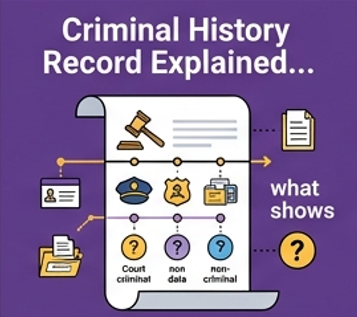
Finding a criminal case is one thing. Understanding what it says about the person or business being checked is another.
That distinction matters when the record is being used for a serious decision.
A lender assessing a borrower cannot treat every court result as equal. An employer screening a senior hire needs to know whether the record actually belongs to that person. A company onboarding a vendor needs more than a spreadsheet containing names and case numbers.
A criminal history record becomes useful only when the information around it can answer a few practical questions:
Is this the right person? What kind of proceeding is it? Is it pending or disposed? How serious is the exposure? And can the finding be traced back to its source?
For risk, compliance, lending and background verification teams, that context is where the real value lies.
Table of Contents
- What is a criminal history record?
- What does a criminal record actually show?
- Why a case count can be misleading
- Identity matching changes the quality of a criminal check
- How criminal history should be assessed
- Which criminal record check should a business use?
- Where criminal history records matter in business
- Frequently asked questions
What Is a Criminal History Record?
In a business screening context, a criminal history record brings together criminal proceedings and related legal information identified for an individual or entity.
But a mature screening process should not stop at criminal cases alone.
Legal exposure may sit across Supreme Court, High Court, district court, tribunal, order and FIR records. Related proceedings can also fall into civil, regulatory or tax categories.
That broader picture matters because risk rarely arrives neatly labelled.
A borrower, promoter, executive or company may have several legal proceedings associated with its identity. Some may matter greatly to the decision. Others may have little relevance.
The job of a criminal record check is therefore not simply to produce more results.
It is to make the relevant results understandable.
What Does a Criminal Record Really Show?
A useful criminal history record should help a reviewer understand several layers of information.
|
Record element |
What it helps answer |
|
Identity match |
Does the record actually belong to the person or entity being checked? |
|
Case category |
Is the proceeding criminal, civil, regulatory or tax related? |
|
Case status |
Is the matter pending or disposed? |
|
Litigation exposure |
What is the nature and relative significance of the identified proceedings? |
|
FIR information |
Are relevant FIR records connected with the subject where available? |
|
Source record |
Can the finding be traced to the underlying legal record? |
|
Risk assessment |
Which findings deserve greater attention or deeper review? |
This is a much more useful picture than simply saying:
“Three cases found.”
Three cases could represent three very different risk profiles.
Why the Number of Criminal Cases Can Mislead You
Imagine two prospective borrowers.
Both searches return four cases.
On a spreadsheet, they look identical.
Once the records are examined, however, Borrower A may have older disposed matters of relatively limited relevance. Borrower B may have pending proceedings that deserve much closer investigation.
The number is the same.
The context is not.
The same issue appears when civil and criminal proceedings are mixed together or when duplicated records inflate the apparent number of cases.
This is why treating every result equally can create poor risk decisions.
The purpose of structured litigation intelligence is to move from case counting to case understanding.
Identity Matching Comes Before Risk Assessment
There is an even more fundamental question:
Does the criminal history record belong to the person you are checking?
Indian names can appear with different spellings, formats and addresses. At the same time, unrelated people can share the same or very similar names.
This creates two expensive screening problems.
A false positive can associate somebody else's proceeding with the subject.
A false negative can leave a genuine record undiscovered because the name or address appears differently.
For an organisation processing thousands of checks, even a small matching problem can create a significant review burden.
If 5,000 profiles each required just 10 minutes of manual searching and reconciliation, that would represent more than 833 hours of review. At 20 minutes per profile, the requirement rises above 1,666 hours.
These figures are illustrative, but they show why scale changes the economics of criminal record screening.
LegitQuest's LIBIL® addresses this through identity resolution across name variations, addresses and record formats before organising matched records into structured results.
How Should a Business Read Criminal History?
A sensible review works in layers.
First, establish identity.
Confirm that the available information supports a connection between the subject and the record.
Second, classify the proceeding.
Criminal, civil, regulatory and tax matters should not be placed into one undifferentiated bucket.
Third, examine status.
A pending proceeding and a disposed matter provide different information and should be read accordingly.
Fourth, assess the wider litigation profile.
A single record may look very different once the subject's broader legal history is considered.
Finally, trace the evidence.
A business should be able to understand where an important finding came from, particularly when the decision involves significant financial, legal or reputational exposure.
LIBIL® uses source linked reporting so findings can be traced to the underlying record. Its LIBIL Score also provides a standardised framework for assessing litigation exposure rather than leaving prioritisation entirely to ad hoc reviewer judgement.
Not Every Criminal Record Check Needs the Same Depth
Screening depth should follow business exposure.
|
Business situation |
Appropriate level of review |
|
Large scale employee or vendor screening |
Instant first pass screening |
|
Higher risk or escalated profile |
Detailed litigation review |
|
Executive hiring |
Lawyer verified review |
|
Larger business loan |
Detailed or lawyer verified review depending on exposure |
|
M&A transaction |
Lawyer verified litigation due diligence |
|
IPO diligence |
IPO specific litigation report |
|
High volume criminal screening |
FIR report / first pass screening |
This tiered approach matters operationally.
Detailed Litigation Check Reports add the LIBIL Score, reasoning and narrative case summaries and are typically delivered within 2 to 4 hours. Lawyer Verified Reports are intended for higher exposure decisions such as executive hiring, larger business loans and M&A and typically take 3 to 5 business days.
A business screening thousands of profiles should not necessarily apply the most intensive review to every person.
A more scalable approach is:
Screen broadly. Identify meaningful findings. Escalate selectively. Review deeply where the exposure warrants it.
Where Criminal History Records Matter Most
Lending and Credit Underwriting
For lenders, criminal and broader litigation information can surface litigation, enforcement and defaulter signals involving borrowers, promoters or guarantors.
It is an additional risk input, not a replacement for the lender's credit decision.
Background Checks and Onboarding
Employee, vendor and onboarding programmes often operate at much greater volume.
Instant screening can help identify profiles requiring additional investigation, with relevant findings escalated to Detailed Reports for legal review.
M&A Due Diligence
The stakes change significantly in an acquisition.
Legal proceedings involving a target, its promoters and related parties can affect diligence, disclosure, indemnity discussions and deal structure. A broader litigation history is therefore more useful than a narrow name based criminal search.
Financial Crime Investigation
Investigations may require connections between litigation exposure, FIRs, enforcement actions, people, entities and assets to be examined together.
Here, the record is part of a wider investigative picture rather than a standalone pass or fail signal.
A Criminal History Record Is Evidence, Not the Decision
The most useful criminal record check does not tell a business what decision to make.
It helps the business understand what it has found.
That means knowing whether the subject has been identified correctly, separating criminal proceedings from other litigation, understanding whether matters are pending or disposed, assessing the broader exposure and being able to return to the underlying source.
That is the business problem LegitQuest's LIBIL® is designed around: turning fragmented legal records into structured, source linked intelligence that risk, legal and compliance teams can review.
For mature organisations, the question is no longer simply:
“Does this person have a criminal record?”
The better question is:
“What does the available legal history actually tell us, and how relevant is it to the decision we are making?”
Frequently Asked Questions
What is a criminal history record?
A criminal history record, in a business screening context, brings together identified criminal proceedings and relevant legal information associated with an individual or entity for further review.
What does a criminal record check show?
Depending on the report and available records, it can identify criminal proceedings, case information, pending or disposed status, FIR related information and other litigation context associated with the subject.
Is finding a criminal case enough to assess risk?
No. Identity, case category, status, broader litigation exposure and the underlying source should be considered before interpreting a finding.
Why is identity resolution important in a criminal history check?
Similar names, name variations, addresses and inconsistent record formats can create false matches or missed records. Identity resolution helps establish whether identified records genuinely relate to the subject.
What is the LIBIL Score?
The LIBIL Score provides a standardised way to assess litigation exposure, supported by reasoning, rather than relying only on individual reviewer judgement.
Can businesses run criminal record checks at scale?
Yes. LegitQuest provides Instant Reports for high volume first pass screening and supports report data through APIs for integration into KYC, core banking and compliance workflows.


