Your Weekly dose of Legal, Technology and Risk Insights
TOP STORY OF THE WEEK
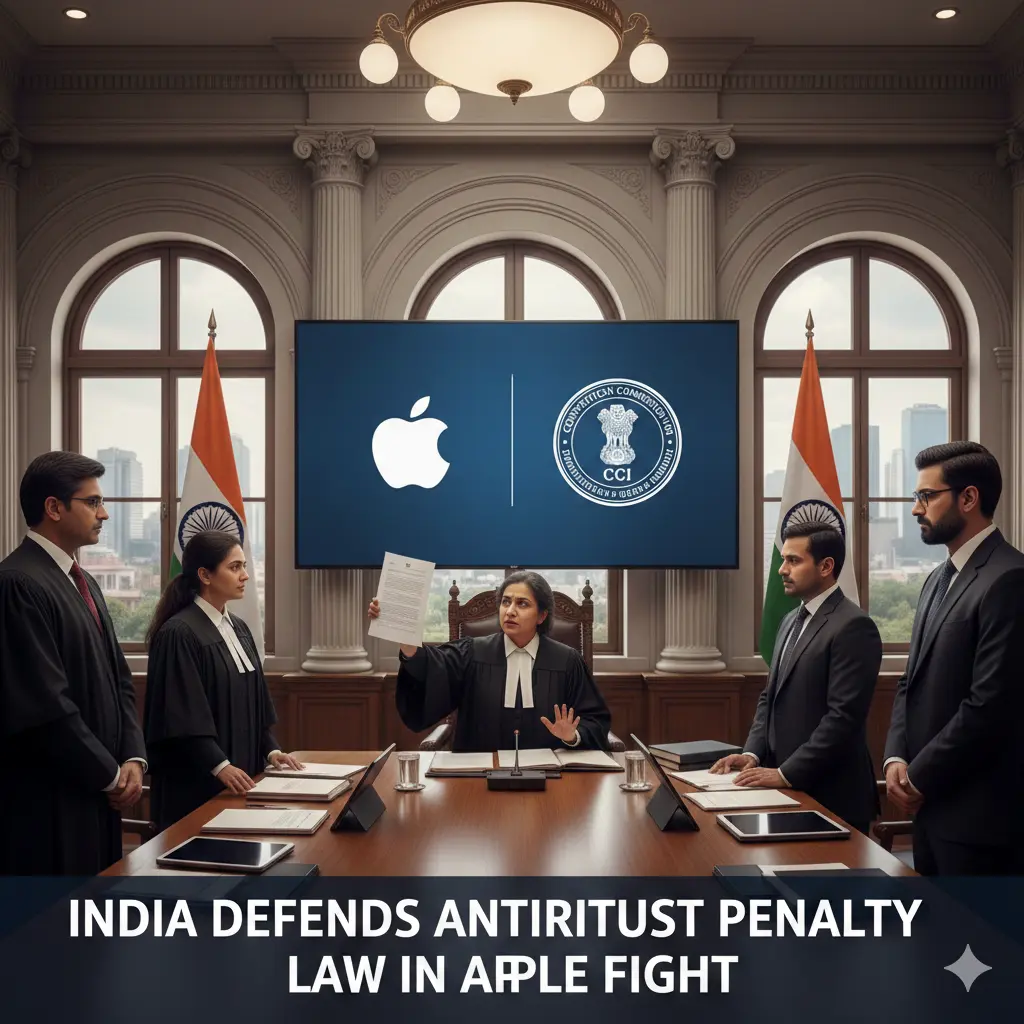
India defends antitrust penalty law in Apple fight
A law used to calculate fines on the basis of a company’s global turnover will discourage breaches by multinationals, India’s antitrust watchdog told a court in opposing Apple’s high-profile challenge to the measure. In November, Apple asked New Delhi judges to strike down the 2024 law, which could also have implications for global giants such as Pernod Ricard, Publicis, Amazon and other foreign companies facing antitrust scrutiny. The law “aligns Indian competition law enforcement with established international practice,” the Competition Commission of India (CCI) said in a December 15 court filing, which is not public, as it laid out
a detailed rationale for the first time.
LEGAL AND TECH
Cash-at-home row: Supreme Court upholds impeachment probe against Justice Yashwant Varma
A fire broke out at Justice Varma’s official residence in Delhi on March 14, 2025, during which firefighters reportedly recovered substantial amounts of unaccounted cash. The incident triggered allegations of corruption and grave misconduct. Although Justice Varma denied the allegations, he was transferred from the Delhi High Court to his parent court, the Allahabad High Court, and divested of judicial work pending further action. Subsequently, the then Chief Justice of India, Justice Sanjiv Khanna, invoked the Supreme Court’s in-house procedure and ordered a preliminary inquiry. Following the completion of the investigation, Justice Varma was advised to either demit office or face removal proceedings under the constitutional mechanism. He declined to resign.
Supreme Court directs higher educational institutions to report student suicides immediately
The Supreme Court has directed all higher education institutions across the country to immediately notify law enforcement authorities of any student suicide or unnatural death, emphasising that colleges and universities cannot evade their statutory and constitutional obligations. Exercising its plenary jurisdiction under Article 142 of the Constitution, the Bench of Justice JB Pardiwala and Justice R Mahadevan on Thursday laid down a comprehensive and enforceable framework to strengthen mental-health safeguards, institutional accountability, and preventive mechanisms across the higher education ecosystem.
CORPORATE COMPLIANCE
SEBI to adopt more analytical, cost-benefit–driven approach to regulatory changes, forms an expert panel
Market regulator Securities and Exchange Board of India (SEBI) is set to adopt a more thoughtful and analytical approach to regulatory changes. In addition to the regular review and updating of regulations, SEBI will now assess cost-benefit impacts, efficiency, relevance, and potential unintended consequences. The process will also factor in regulatory gaps, redundancies, and unaddressed or emerging risks. With this objective, SEBI has constituted an External Experts Advisory Committee (EEAC) to undertake focused, independent, theme-based reviews of key securities market regulations. The move is part of SEBI’s broader effort to enhance regulatory effectiveness while improving ease of compliance and ease of doing business.
Embedded finance must blend tech, compliance, and trust: BFSI CEOs
This panel discussion featuring Rishi Gupta, MD & CEO, Fino Payments Bank; Pranav Haridasan, MD & CEO, Axis Securities; Salee S Nair, MD & CEO, Tamilnad Mercantile Bank; Satishwar B, MD & CEO, Bandhan Life; Shaji Varghese, CEO, Muthoot FinCorp; and Shanai Ghosh, MD & CEO, Zuno General Insurance, examined how embedded finance is evolving from simple add-ons to deeply integrated customer journeys across banking, insurance, lending, and capital markets. Shanai Ghosh of Zuno highlighted modular insurance products designed for impulse purchases and telematics-enabled crash detection to simplify claims. Shaji Varghese of Muthoot FinCorp stressed the importance of selecting the right partners and building risk frameworks for small-ticket loans, while noting that Rs 400 crore of monthly disbursements already come via embedded models.
RISK INTELLIGENCE
SEBI set to clear the way for NSE IPO in as early as January
The Securities and Exchange Board of India is set to issue an approval for the long awaited NSE IPO, thereby clearing the decks for the country's largest stock market to list on the exchanges. The approval, which he said would be issued this month, will allow the NSE to prepare its IPO prospectus and is a crucial step in gaining IPO approval given the dispute between two sides. The National Stock Exchange, which is also the world's most active derivatives exchange, has been in litigation with SEBI since 2019 when it was fined Rs 1,100 crore (~$122.04 million) for failing to provide equitable access to all its trading members. NSE offered $160 million to settle the matter, Reuters had reported in June.
NCLT bottleneck hinders India’s M&A boom. Govt’s fast-track framework ignores the real problem -
India’s mergers and acquisitions market is getting bigger, but quieter. Deal values hit $14 billion in Q3 2025, up 50 per cent from the year before. Yet, fewer deals are closing. Companies are doing larger but fewer transactions, and smaller deals are falling away. Mergers are important because they offer real exits to shareholders, and enable firms to grow bigger, allowing them to optimise economies of scale and create surplus for consumers. For a government that wants to focus on ease of doing business and has aspirations of a $7.3 trillion economy, months lost in tribunal queues carry a real cost to shareholders and Indian firms wanting to grow.