When someone says, “We need to run a background check,” the next question should be simple:
What exactly are we trying to find out?
That question matters because a criminal record check and a litigation check are not the same thing.
A criminal record check is generally focused on criminal history or criminal proceedings within the scope of the search.
A litigation check can provide a broader view of legal proceedings involving an individual or entity, which may include civil, commercial, criminal and other types of matters depending on the search.
For an employer screening a senior employee, a criminal record check may be an important part of the process.
For an investor evaluating a company, a vendor being onboarded by a large enterprise, or a lender reviewing a borrower, a broader litigation check may provide information that a criminal record search alone does not capture.
The difference becomes particularly important when the decision involves significant money, responsibility or access.
Table of Contents
- Litigation Check vs Criminal Record Check at a Glance
- What Is a Criminal Record Check?
- What Is a Litigation Check?
- The Main Difference Between the Two
- Why a Criminal Record Check May Not Be Enough
- Why Litigation Checks Can Provide More Context
- When Should You Use a Criminal Record Check?
- When Does a Litigation Check Make More Sense?
- When Should You Consider Both?
- How Identity Matching Changes the Picture
- How LegitQuest Approaches Litigation Screening
- Frequently Asked Questions
Litigation Check vs Criminal Record Check at a Glance
Here is the simplest way to understand the difference.
|
Factor |
Criminal Record Check |
Litigation Check |
|
Primary focus |
Criminal history and proceedings |
Broader legal and litigation exposure |
|
Criminal matters |
Yes, within search scope |
Yes, within search scope |
|
Civil matters |
Generally not the primary focus |
Can be included |
|
Commercial disputes |
Generally not the primary focus |
Can be relevant |
|
Court information |
May be available depending on the check |
Typically an important part of the report |
|
Case status |
May be included |
Important for understanding current exposure |
|
Vendor due diligence |
Useful in certain situations |
Often more relevant for broader risk assessment |
|
Investor due diligence |
May provide limited information |
Can provide broader legal context |
|
Employee screening |
Commonly relevant |
Useful for senior or sensitive roles |
|
Counterparty risk |
Limited view |
Broader view |
|
Best used for |
Criminal history screening |
Broader legal risk assessment |
The two checks overlap.
But they are designed to answer different questions.
What Is a Criminal Record Check?
A criminal record check is intended to identify relevant criminal history or criminal proceedings associated with an individual, subject to the scope and sources used by the screening process.
An employer may conduct one before hiring someone into a sensitive position.
A company may screen a contractor before giving them access to secure facilities.
A financial institution may conduct criminal background checks as part of a broader verification process.
The question is usually something like:
“Is there relevant criminal history associated with this person?”
That can be an important question.
But it is only one question.
A person or company can be involved in legal disputes that have nothing to do with criminal activity.
Those matters can still matter to a business decision.
What Is a Litigation Check?
A litigation check looks more broadly at legal proceedings associated with an individual or entity.
Depending on the scope, it can provide information about matters such as:
- Civil disputes
- Commercial litigation
- Criminal proceedings
- Property related matters
- Financial disputes
- Other court proceedings
The purpose is not simply to find a case.
It is to understand the legal exposure surrounding the subject.
For example, an investor assessing a company may want to know whether its promoters or relevant entities are involved in ongoing disputes.
A procurement team may want to understand the legal background of a strategic vendor.
A lender may want additional information about a borrower.
In each case, a criminal record check alone may not answer the full question.
The Main Difference Between the Two
The easiest way to remember the distinction is this:
A criminal record check looks primarily at criminal history.
A litigation check looks at a wider legal picture.
Imagine a business owner is involved in three commercial disputes with former partners.
Those disputes may have nothing to do with criminal conduct.
A criminal record check could therefore return no relevant criminal history.
But a litigation check may identify the commercial proceedings.
Now consider the opposite situation.
An individual is involved in a criminal proceeding.
That may be highly relevant to a criminal record screening.
It may also appear as part of a broader litigation check.
So there is an overlap, but the scope is different.
Why a Criminal Record Check May Not Be Enough
Consider a company that is selecting a new technology vendor.
The vendor will have access to customer information and internal systems.
The company conducts a criminal record check on the relevant individuals and finds no significant criminal history.
The team is comfortable moving ahead.
But the company has not asked another important question:
What other legal disputes is this vendor involved in?
Perhaps the company is facing a major contractual dispute.
Perhaps there are several unresolved commercial cases.
Perhaps there is a significant dispute involving a former business partner.
None of these necessarily means the vendor is unsuitable.
But they could affect how the company evaluates the relationship.
That is where broader litigation screening becomes useful.
Why Litigation Checks Can Provide More Context
Legal disputes often tell a story about business relationships.
A single case may be routine.
Several similar cases may reveal a pattern worth understanding.
For example, a company may have:
- A dispute with a supplier
- A separate payment dispute
- A contractual case with a former customer
None of these automatically means the company is risky.
But if you are considering giving that company a large advance payment or signing a five year agreement, you may want to know about them.
A litigation check can therefore provide context that goes beyond criminal history.
That is particularly relevant to corporate due diligence.
When Should You Use a Criminal Record Check?
A criminal record check may be appropriate when the main concern is criminal history.
Common situations include:
Employee Screening
Particularly for senior, sensitive or trust based roles.
Contractor Screening
Especially where individuals receive access to facilities or sensitive environments.
Security Sensitive Roles
Where the nature of the job creates additional screening requirements.
High Risk Candidate Assessment
Where additional background information is needed before a hiring decision.
Compliance Processes
Where internal policies or applicable requirements call for criminal background screening.
The exact scope and legal requirements can vary by jurisdiction and use case.
When Does a Litigation Check Make More Sense?
A litigation check can be particularly useful when you need to understand broader legal exposure.
For example:
Vendor Due Diligence
You may want to understand the legal history of a company you are giving a significant contract.
Investor Due Diligence
Before investing substantial capital, litigation involving the company or key individuals may be relevant.
Borrower Review
Lenders may consider litigation information alongside financial and other due diligence.
M&A Due Diligence
An acquisition can expose the buyer to risks connected to the target company and its important counterparties.
Real Estate Transactions
Developers, landowners, sellers and other counterparties may warrant broader legal screening.
Business Partnerships
A long term partner can have a significant impact on the business, making counterparty due diligence important.
When Should You Consider Both?
Sometimes the answer is not either/or.
It is both.
Suppose a company is onboarding the promoter of a business it intends to acquire.
The company may want to understand:
- Criminal history
- Civil litigation
- Commercial disputes
- Property related proceedings
- Financial disputes
- Other relevant legal matters
A criminal record check addresses part of that picture.
A litigation check can add broader legal context.
Together, they may provide a more complete view, subject to the scope and quality of the underlying data.
This is particularly useful when the decision has a high financial or reputational impact.
How Identity Matching Changes the Picture
There is another issue that is easy to overlook.
Both types of checks can produce false matches.
A person named Rahul Sharma may have several unrelated legal records associated with that name.
A company called ABC Industries may have a completely unrelated business with a similar name.
That means the question is not simply:
“Did the search find a case?”
It is:
“Does the case actually belong to the person or entity being screened?”
Identity matching is therefore critical.
LegitQuest's Detailed Litigation Check Report includes match confidence scores, allowing reviewers to assess how strongly a legal record appears to match the subject. It also provides detailed court metadata and source traceability for further review.
How LegitQuest Approaches Litigation Screening
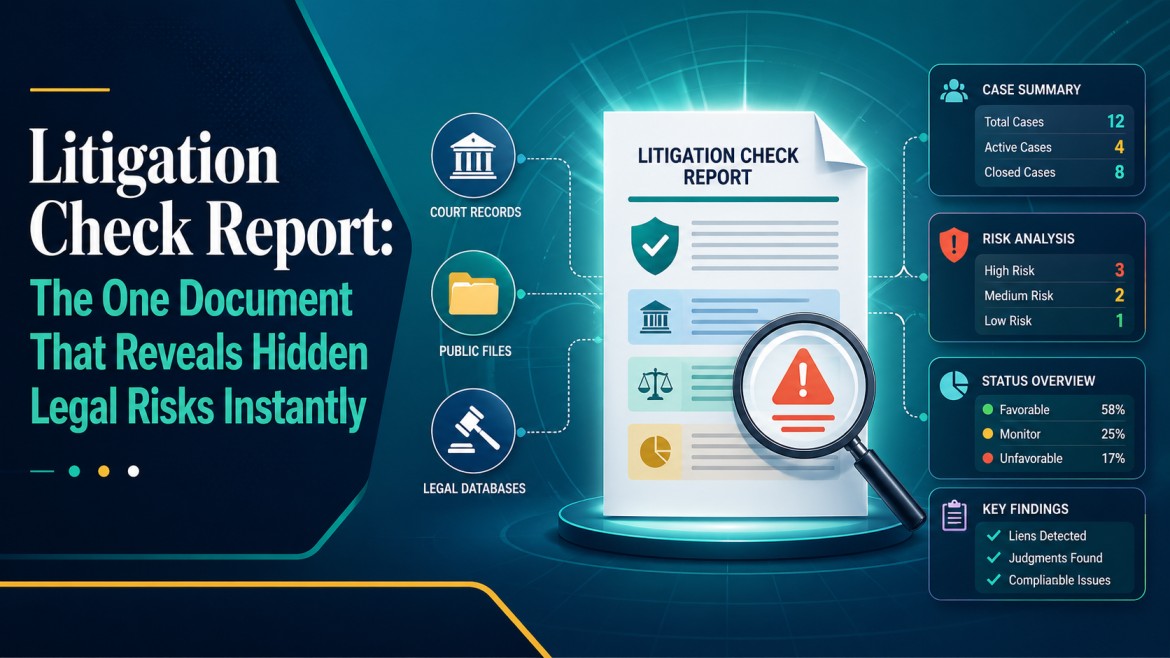
LegitQuest's Detailed Litigation Check Report is designed to provide a structured view of litigation information rather than simply returning a list of cases.
The report includes:
- Case type and status
- Detailed court metadata
- Match confidence scores
- FIR text matches where available
- Source traceability
- LIBIL Score and Risk Band
- Reasoning narrative
This is particularly relevant when the objective is broader than criminal background screening.
A procurement team may be evaluating a vendor.
A lender may be reviewing a borrower.
An investor may be assessing a promoter.
A company may be conducting investigative due diligence before entering a major transaction.
In those situations, understanding the nature and status of legal proceedings can be just as important as knowing whether a criminal record exists.
The report also provides a risk assessment through the LIBIL Score and Risk Band, giving reviewers a structured starting point before they examine individual cases.
The product page states a 2 to 4 hour turnaround and supports portal and API based delivery, which can be useful for organizations that need litigation screening as part of a repeatable due diligence process.
Which One Should You Choose?
It really comes down to the question you are trying to answer.
If your primary question is:
“Does this person have relevant criminal history?”
A criminal record check may be appropriate.
If your question is:
“What legal proceedings and litigation exposure should I know about before entering this relationship?”
A litigation check can provide a broader answer.
And if the decision is particularly important, using both may provide a stronger picture.
The important thing is not to treat the two checks as interchangeable.
A clean criminal record check does not necessarily mean that a person or company has no litigation exposure.
Likewise, finding a lawsuit does not automatically mean that a person or business is unsafe.
The value comes from understanding what the record means, whether it belongs to the right subject, what its current status is and how relevant it is to the decision being made.
That is ultimately what good due diligence is about.
Not collecting the most information.
Collecting the right information before making an important decision.
Frequently Asked Questions
Is a litigation check the same as a criminal record check?
No. A criminal record check focuses primarily on criminal history or proceedings, while a litigation check can provide a broader view of legal proceedings involving an individual or entity.
Which is more comprehensive, litigation check or criminal record check?
They serve different purposes. A litigation check can provide broader legal information, while a criminal record check is more specifically focused on criminal history.
Can a litigation check include criminal cases?
Yes. Depending on the scope of the search, criminal proceedings can form part of a broader litigation check.
Can a criminal record check show civil cases?
Generally, a criminal record check is not designed to provide a comprehensive view of civil or commercial litigation. A broader litigation search may be more appropriate for that purpose.
Should businesses conduct both checks?
For higher risk decisions, businesses may consider both. A criminal record check can address criminal history while litigation screening provides broader legal context.
Which check is better for vendor due diligence?
A broader litigation check can be useful for vendor due diligence because commercial and civil disputes may be relevant in addition to criminal proceedings.
Which check is useful for employee background verification?
A criminal record check can be an important part of employee background verification, particularly for sensitive or senior roles. The appropriate screening should depend on the role, jurisdiction and applicable requirements.
Does a litigation case mean someone is guilty?
No. The existence of litigation does not by itself establish guilt or wrongdoing. The case type, allegations, status, orders and other underlying information need to be considered.
Why is identity matching important in litigation and criminal checks?
Names can be shared by multiple people and companies. Identity matching helps reduce the risk of incorrectly attributing a legal record to the wrong person or entity.
What does LegitQuest include in a detailed litigation check?
LegitQuest's Detailed Litigation Check Report includes case type and status information, court metadata, match confidence scores, FIR text matches where available, source traceability, a LIBIL Score and Risk Band, and a reasoning narrative.


