Gautam Chowdhary, J. - By way of this appeal the appellant has challenged the judgement and order dated 21.12.2010, passed by Additional Sessions Judge, Fast Track Court No.1, Baghpat, in Sessions Trial No. 488 of 2006 (State Vs. Virpal and others) and Sessions Trial No. 489 of 2006 (State Vs. Tejpal), whereby the accused- Tejpal was convicted and sentenced for commission of offence under Section 452 I.P.C. for three years rigorous imprisonment with fine of Rs. 5000/- and for commission of offence u/s 302 I.P.C. for life imprisonment with fine of Rs. 50,000/-
2. The learned Judge acquitted all the other co-accused and convicted the present accused for commission of offence under Section 302 I.P.C. with fine of Rs. 50,000/-. The moot question which has been raised is could accused who were all facing charges under Section 302 I.P.C. could be acquitted on the same set of evidence led before the learned trial court.
3. Brief facts of this case are that an F.I.R. was lodged by the informant Jai Bhagwan against the accused/appellant alleging therein that on 18.9.2004 at about 10:30 am. when he was at his grocery shop, he heard firing at late Baburam's house. After hearing that sound, he was going to Baburam's house and at that time deceased-Ajay, nephew of the informant came running and shouting for help to the informant from Baburam's house. Accused- Tejpal and his three other companions came there following Ajay. All the four persons were armed with country-made pistols. On seeing the informant, the deceased asked for help and said that Tejpal had fired at him and he fell on the road (khadanja). Thereafter, all the four accused opened fire at the deceased- Ajay, whereupon he died on the spot. The informant went to Baburam's house where he found the dead body of Baburam's son, namely, Deepak @ Kale, covered in blood, on the cot in the living room. In that living room deceased Deepak and Ajay were there with other villagers when the accused Tejpal and three others opened fire at Deepak and Ajay. Deepak died on the spot on cot and Ajay in order to save his life tried to flee away but the accused followed Ajay and by indiscriminate firing killed him. The incident took place in front of many villagers but nobody could dare to catch the accused persons. The accused ran away towards fields on western side, hurling threats that whosoever would try to find them, he too would be met with similar consequence.
4. After the investigation was over, charge-sheet was filed against the accused. As the case was exclusively triable by the court of sessions, the same was committed to the sessions court. Charges were framed by the trial court against all the accused/appellant who pleaded not guilty and claimed for trial.
5. The prosecution, in order to prove its case, examined 11 witnesses as under :-
| 1. | Jai Bhagwan | PW-1 |
| 2. | Sanjiv Kumar | PW-2 |
| 3. | Smt. Prembala Devi | PW-3 |
| 4. | Sonu Upadhyay | PW-4 |
| 5. | Dr. S.K. Tyagi | PW-5 |
| 6. | Rajendra @ Leelu | PW-6 |
| 7. | S.I. Rajendra Singh Yadav | PW-7 |
| 8. | Meerpal Singh | PW-8 |
| 9. | Sheelchand Tyagi | PW-9 |
| 10. | Jagdish Bhatnagar | PW-10 |
| 11. | S.I. Sethpal Singh | PW-11 |
6. In support of the ocular version of the witnesses, following documents were produced and contents were proved by leading evidence
| 1. | Chik F.I.R. | Ex.ka.1 |
| 2. | Post mortem report of Ajay | Ex.ka.2 |
| 3. | Post mortem report of Deepak | Ex.ka.3. |
| 4. | Panchayatnama of dead body of Deepak | Ex.ka.4 |
| 5. | Photo nash | Ex.ka.5 |
| 6. | Chalan Nash | Ex.ka.6 |
| 7. | Letter to C.M.O. | Ex.ka.7 & ka.8 |
| 8. | Panchayatnama of dead body of Ajay | Ex.ka.9 |
| 9. | Sample of simple soil | Ex.ka.14 |
| 10. | Sample of blood stained cot | Ex.ka.15 |
| 11. | Recovery of live and empty cartridges | Ex.ka.16 |
| 12. | Sample of blood stained and plain soil | Ex.ka.17 |
| 13. | Site Plan | Ex.ka.18 |
| 14. | G.Diary | Ex.ka.22 |
| 15. | Chik entry | Ex.ka.23 |
| 16. | Charge Sheet | Ex.ka.25 |
7. We had deferred the judgement on 3.2.2021 as we wanted some clarifications which have been made by Sri D.K. Srivastava, learned counsel for the appellant.
8. Heard Sri D.K. Srivastava, learned counsel, assisted by Sri H.K. Singh, learned counsel for the appellant and Sri N. K. Srivastava, learned counsel for the State.
9. Learned counsel for the appellant has submitted that learned Judge could not have convicted the accused when the evidence was scanty and when the other accused were held not guilty on the same set of evidence. All the accused were exonerated for offence u/s 25 Arms Act. He has further submitted that recovery was also not proper and conviction of the accused on inculpatory statement was also not proper. Most of the witness testified that Tejpal as well as Pintu were causing injuries which is also borne out from the oral testimony of PW-1 and therefore, has asked for acquittal of the accused. Learned counsel for the appellant has placed reliance on judgements of Apex Court titled (i) Jagdish Prasad and others Vs. State of M.P., (1995) SCC(Cri) 160, (ii) Smt. Chintambaramma & Anr. Vs. State of Karnataka, (2019) 3 JIC 560 (SC) and (iii) Vadivelu Thevar Vs. State of Madras, (1957) AIR SC 614.
10. Per contra learned counsel for the State has submitted that it has been conclusively proved that it was Tejpal alone who had caused death of both the deceased. The learned A.G.A. has placed reliance on the judgement of Apex Court in Ravi vs. State, (2008) 15 SCC 115 [LQ/SC/2008/1818] and Ganesan vs. State which is a recent judgement in Crl. Appeal No. 680 of 2020, decided on 14.10.2020.
11. Learned counsel for the appellants has advanced the following points to be discussed:
(i) whether the testimony of P.W.-1, namely, Jai Bhagwan, is beyond doubt and proves the case against Tejpal;
(ii) whether the testimony deposed by PW-1 is believable that all the injuries were caused by a single person;
(iii) whether the injuries mentioned in the post mortem report can be caused by single country made pistol (katta) and;
(iv) on same set of evidence which has been led before the trial court the appellants just because the accused was named in the F.I.R., he could be convicted when on the same set of evidence the other co-accused, whose role was assigned by the witnesses, have been acquitted by the learned Judge.
12. While discussing the first point it is relevant to mention that learned counsel for the appellant has drawn our attention to the statement of P.W.-1 who has stated in his statement recorded on 17.1.2008 as below:
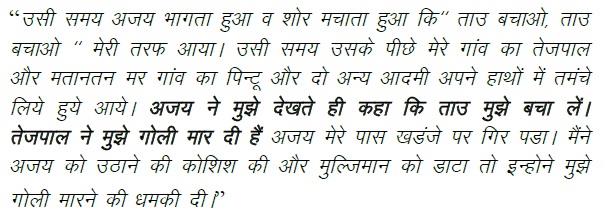
Here the PW-1 is stating that Ajay told him that Tejpal had fired at him. Then the learned counsel has pointed out the statement of PW-1 recorded as under:-

Here the PW-1 states that accused- Tejpal and Pintu along with other accused assaulted deceased Ajay and Deepak. First he said that deceased Ajay was shot by accused- Tejpal and now he is stating that both accused- Tejpal and Pintu along with other accused fired at him. Learned counsel has further drawn our attention to statement of PW-1 recorded as under:-

Now here again the testimony of PW-1 is creating a doubt who states that he had not seen the other person.
13. On 27.2.2008 the PW-1 has stated as follows:-
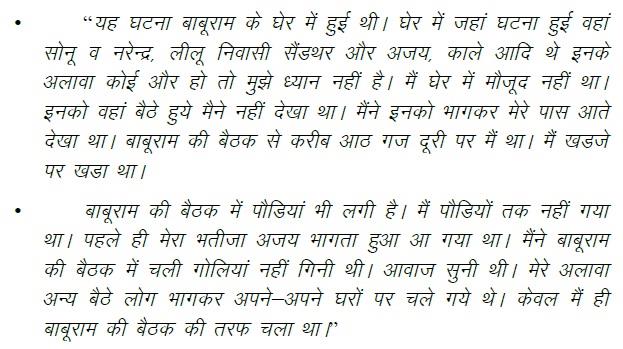
Here he states that at the place of incident where first fire took place, he was not there and he again states that he had not seen the incident rather he was not present there. PW-1 has further stated as under:-

PW-1 is only stating that Ajay told him that Tejpal and Pintu were assaulting so he cannot be said to be eye witness at all as he was conveyed by Ajay. He is saying that this was told by Ajay and here again he is saying that there were four persons who caused this incident. Later he discloses that all four persons were firing. All these statements were deposed by the PW-1 on 27.2.2008.
14. Again on 11.3.2008 statement of PW-1 proceeded and at Page-44 of the paper he narrates:
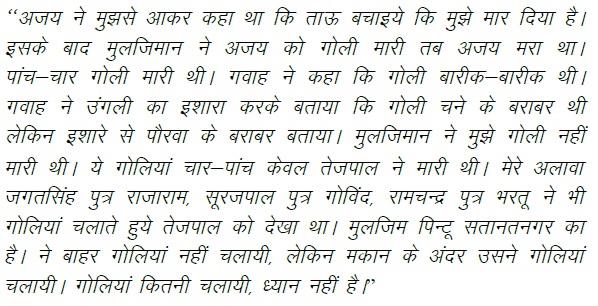
Here he clearly states Ajay conveyed him. Here he says that all the accused fired at deceased as he is using the word 'mulziman' and not 'Mulzim'. 'Mulziman' is plural whereas 'Mulzim' is singular. Here he is disclosing that all the accused participated but in his cross-examination he comes up with a new story and states that only Tejpal fired and the rest accused were standing. Further he states in cross-examination as under:
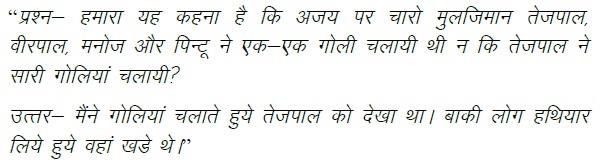
15. While discussing this part of the testimony, it appears that here PW-1 has taken U-turn and discloses that only Tejpal was firing and rest were standing which is very hypothetical, from beginning he never stated that only Tejpal fired.
16. Now in conclusion we draw that the testimony of PW-1 is highly doubtful and it cannot be said to be beyond doubt as he is continuously changing his version.
17. On this point the appellant relied upon judgement of the Apex Court in Jagdish Prasad and others vs. State of M.P., (1995) SCC(Cri) 160, in which the Apex Court clearly has classified three types of testimony; one is wholly reliable, the other is wholly unreliable and third is neither wholly reliable nor wholly unreliable. Perused that in case of third category cases, the court has to be circumspect and has to look for corroboration in the material particularly by reliable testimony either direct or circumstantial. The relevant portion reads as follows:-
"As a general rule, a court can and may act on the testimony of a single witness though uncorroborated provided the testimony of that single witness is found out entirely reliable. In that case, there will be no legal impediment for recording a conviction. But if the evidence is open to doubt or suspicion, the court will require sufficient corroboration. In this connection, reference may be made to a decision of this Court in Vadivelu Thevar v. State of Madras, wherein this Court has classified the testimony of a witness into three categories. viz. (1) wholly reliable (2) wholly unreliable, and (3) neither wholly reliable nor wholly unreliable and observed that though in the first two categories of classification, there may not be any difficulty in coming to a conclusion either accepting or rejecting the testimony but it is in the third category of cases that the court has to be circumspect and has to look for corroboration in material particulars by reliable testimony either direct or circumstantial."
18. While discussing second and third point when we go through the post mortem report. From perusal of the post mortem report there are five injuries. At one place PW-1 also says that it took one minute only, so it is vehemently argued by the learned counsel that it is not corroborating with the testimony of PW-1 as it is not possible for one single man to fire four or five shots within one minute by a country made pistol.
19. Now in the conclusion we are of the view that this. The testimony of PW-1 is not corroborating with the injuries.
20. While discussing the fourth point, we have gone through the judgement of the Court below and relevant part, which is required to be discussed, is at Page-123 of paper book which reads as under:-
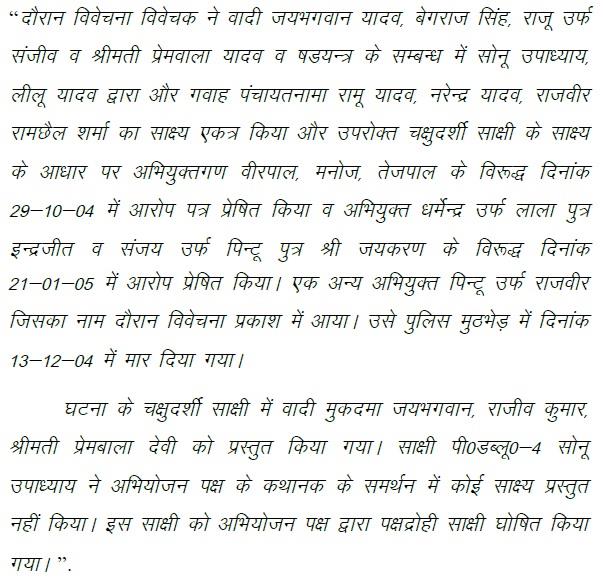
21. While discussing this question it is relevant to mention here that if all the shots were fired by accused Tejpal then question would arise where are the empty cartridges. In record it comes that one empty cartridge was recovered from the room where deceased- Deepak was shot. As story narrated by PW-1 become erroneous default and unproved as neither the pistol nor the empty cartridges were recovered from spot. It can be said that pistol may not be recovered but when the incident took place at one place and all the shots were fired by single accused then why the cartridges are recovered from the room where Deepak was shot and in his testimony the PW-1 clearly stated that he never visited the room where Deepak was shot dead or fire took place. From beginning he was stating that all four persons participated later he converted that only two persons were firing and at last he converted himself that only the accused Tejpal was firing.
22. We are unable to comprehend certain facts by going through the testimony of PW-1. We cannot hold that he is intact eye witness of fact. Adverted to oral testimony of PW-1, it is very doubtful whether he was, in fact, present at the place of occurrence. The decision of the Apex Court in the case of Vadivelu Thevar Vs. State of Madras, (1957) AIR SC 614, which is based on the fact that the contention that in a murder case, the Court should insist upon plurality of witnesses, is much too broadly stated. However, the later decision goes to hold that it is quality which matters and not quantity. In our case can it be said that accused and accused alone could be convicted when all the accused were charged for harbouring common intention. Prosecution story proceeded on the basis that the accused were conspirators but failed to prove the charge of conspiracy. Moreover, testimony of PW-1 cannot be said to be circumstantial evidence also as it not corroborates with the other evidence. As above it has been discussed that the testimony of PW-1 is not beyond doubt, hence after discussing all the records and perusing the judgement of the lower Court too as well as the case law, we are of the view that the appellant is not guilty.
23. Pw-1 is changing version during his recording of evidence and that other witnesses only support him up to the extend that Ajay conveyed that accused had fired. None of the other witnesses clearly stated that the accused fired all the four gun shots on the deceased, rather they are only stating that they had heard that accused had fired. It appears that PW-1 has later been tutored. In Smt. Chintambaramma & Anr. Vs. State of Karnataka, (2019) 3 JIC 560 (SC), the Apex Court has held that the prosecution must prove all the circumstances connecting unbroken chain of links leading to only one inference that the accused committed the crime. There is no continuous chain of evidence.
24. The finding of conviction of the sole appellant could not have been returned by the court below. It is the evidence of PW-1 which casts a shadow. Deceased Ajay received five fire arm injuries and Deepak received three gun shot wounds. Though six persons were involved, trial of the other accused brought acquittal to them. No other eye witness has testified in favour of the prosecution. There are major contradictions and no witness is testified that it was accused alone who had fired six times. The recovery of the pistol is also not proved. The evidence is so scanty as PW-6 cannot even recognise who had fired on deceased, Deepak or Ajay. The witnesses have not identified the accused. The case diary also throws some light and even if we go by the submission of the learned A.G.A., accused- Tejpal had only instigated. It is nobody's case that gun shot injuries were caused by Tejpal. Other accused- Manoj Pal, Sanjay and Dharmendra were acquitted.
25. The judgements of the Apex Court relied by the learned counsel for appellant would come to the aid of the accused. The decision of the Apex Court in the case of Ram Bihari Yadav vs. State of Bihar, (1998) AIR SC 1850 would come to the aid of the accused.
26. The fact that the legal position as set out cannot permit us to concur with the learned Judge who has convicted the accused on the premise that the F.I.R. disclosed the name of all the accused.
27. We have already held that testimony of PW-1 though being a rustic villager does not inspire confidence. Sanjiv Kuamr (PW-2) has been believed and Prembala Devi (PW-3) has also been believed. Though they have not supported the prosecution despite that much weightage is given to their testimony.
28. The recovery u/s 27 Arms Act was also not from Tejpal and, therefore, the interested witnesses have been examined. The learned Judge, after relying on the decision in Badam Singh vs. State of M.P., (2003) 12 SCC 792, [LQ/SC/2003/1105] has come to the conclusion that no case is made out under Sections 149, 120-B, 148, 452, 302 I.P.C. against the other accused and also acquits the accused- Tejpal for commission of offence u/s 25 Arms Act but convicts him under Section 452 read with 302 I.P.C.
29. The discussion herein above and the evidence which we have perused and discussed at times in Hindi, will not permit us to concur with the learned Judge.
30. We can easily place reliance on Chunthu Ram vs. State of Chhattisgarh, (2020) 10 SCC 733, [LQ/SC/2020/751 ;] ">(2020) 10 SCC 733, [LQ/SC/2020/751 ;] [LQ/SC/2020/751 ;] wherein also in view of serious infirmities in prosecution evidence, the conviction of the sole appellant was reversed as in that case also recovery of alleged weapons, on the basis of statement of accused, was not linked to the crime. The vital forensic evidence was withheld by prosecution, there were infirmities in our case as to the oral testimony of the witnesses. The benefit of doubt will have to be given to the accused as it is not proved by the cogent evidence that the evidence adduced pointed to the guilt of accused and accused alone. In that view of the matter we also hold that accused could not have been convicted. The foundation of conviction on the basis of common intention and constructive liability have been summarised by the Apex Court in Subed Ali Vs. State of Assam, (2020) 10 SCC 517 [LQ/SC/2020/693] .
31. For the reasons to be recorded, we are convinced that the judgements relied by the learned counsel for appellant would enure for the benefit of the accused also.
32. The reason being of the same set of evidence which has been led before the trial court just because the accused was named in the F.I.R., he could not have been convicted when on the same set of evidence, on the basis of the charge sheet and the evidence, the other co-accused, whose role was assigned by the witnesses, have been acquitted by the learned Judge. The witnesses who have deposed their statements were recorded belatedly. The incriminating circumstances against the accused is only that he was named in the F.I.R.
33. We have been taken through Page No. 123 of the paper book once again today. The judgement of Rambali Vs. State of U.P., on which heavy reliance has been placed by the State, the facts are different.
34. The judgement of Ravi (supra) also would not come to the aid of the State as Mallikarjun. The facts are entirely on a different canvas.
35. The judgement of this High Court and the Apex Court in Jagdish Prasad (supra) and Smt. Chintambaramma (supra) would go to show that once there is lack of common intention, no doubt if there are startling witnesses and the evidence, only then the accused can be convicted. In our case while going to the deposition of Jai Bhagawan (PW-1) and Sanjiv Kumar (PW-2) as well as Prem Bala Devi (PW-3), we find that there are certain contradictions which would go in favour of the accused.
36. We have no other option but to acquit the accused. The conviction is reversed.
37. The accused is in jail for more than 10 years. He be set free immediately, if not needed in any other offence.
38. Record and proceedings be sent back to the trial court.
39. We are thankful to learned counsel Sri D.K. Srivastava assisted by Sri H.K. Singh, learned counsel for the appellant and Sri N. K. Srivastava, learned counsel for the State for ably assisting this Court.







