A criminal report rarely gives an enterprise a simple yes or no answer.
Imagine a bank screening 25,000 borrowers, an employer onboarding 8,000 people a year, or a background verification company processing thousands of checks every week.
A court record appears against one applicant.
What happens next?
The easy response is to flag the profile.
The responsible response is to ask whether the record actually belongs to that person, what the proceeding is about, whether it is pending or disposed, how serious it is in the context of the decision, and whether there are other related matters that change the overall risk picture.
That distinction is important.
For enterprise risk teams, the biggest challenge is often not discovering a record. It is turning fragmented legal information into a decision that can be explained six months later to compliance, internal audit, senior management or the individual concerned.
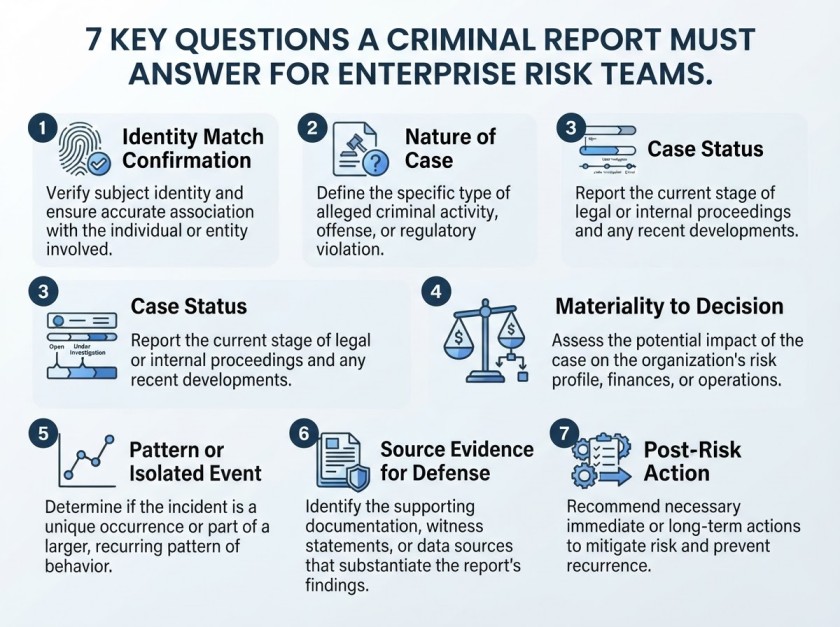
A useful criminal report should help answer seven questions before that decision is made.
1. Are We Certain the Record Belongs to the Same Person?
This is the first control because everything that follows depends on it.
A name match is not an identity match.
Consider a lender evaluating an applicant named Amit Kumar. A court search returns three criminal matters associated with the same name.
The lender now has two risks.
The first is accepting an applicant despite a material legal issue.
The second is rejecting a legitimate applicant because a case belonging to another Amit Kumar was incorrectly attributed to him.
At enterprise volumes, even a small matching problem compounds quickly.
If an organisation processes 100,000 screenings annually, a hypothetical 0.5% incorrect matching rate could create 500 profiles requiring unnecessary investigation.
This is why identity resolution should sit before risk interpretation.
Teams should examine available identifiers, addresses, name variations and the consistency of records before concluding that a legal proceeding belongs to the subject.
Legitquest's LIBIL® addresses this through identity resolution across names, addresses and different record formats rather than relying purely on exact name searches.
2. What Exactly Is the Nature of the Case?
Once identity is reasonably established, the next mistake is treating every legal record as equivalent.
They are not.
A criminal proceeding, commercial dispute, tax matter and regulatory action can indicate very different forms of exposure.
The risk team needs classification before interpretation.
|
Finding |
Enterprise Risk Question |
|
Criminal matter |
What is alleged and how material is it to the decision? |
|
Civil litigation |
Does it indicate contractual, financial or behavioural risk? |
|
Regulatory matter |
Could it indicate a compliance or governance concern? |
|
Tax litigation |
Is there meaningful financial or statutory exposure? |
|
FIR related record |
What is the nature and current stage of the matter? |
|
Disposed case |
What was the outcome and does it remain relevant? |
This becomes particularly important when screening promoters, directors, senior executives, borrowers, guarantors and critical vendors.
The objective is not to collect the largest number of court records.
It is to identify the records that could reasonably change the business decision.
That is the difference between a court search and legal due diligence.
3. Is the Matter Pending, Disposed or Still Developing?
A case status is not an administrative detail. It changes how the information should be interpreted.
Suppose two potential borrowers each have one litigation record.
Borrower A has an old matter that has already been disposed of.
Borrower B has an active proceeding involving allegations directly relevant to the credit decision.
Counting cases gives both borrowers a score of one.
Risk analysis does not.
The team should understand:
When was the matter initiated? What is its current status? How long has it been pending? What has happened procedurally? What was the outcome if it was disposed of?
This is particularly relevant in India, where litigation can remain pending for substantial periods.
A mature risk process therefore avoids rules such as:
Criminal case found = reject.
4. Is the Finding Material to the Decision We Are Making?
Materiality is where a criminal report becomes useful to an enterprise.
The same legal finding can carry different significance depending on the decision.
Consider four situations.
A bank is evaluating a Rs50 crore commercial exposure.
An NBFC is processing a relatively small retail loan.
A company is appointing a Chief Financial Officer.
A large enterprise is onboarding a vendor that will have access to sensitive customer information.
In employee screening, criminal history verification should consider identity, case status and the individual's connection to a proceeding before the findings influence a hiring decision.
The appropriate depth of review should not necessarily be identical.
Enterprise risk teams should evaluate at least three dimensions:
Severity: How significant is the underlying matter?
Relevance: Does it relate to the role, transaction or exposure being evaluated?
Exposure: What could the organisation lose if the risk materialises?
This creates a much more useful model:
Legal Finding × Business Relevance × Exposure = Review Priority
This is also why a tiered investigation model makes sense.
Legitquest's LIBIL® supports Instant Reports for faster initial screening, Detailed Reports where deeper investigation is required, and Lawyer Verified Reports for situations where the exposure warrants legal review.
High volume screening and high consequence decisions should not be forced through the same process.
The importance of a finding also depends on the position involved. A litigation check before hiring senior employees may warrant closer review when the role carries substantial financial or governance responsibility.
5. Are We Looking at an Isolated Event or a Pattern?
One case tells you something.
A pattern can tell you considerably more.
Suppose a promoter has six litigation records.
The number “6” sounds significant, but it is not enough to make a decision.
Those six records could represent six unrelated matters.
Or several records could arise from the same underlying dispute appearing across different courts or stages.
Alternatively, the records could reveal repeated disputes of a similar nature over several years.
Those scenarios carry very different implications.
Enterprise risk teams should therefore look beyond the case count and examine:
Frequency, recency, similarity, jurisdiction, counterparties and outcomes.
For example, repeated litigation involving similar commercial conduct may deserve more attention during vendor or promoter due diligence than several unrelated historical disputes.
For third-party onboarding, criminal record checks for vendors and partners can provide an additional layer of information when assessing relationships involving financial, operational or reputational exposure.
This is where structured litigation intelligence becomes more useful than a spreadsheet containing search results.
6. Can We Defend the Decision With Source Evidence?
Enterprise risk decisions need an audit trail.
Imagine an applicant is rejected or escalated because of a criminal record.
Three months later, compliance asks why.
Six months later, internal audit reviews the process.
Or the individual disputes the finding immediately.
Can the organisation reproduce the evidence used to make the decision?
A report that merely says “criminal record found” is weak decision evidence.
Risk teams should be able to establish the source of the information, the matter reviewed, its status and the reasoning behind the escalation.
This is why source linked findings matter.
LIBIL® connects findings back to underlying source records, helping teams move from a summary to the material on which that summary is based.
For enterprises, traceability supports more than convenience.
It improves auditability, review consistency and accountability.
A strong criminal screening process should allow another qualified reviewer to understand how the original decision was reached.
7. What Should Happen After a Risk Is Identified?
This is where many screening processes become inefficient.
Finding risk is only half the job.
The system also needs to determine what happens next.
Without clear escalation logic, organisations tend to fall into one of two extremes.
Either every match is escalated to legal, creating unnecessary cost and turnaround time.
Or teams resolve too many cases operationally, increasing the possibility that a material issue is overlooked.
A tiered model is more practical.
|
Finding |
Possible Enterprise Action |
|
No material record identified |
Continue normal workflow |
|
Possible identity mismatch |
Identity verification |
|
Historical, low relevance matter |
Policy based review |
|
Material pending proceeding |
Detailed investigation |
|
Multiple related proceedings |
Enhanced risk review |
|
Significant criminal finding |
Compliance or legal escalation |
|
High value lending or transaction |
Detailed legal due diligence |
|
Senior leadership or M&A exposure |
Lawyer verified review |
A criminal report may identify a proceeding without resolving its business significance. Understanding when a case finding needs deeper legal due diligence can help risk teams decide what to investigate next.
This creates an important operational principle:
The depth of investigation should increase with the potential business exposure.
That keeps legal resources focused on the cases where professional judgement adds the most value.
The Real Enterprise Problem Is Decision Quality at Scale
Consider an organisation conducting 50,000 checks a year.
If 3% of profiles require some form of additional review, that means:
1,500 profiles need interpretation.
If each manual investigation takes 30 minutes, that represents:
750 analyst hours.
And this calculation does not include legal escalation, duplicate records, identity mismatches, internal communication or rework.
Now consider the opposite risk.
If teams optimise entirely for speed and a material case is missed during a senior hire, large credit decision, acquisition or critical vendor onboarding, the financial and reputational impact can be significantly greater than the screening cost itself.
This is the operating problem enterprise risk leaders need to solve:
Reduce unnecessary investigation without reducing the quality of risk detection.
That requires more than access to court records.
It requires identity resolution, classification, contextual analysis, source traceability and a defined escalation framework.
LegitQuest's litigation check helps organisations review potential legal proceedings through structured case information, identity resolution and source-linked findings.
Frequently Asked Questions
What does a criminal report show?
A criminal report can surface relevant criminal proceedings and associated court information within the scope of the search. Depending on the report, this can include case details, status, parties, categorisation and supporting source records.
Why is identity matching important in criminal background checks?
Names are not unique identifiers. Similar names, spelling variations and inconsistent records can create false matches. Identity resolution helps risk teams establish whether a court record actually relates to the person being screened before acting on it.
Should an enterprise reject an applicant if a criminal case is found?
A case appearing in a search should not automatically determine the decision. Enterprises should examine identity confidence, nature of the matter, status, relevance, severity and applicable organisational policies before determining the appropriate action.
How should enterprises handle large volumes of criminal record checks?
A tiered screening model can help. Routine profiles can undergo initial screening, while potentially material findings move to detailed investigation. High exposure cases can then be escalated for legal review.
How is a criminal report different from legal due diligence?
A criminal report focuses on criminal record information within the scope of a screening exercise. Legal due diligence is broader and can assess civil, criminal, regulatory, tax and other litigation exposure relevant to a transaction, individual or organisation.
Who can use litigation checks in an enterprise?
Common use cases include banks and NBFCs conducting borrower or promoter checks, enterprises screening employees and senior executives, BGV companies conducting background verification, risk teams evaluating vendors and counterparties, and legal teams conducting transaction or M&A due diligence.


