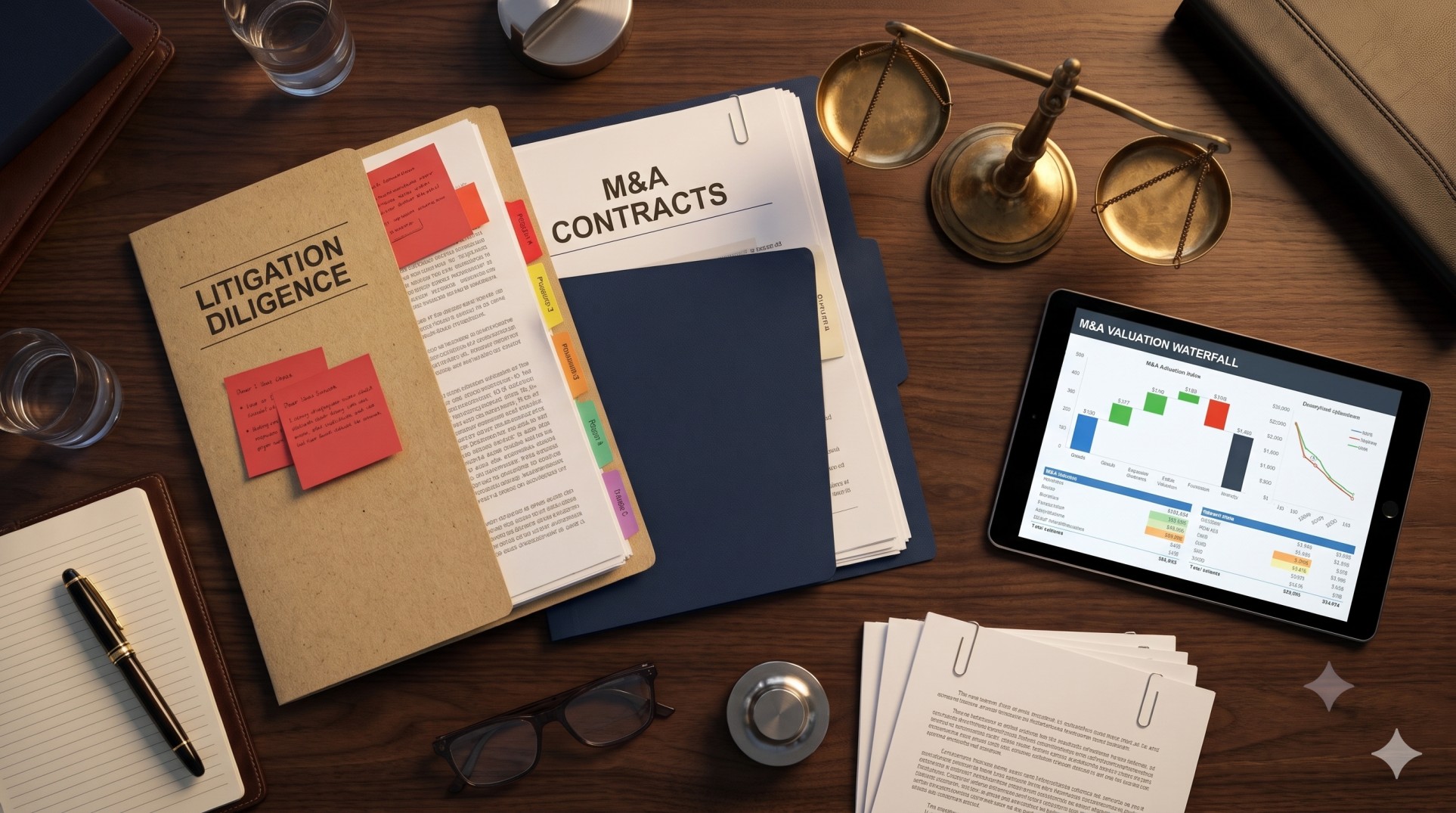
A buyer and seller may agree on revenue growth, EBITDA margins and the strategic value of an acquisition, yet arrive at substantially different valuations once litigation exposure is examined.
Consider a hypothetical acquisition valued at Rs 600 crore. Financial due diligence supports the agreed enterprise value, but an independent court record check identifies proceedings involving the target's principal operating subsidiary. One dispute concerns a significant customer contract, another involves a regulatory approval, and several others relate to unpaid vendor claims.
None of these findings automatically reduces the company's value. Their significance depends on potential financial consequences, probability of adverse outcomes and the extent to which the risks have already been reflected in the transaction assumptions.
For investment committees and corporate development teams, litigation due diligence should answer a commercial question: what would a rational buyer pay for the business after accounting for the legal uncertainty?
Why Financial Due Diligence May Not Capture the Full Litigation Exposure
Financial due diligence typically evaluates historical performance, working capital, debt, earnings quality and reported liabilities. Litigation can create exposures that are difficult to measure through financial statements alone.
A disputed claim may be disclosed as a contingent liability without being recognised as a provision. A regulatory proceeding may threaten future revenue without creating an immediate accounting charge. A dispute involving a promoter may introduce governance concerns that are not visible in the target's financial metrics.
The challenge is therefore not simply identifying undisclosed cases. It is determining whether existing financial assumptions adequately reflect their consequences.
A court record check provides an independent source of information that can be reconciled against management disclosures, legal representations and financial diligence findings.
The Litigation Perimeter Should Follow Enterprise Value
A conventional search limited to the target company's registered name can overlook exposure elsewhere in the business.
Acquisition value may depend on subsidiaries, intellectual property holding entities, key operating companies, promoters or contractual arrangements involving related parties.
The diligence perimeter should reflect these dependencies.
For example, a manufacturing target may generate most of its EBITDA through a subsidiary holding essential operating approvals. Litigation involving that subsidiary may be more material than several proceedings against the parent company.
Similarly, proceedings involving promoters or directors may warrant investigation where they affect ownership, pledged shares, guarantees or transaction execution.
Identity resolution and entity mapping are therefore central to reliable litigation screening. LegitQuest's LIBIL® Litigation Check supports searches across name variations and relevant records, helping diligence teams investigate connected entities and individuals.
Translate Court Record Findings Into Valuation Consequences
Litigation findings influence transaction economics through several distinct mechanisms.
|
Litigation Finding |
Potential Economic Consequence |
Transaction Response |
|
Material damages claim |
Possible future cash outflow |
Valuation adjustment or indemnity |
|
Regulatory proceeding |
Revenue interruption or compliance expenditure |
Scenario analysis and closing conditions |
|
Customer contract dispute |
Revenue concentration risk |
Earnings forecast adjustment |
|
Intellectual property litigation |
Restrictions on commercially important assets |
Specialist legal review |
|
Promoter-related proceedings |
Governance or transaction execution risk |
Enhanced representations and protections |
|
Recurring supplier disputes |
Potential working capital pressure |
Financial and operational reconciliation |
The appropriate response depends on the evidence. A claim amount should not be treated automatically as the expected loss, and litigation exposure should not be deducted twice where it has already been reflected in the financial model.
How a Rs40 Crore Litigation Exposure Could Change a Rs600 Crore Deal
Consider a hypothetical transaction with an agreed enterprise value of Rs600 crore.
During diligence, the buyer identifies litigation with a claimed exposure of Rs40 crore. Legal advisers assess several possible outcomes, but the claim amount alone does not establish the likely liability.
For illustration, assume the diligence team develops three scenarios:
|
Scenario |
Illustrative Financial Impact |
Assumed Probability |
|
Favourable resolution |
Rs0 crore |
40% |
|
Negotiated settlement |
Rs15 crore |
40% |
|
Adverse outcome |
Rs40 crore |
20% |
The probability-weighted financial exposure is Rs14 crore.
This is a modelling illustration, not a prediction of any court outcome.
The buyer must then consider whether the estimated exposure is already reflected in the valuation, whether the liability will remain with the acquired business and whether the seller can provide enforceable protection.
A Rs14 crore expected exposure does not necessarily require a Rs14 crore purchase price reduction. Depending on transaction structure, the parties might negotiate an indemnity, escrow, contingent payment or another risk allocation mechanism.
The distinction matters because valuation and contractual risk allocation are related, but not interchangeable.
Litigation Patterns Can Reveal Weaknesses in Earnings Quality
Individual court cases are important, but repeated disputes may provide more useful evidence about the sustainability of earnings.
Suppose a target has 22 proceedings, including 14 involving delayed payments to suppliers. Each dispute is relatively small, but their concentration may indicate working capital pressure or weaknesses in procurement and payment controls.
Alternatively, repeated customer claims may warrant investigation into revenue recognition, product quality or contractual performance.
These patterns should be examined alongside operational and financial data rather than interpreted as proof of misconduct.
For deal teams, the relevant question is whether litigation history reveals a recurring business condition that could affect future cash flows.
Pending and Disposed Cases Require Different Valuation Treatment
Court case status online can establish whether proceedings remain pending or have been disposed, but the status alone does not establish their economic significance.
A pending matter may carry limited exposure if the underlying claim is immaterial. A disposed case may remain relevant where an adverse order creates an unpaid obligation, further proceedings are underway or settlement commitments continue.
Historical litigation may also reveal patterns relevant to the target's future operating performance.
M&A teams should therefore examine the underlying orders, procedural history, materiality and continuing obligations before determining whether a finding affects valuation.
When Lawyer Verified Litigation Due Diligence Becomes Necessary
Initial court record screening is useful for identifying potentially relevant proceedings. However, material findings often require professional interpretation before they can influence transaction terms.
Enhanced review may be appropriate where litigation concerns critical assets, regulatory permissions, substantial financial claims, promoter interests or disputes capable of changing the investment thesis.
LegitQuest's LIBIL® offers Instant, Detailed and Lawyer Verified Litigation Check Reports. This allows transaction teams to begin with structured screening and pursue deeper verification where legal uncertainty could materially affect the acquisition.
Source-linked findings and litigation categorisation also support reconciliation with information supplied by the target and its advisers.
The purpose is not to replace transaction counsel. It is to improve the quality and organisation of evidence available for legal and commercial assessment.
Litigation Due Diligence Should Produce Negotiable Outcomes
A mature diligence process should conclude with a clear explanation of how each material finding affects the transaction.
Some matters may require no adjustment. Others may justify revised forecasts, additional warranties, specific indemnities, escrow arrangements or conditions that must be satisfied before closing.
In more serious situations, the findings may challenge the acquisition rationale itself.
The quality of a court record check should therefore be assessed by its contribution to decision-making, not the number of cases identified.
For buyers, the central objective is to understand which legal exposures are already priced into the transaction, which remain uncertain and which require contractual protection.
That is how litigation intelligence becomes part of valuation discipline rather than another document in the diligence data room.
Frequently Asked Questions
Why are court record checks important in M&A transactions?
Court record checks help identify litigation involving a target business and relevant connected entities. The findings can inform assessments of financial liabilities, operational continuity, governance and transaction risk.
Can pending litigation reduce the valuation of a company?
Yes, where credible analysis indicates that the proceeding could materially affect cash flows, assets or business operations. The impact depends on the circumstances and should not be determined solely from the claimed amount.
Should M&A teams review disposed court cases?
Yes, when relevant. Disposed cases may involve continuing obligations, further proceedings or historical patterns that provide insight into the target's business practices.
How is litigation exposure reflected in acquisition pricing?
Depending on the circumstances, litigation may influence forecasts, enterprise valuation, purchase price adjustments, indemnities, escrow arrangements or closing conditions. Teams should avoid counting the same exposure more than once.
When is a lawyer verified litigation report appropriate?
Lawyer verified review may be appropriate when proceedings involve material liabilities, complex legal questions, critical assets, regulatory exposure or other matters capable of influencing transaction terms.


